DEF 14A: Definitive proxy statements
Published on
UNITED STATES
SECURITIES AND EXCHANGE COMMISSION
WASHINGTON, D.C. 20549
Proxy Statement Pursuant to Section 14(a) of the
Securities Exchange Act of 1934
Filed by the Registrant ☒ Filed by a party other than the Registrant ☐
Check the appropriate box:
☐
|
Preliminary Proxy Statement |
☐ |
Confidential, for Use of the Commission Only (as permitted by Rule 14a-6(e)(2)) |
☒ |
Definitive Proxy Statement |
☐ |
Definitive Additional Materials |
☐ |
Soliciting Material under 240.14a-12 |
(Name of Registrant as Specified In Its Charter)
(Name of Person(s) Filing Proxy Statement, if other than the Registrant)
Payment of Filing Fee (Check all boxes that apply)
☒ |
No fee required |
☐ |
Fee paid previously with preliminary materials. |
☐ |
Fee computed on table in exhibit required by Item 25(b) per Exchange Act Rules 14a-6(i)(1) and 0-11. |
OPKO HEALTH, INC.
4400 Biscayne Blvd.
Miami, FL 33137
NOTICE OF 2026 ANNUAL MEETING OF STOCKHOLDERS
TO BE HELD JUNE 18, 2026
Notice is hereby given that the Annual Meeting of Stockholders (the “Annual Meeting”) of OPKO Health, Inc., a Delaware corporation (the “Company”), will be held on Thursday, June 18, 2026 beginning at 10:00 a.m., Eastern Time. The Annual Meeting will be held virtually via live webcast, during which you will be able to vote your shares electronically and submit your questions. At the Annual Meeting, we will ask you:
Holders of record of our common stock at the close of business on Monday, April 20, 2026, will be entitled to notice of and to vote at the Annual Meeting or any adjournments thereof. On or about April 30, 2026, the Company began mailing to stockholders of record as of April 20, 2026, a Notice of Annual Meeting, this proxy statement, the accompanying form of proxy, and our Annual Report to Stockholders for our fiscal year ended December 31, 2025 (“fiscal 2025”).
Whether or not you plan to participate in the Annual Meeting, it is important that you vote your shares. Regardless of the number of shares you own, please promptly vote your shares by telephone or Internet prior to the Annual Meeting or by marking, signing and dating the proxy card and returning it to the Company in the postage paid envelope provided. Should you participate in the live webcast, you may, if you wish, withdraw your proxy and vote your shares on the Internet during the Annual Meeting.
|
By Order of the Board of Directors, |
|
|
|
Steven D. Rubin Executive Vice President – Administration |
Miami, Florida
April 30, 2026
Important Notice Regarding the Availability of Proxy Materials for the Annual Meeting to Be Held on June 18, 2026
The Proxy Statement and 2025 Annual Report are available at www.opko.com.
OPKO HEALTH, INC.
PROXY STATEMENT FOR THE 2026 ANNUAL MEETING OF STOCKHOLDERS
TO BE HELD
THURSDAY, JUNE 18, 2026
This proxy statement is being made available to you by the Board of Directors (the “Board”) of OPKO Health, Inc., a Delaware corporation (the “Company,” “OPKO,” or “we,” “us” or “our”) in connection with the solicitation of proxies to be voted at the Annual Meeting of Stockholders of the Company on Thursday, June 18, 2026, beginning at 10:00 a.m., Eastern Time, and all adjournments thereof (the “Annual Meeting”). The 2026 Annual Meeting will be a virtual meeting of stockholders to be held solely as a live webcast over the Internet at www.proxydocs.com/OPK. There will not be a physical location for the Annual Meeting. At the Annual Meeting, the items of business to be voted on are:
Our Board has fixed the close of business on Monday, April 20, 2026, as the record date for the determination of stockholders entitled to notice of and to vote at the Annual Meeting or any adjournments thereof. As of that date, there were issued and outstanding 755,092,256 shares of our common stock. The holders of our common stock are entitled to one vote for each outstanding share held by them on all matters submitted to our stockholders.
On or about April 30, 2026, the Company began mailing a Notice of Annual Meeting, this proxy statement, the accompanying form of proxy, and our Annual Report to Stockholders for our fiscal year ended December 31, 2025 (“fiscal 2025”) to stockholders of record as of April 20, 2026.
Virtual Meeting Participation and Voting Procedure
You will be able to participate in the Annual Meeting online and submit your questions during the meeting by visiting www.virtualshareholdermeeting.com/OPK2026 and registering 15 minutes in advance of the meeting. To participate in the Annual Meeting, you will need the control number included on your proxy card or on the instructions that accompanied your proxy materials. Please be sure to follow instructions found on your proxy card and/or voting instruction form. You also will be able to vote your shares electronically at the Annual Meeting. Stockholders will be able to listen, vote and submit questions from their home via the Internet or from any remote location with Internet connectivity. The meeting webcast will begin promptly at 10:00 a.m. Eastern Time. We encourage you to access the meeting prior to the start time. Online access will begin at 9:45 a.m. Eastern Time. If you encounter any difficulties while accessing the virtual meeting during the check-in or meeting time, a technical assistance phone number will be made available on the virtual meeting registration page 15 minutes prior to the start time of the meeting.
The virtual meeting platform is fully supported across browsers (Firefox, Chrome, and Safari) and devices (desktops, laptops, tablets, and cell phones) running the most updated version of applicable software and plugins. Participants should ensure that they have a strong Internet connection wherever they intend to participate in the meeting. Participants should also give themselves plenty of time to dial-in to the conference call or log in and ensure that they can hear audio prior to the start of the meeting.
If you wish to submit a question during the meeting, you may do so by following the instructions on the virtual shareholder meeting landing page. Questions submitted and which are pertinent to meeting matters will be answered during the meeting, subject to time constraints. Questions or comments that are not related to the proposals under discussion, are about personal concerns not reasonably shared by all of our stockholders generally, or use blatantly offensive language may be ruled out of order and will not be answered. Additionally, the Company may not be able to answer multiple questions submitted by the same stockholder. The questions and answers will be available as soon as practicable after the meeting and will remain available until one week after posting on the Company’s website.
2
Required Vote and Quorum at the Annual Meeting
A nominee for director will be elected to the Board if the votes cast in favor of such nominee by the holders of shares of our common stock present or represented and entitled to vote at the Annual Meeting at which a quorum is present exceed the votes cast against such nominee. The advisory vote on the Say on Pay proposal will be approved if the votes cast in favor of the proposal by the holders of shares of our common stock present or represented and entitled to vote on the proposal at the Annual Meeting at which a quorum is present exceed the votes cast against the proposal. Because your vote on the Say on Pay proposal is advisory, it will not be binding on the Board or the Company. However, the Compensation Committee of the Board will take into account the outcome of the Say on Pay vote when considering future executive compensation arrangements. The vote to approve the OPKO Health, Inc. 2026 Equity Incentive Plan and to ratify the appointment of Ernst & Young LLP as the Company’s independent registered public accounting firm for the fiscal year ending December 31, 2026 will be approved, in each case, if the votes cast in favor of the proposal by the holders of shares of our common stock present or represented and entitled to vote on the proposal at the Annual Meeting at which a quorum is present exceed the votes cast against the proposal. Any other matter that may be submitted to a vote of our stockholders at the Annual Meeting will be approved if the number of shares of common stock voted for the proposal exceed the votes cast against the proposal, unless such matter is one for which a greater vote is required by law or our Certificate of Incorporation or our amended and restated bylaws (the “Amended and Restated Bylaws”).
The presence, in person via participation in the virtual meeting or by proxy, of holders of a majority of our outstanding common stock entitled to vote constitutes a quorum at the Annual Meeting. Shares of our stock represented by proxies that reflect abstentions will be counted for the purpose of determining the existence of a quorum at the Annual Meeting, but will have no effect on the election of directors, the approval of the OPKO Health, Inc. 2026 Equity Incentive Plan, the Say on Pay proposal, or the ratification of the appointment of Ernst & Young LLP as our independent registered public accounting firm for the fiscal year ending December 31, 2026.
Shares of stock represented by proxies that reflect “broker non-votes” (i.e., stock represented at the Annual Meeting by proxies held by brokers or nominees as to which (i) the brokers or nominees have not received voting instructions from the beneficial owners of such shares and (ii) the brokers or nominees do not have the discretionary voting power on a particular matter) will be counted for the purpose of determining the existence of a quorum at the Annual Meeting because brokers have discretion to vote on at least one proposal at the Annual Meeting. A broker does not have the discretion to vote on the election of directors, the OPKO Health, Inc. 2026 Equity Incentive Plan or the non-binding Say on Pay proposal. A broker non-vote will have no effect on the approval of the election of directors, the OPKO Health, Inc. 2026 Equity Incentive Plan, or the Say on Pay proposal. A broker has the discretion to vote on the ratification of the appointment of Ernst & Young LLP as our independent registered public accounting firm for the fiscal year ending December 31, 2026; therefore, if the broker exercises its discretion to vote on the proposal to ratify the appointment of Ernst & Young LLP as independent registered public accounting firm for the fiscal year ending December 31, 2026, its vote will be counted for purposes of determining the outcome of that proposal.
Any stockholder giving a proxy will have the right to revoke it at any time prior to the time it is voted. A proxy may be revoked by: (i) written notice to us on the date of or prior to the Annual Meeting at our executive offices located at 4400 Biscayne Blvd., Miami, Florida 33137, attention: Secretary; (ii) execution of a subsequent proxy; (iii) participating and voting electronically at the Annual Meeting by completing a ballot online during the live webcast; or (iv) re-voting by telephone or by Internet prior to the meeting (only your latest telephone or Internet vote will be counted). Participation at the Annual Meeting will not automatically revoke your proxy. If your shares are held in the name of a broker or nominee, you must follow the instructions of your broker or nominee to revoke a previously given proxy. All shares of our stock represented by effective proxies will be voted at the Annual Meeting or at any adjournment thereof. Unless otherwise specified in the proxy, shares of our stock represented by proxies will be voted: (i) FOR the election of the Board’s nominees for directors; (ii) FOR the approval of the OPKO Health, Inc. 2026 Equity Incentive Plan; (iii) FOR the approval of the Say on Pay proposal; (iv) FOR the proposal to ratify the appointment of Ernst & Young, LLP, an independent registered public accounting firm, as the independent registered public accounting firm of the Company for the fiscal year ending December 31, 2026; and (v) in the discretion of the proxy holders with respect to such other matters as may properly come before the Annual Meeting.
Our executive offices are located at 4400 Biscayne Blvd., Miami, Florida 33137.
Security Ownership of Certain Beneficial Owners and Management
The following table contains information regarding the beneficial ownership of our common stock, which is our only outstanding class of voting securities, as of April 20, 2026 held by (i) each stockholder known by us to beneficially own more than 5% of the outstanding shares of common stock; (ii) our directors and director nominees; (iii) our Named Executive Officers as defined in the paragraph preceding the Summary Compensation Table contained elsewhere in this proxy statement and our current executive officers; and (iv) all current directors and executive officers as a group. Except where noted, all holders listed
3
below have sole voting power and investment power over the shares beneficially owned by them. Unless otherwise noted, the address of each person listed below is c/o OPKO Health, Inc., 4400 Biscayne Blvd., Miami, FL 33137.
Beneficial ownership is determined according to the rules of the SEC, which generally provide that a person has beneficial ownership of a security if he, she or it possesses sole or shared voting or investment power over that security, including options and warrants that are currently exercisable or exercisable within 60 days. In computing the number of shares beneficially owned by a person or entity and the percentage ownership of that person or entity in the table below, all shares subject to options or other derivative securities held by such person or entity were deemed outstanding if such securities are currently exercisable or would vest based on applicable vesting conditions within 60 days of April 20, 2026. These shares were not deemed outstanding, however, for the purpose of computing the percentage ownership of any other person or entity.
4
|
|
|
|
Amount and Nature |
|
|
|
||||
Name and Address of |
|
|
|
Beneficial |
|
Percentage of |
|
||||
Beneficial Owner |
|
Class of Security |
|
Ownership |
|
Class** |
|
||||
Directors and Named Officers: |
|
|
|
|
|
|
|
|
|
||
Phillip Frost, M.D. |
|
Common Stock |
|
|
252,327,576 |
|
(1) |
|
|
33.31 |
% |
CEO & Chairman of the Board |
|
|
|
|
|
|
|
|
|
||
|
|
|
|
|
|
|
|
|
|
||
Jane H. Hsiao, Ph.D., MBA |
|
Common Stock |
|
|
35,552,284 |
|
(2) |
|
|
4.69 |
% |
Vice Chairman of the Board & Chief Technical Officer |
|
|
|
|
|
|
|
|
|
||
|
|
|
|
|
|
|
|
|
|
||
Elias A. Zerhouni, M.D., Ph.D. |
|
Common Stock |
|
|
21,142,414 |
|
(3) |
|
|
2.80 |
% |
Vice Chairman of the Board and President |
|
|
|
|
|
|
|
|
|
||
|
|
|
|
|
|
|
|
|
|
||
Steven D. Rubin |
|
Common Stock |
|
|
8,072,107 |
|
(4) |
|
|
1.07 |
% |
Executive Vice President – Administration and Director |
|
|
|
|
|
|
|
|
|
||
|
|
|
|
|
|
|
|
|
|
||
Adam Logal |
|
Common Stock |
|
|
2,063,537 |
|
(5) |
|
* |
|
|
Senior Vice President, Chief Financial Officer, Chief Accounting Officer, and Treasurer |
|
|
|
|
|
|
|
|
|
||
|
|
|
|
|
|
|
|
|
|
||
Gary J. Nabel, M.D., Ph.D. |
|
Common Stock |
|
|
21,196,278 |
|
(6) |
|
|
2.80 |
% |
Chief Innovation Officer |
|
|
|
|
|
|
|
|
|
||
|
|
|
|
|
|
|
|
|
|
||
Subbarao V. Uppaluri, Director(7) |
|
Common Stock |
|
|
3,158,817 |
|
(8) |
|
* |
|
|
|
|
|
|
|
|
|
|
|
|
||
Richard C. Pfenniger, Jr., Director |
|
Common Stock |
|
|
785,000 |
|
(9) |
|
* |
|
|
|
|
|
|
|
|
|
|
|
|
||
John A. Paganelli, Director |
|
Common Stock |
|
|
653,515 |
|
(10) |
|
* |
|
|
|
|
|
|
|
|
|
|
|
|
||
Alice Lin-Tsing Yu, M.D., Ph.D., Director |
|
Common Stock |
|
|
316,490 |
|
(11) |
|
* |
|
|
|
|
|
|
|
|
|
|
|
|
||
Prem A. Lachman, M.D., Director |
|
Common Stock |
|
|
190,000 |
|
(12) |
|
* |
|
|
|
|
|
|
|
|
|
|
|
|
||
Roger J. Medel, M.D., Director |
|
Common Stock |
|
|
190,000 |
|
(13) |
|
* |
|
|
|
|
|
|
|
|
|
|
|
|
||
All Executive Officers and Directors as a group |
|
Common Stock |
|
|
342,862,534 |
|
|
|
|
44.72 |
% |
(12 persons) |
|
|
|
|
|
|
|
|
|
||
|
|
|
|
|
|
|
|
|
|
||
More than 5% Owners: |
|
|
|
|
|
|
|
|
|
||
Frost Gamma Investments Trust |
|
Common Stock |
|
|
216,706,448 |
|
(14) |
|
|
28.70 |
% |
|
|
|
|
|
|
|
|
|
|
||
Bruce C. Holbrook |
|
Common Stock |
|
|
40,380,104 |
|
(15) |
|
|
5.35 |
% |
1107 Botetourt Gardens |
|
|
|
|
|
|
|
|
|
||
Norfolk, VA 23507 |
|
|
|
|
|
|
|
|
|
||
|
|
|
|
|
|
|
|
|
|
||
Coe M. Magruder |
|
Common Stock |
|
|
39,824,918 |
|
(16) |
|
|
5.27 |
% |
2200 Pennsylvania Avenue, Suite 400 East |
|
|
|
|
|
|
|
|
|
||
Washington, DC 20037 |
|
|
|
|
|
|
|
|
|
||
|
|
|
|
|
|
|
|
|
|
||
Rubric Capital Management LP |
|
Common Stock |
|
|
47,791,243 |
|
(17) |
|
|
6.33 |
% |
155 East 44th Street |
|
|
|
|
|
|
|
|
|
||
New York, NY 10017 |
|
|
|
|
|
|
|
|
|
||
* Less than 1%
** Percentages based upon 755,092,256 shares of our common stock issued and outstanding at April 20, 2026.
5
(1) |
Includes 216,706,448 shares of common stock held by Frost Gamma Investments Trust. Also includes 3,068,951 shares of common stock and options to purchase 2,425,000 shares of common stock held by Dr. Frost. Dr. Frost is the trustee and Frost Gamma Limited Partnership is the sole and exclusive beneficiary of Frost Gamma Investments Trust. Dr. Frost is one of two limited partners of Frost Gamma Limited Partnership. The general partner of Frost Gamma Limited Partnership is Frost Gamma Inc. and the sole stockholder of Frost Gamma, Inc. is Frost-Nevada Corporation. Dr. Frost is also the sole stockholder of Frost-Nevada Corporation. The number of shares included above also includes 30,127,177 shares of common stock owned directly by Frost Nevada Investments Trust, of which the Dr. Frost is the trustee and Frost-Nevada, L.P. is the sole and exclusive beneficiary. Dr. Frost is one of seven limited partners of Frost-Nevada, L.P. and the sole shareholder of Frost-Nevada Corporation, the sole general partner of Frost-Nevada, L.P. Does not include shares of 2,851,830 common stock held by the Phillip and Patricia Frost Philanthropic Foundation, Inc., of which Dr. Frost is one of three directors. Dr. Frost has sole voting and dispositive power over 252,327,576 shares of the Company’s common stock reported as beneficially owned. |
(2) |
Includes 27,999,880 shares of common stock and options to purchase 2,425,000 shares of common stock held by Dr. Hsiao. Also includes 5,127,404 shares of common stock held by Hsu Gamma Investment, L.P., for which Dr. Hsiao serves as General Partner. |
(3) |
Includes 89,600 shares of common stock and options to purchase 725,000 shares of common stock held by Dr. Zerhouni. Also includes 20,327,814 shares of common stock held by the Zerhouni Irrevocable Trust, for which the independent trustee has delegated investment authority to Dr. Zerhouni. The shares of common stock held by the Zerhouni Irrevocable Trust are for the benefit of the Dr. Zerhouni and his children and descendants, as well as certain qualifying charitable organizations, and for which an independent trustee has been appointed. Dr. Zerhouni's beneficial ownership excludes 19,777,514 shares of common stock held by the EAZ Zeraz Trust, which are for the benefit of Dr. Zerhouni’s spouse and descendants, as well as certain qualifying charitable organizations, and an independent trustee has been appointed. Dr. Zerhouni does not have either voting or dispositive power over the securities held by the EAZ Zeraz Trust. The Zerhouni Irrevocable Trust and the EAZ Zeraz Trust own in the aggregate approximately 5.75% of the shares of Company’s common stock. |
(4) |
Includes 6,187,732 shares of common stock and options to purchase 1,884,375 shares of common stock. |
(5) |
Includes 179,162 shares of common stock and options to purchase 1,884,375 shares of common stock. |
(6) |
Includes 263,079 shares of common stock and options to purchase 669,298 shares of common stock held by Dr. Nabel. Also includes 351,442 shares of common stock held directly by the Nabel Family Investments LLC, for which Dr. Nabel serves as the authorized agent, and 19,912,459 shares held by the EGN 2021 Trust, for which Dr. Nabel serves as an investment advisor together with an independent trustee, which shares are for the benefit of Dr. Nable and his descendants. Excludes 19,912,459 shares of common stock held by the GJN 2021 Trust, which shares are for the benefit of Dr. Nabel’s spouse and descendants, and Dr. Nabel’s spouse serves as co-trustee together with an independent trustee. The GJN 2021 Trust and the EGN 2021 Trust own in the aggregate approximately 5.27% of the shares of common stock outstanding. Dr. Nabel disclaims beneficial ownership of the shares of common stock owned by each of the GJN 2021 Trust and the EGN 2021 Trust, except to the extent of his pecuniary interest therein. Also excludes 220,689 shares of common stock held by Dr. Nabel’s spouse, for which Dr. Nabel disclaims beneficial ownership, except to the extent of his pecuniary interest therein. |
(7) |
Dr. Uppaluri was appointed to the Board of Directors on March 18, 2026. |
(8) |
Includes 622,817 shares of common stock held by Dr. Uppaluri. Also includes 500,000 shares of common stock held directly by the Ajay Uppaluri 2020 Gift Trust, for which Dr. Uppaluri and his spouse serve as co-trustees, which shares are for the benefit of Dr. Uppaluri’s son, 2,000,000 shares held by Uppaluri Investments, LLC., for which Dr. Uppaluri is the Manager, and 36,000 shares of common stock held directly by Dr. Uppaluri’s spouse. Uppaluri Investments, LLC. is owned 50% each by the Ajay Uppaluri 2020 Gift Trust and the 2012 Uppaluri Family Trust, for which Dr. Uppaluri’s spouse is the trustee and beneficiary. Dr. Uppaluri disclaims beneficial ownership of the shares held by each of the Ajay Uppaluri 2020 Gift Trust, Uppaluri Investments, LLC, and his spouse, except to the extent of his pecuniary interest therein. |
(9) |
Includes 325,000 shares of common stock and options to acquire 460,000 shares of common stock. |
(10) |
Includes 394,340 shares of common stock and options to acquire 250,000 shares of common stock. Also includes 9,175 shares of common stock held by Mr. Paganelli’s spouse. |
(11) |
Includes 66,490 shares of common stock and options to acquire 250,000 shares of common stock. |
(12) |
Includes options to acquire 190,000 shares of common stock. |
(13) |
Includes options to acquire 190,000 shares of common stock. |
(14) |
The Frost Gamma Investments Trust has sole voting and dispositive power over 216,706,448 shares of the Company’s common stock. Does not include 3,068,951 shares of common stock held directly by Dr. Frost, 2,425,000 options to purchase shares of common stock held by Dr. Frost, 30,127,177 shares of common stock owned directly by Frost Nevada Investments Trust, or 2,851,830 shares of common stock held by the Phillip and Patricia Frost Philanthropic Foundation, Inc. |
6
(15) |
Based solely on information reported on Schedule 13D filed by the stockholder on June 29, 2022, information received from the stockholder on January 23, 2024, and a reduction in the number of outstanding shares of the Company. Mr. Holbrook has sole voting power and sole dispositive power over 274,776 shares of the Company’s common stock held individually by Mr. Holbrook, shared voting power and shared dispositive power over 40,105,328 shares of the Company’s common stock, which includes (i) 19,777,514 shares of the Company’s common stock held directly by the EAZ Zeraz Trust, for which Mr. Holbrook serves as the sole trustee, and (ii) 20,327,814 shares of the Company’s common stock held directly by the Zerhouni Irrevocable Trust, for which Mr. Holbrook serves as the sole trustee and has delegated investment authority to Dr. Zerhouni. |
(16) |
Based solely on information reported on Schedule 13D filed by the stockholder on June 29, 2022 and a reduction in the number of outstanding shares of the Company. Mr. Magruder has no sole voting power or sole dispositive power over any shares of the Company’s common stock and shared voting power and shared dispositive power over 39,824,918 shares of the Company’s common stock, which includes (i) 19,912,459 shares of the Company’s common stock held directly by the EGN 2021 Trust, for which Mr. Magruder serves as the sole trustee, and as investment advisor together with Dr. Gary Nabel, and (ii) 19,912,459 shares of the Company’s common stock held directly by the GJN 2021 Trust, for which Mr. Magruder serves as co-trustee together with Dr. Elizabeth Nabel. Mr. Magruder disclaims beneficial ownership of these shares. |
(17) |
Based solely on information reported on Schedule 13G/A filed on July 9, 2025 by Rubric Capital Management LP and David Rosen. According to the information reported in the Schedule 13G/A, Mr. Rosen is the Managing Member of Rubric Capital Management GP LLC, which is the general partner of Rubric Capital Management LP and Mr. Rosen and Rubric Capital Management LP have shared voting and dispositive power over 47,791,243 shares of the Company’s common stock. |
7
PROPOSAL ONE:
ELECTION OF DIRECTORS
Pursuant to the authority granted to our Board under Article III of our Amended and Restated Bylaws, the Board has fixed the number of directors constituting the entire Board at 11. All 11 directors have been nominated for election at the Annual Meeting. If elected, each nominee will hold office until the 2027 annual meeting of stockholders or until his or her successor is duly elected and qualified. Each stockholder of record on April 20, 2026 is entitled to cast one vote for each share of our common stock either in favor of or against the election of each nominee, or to abstain from voting on any or all nominees. Although management does not anticipate that any nominee will be unable or unwilling to serve as a director, in the event of such an occurrence, proxies may be voted in the discretion of the persons named in the proxy for a substitute designated by the Board, unless the Board decides to reduce the number of directors constituting the Board. Each nominee will be elected if the votes cast in favor of a nominee by the holders of shares of our common stock present or represented and entitled to vote at the Annual Meeting at which a quorum is present exceed the votes cast against a nominee.
NOMINEES FOR DIRECTOR
The following sets forth information provided by the nominees as of April 20, 2026. All of the nominees are currently serving as directors for the Company. All of the nominees have consented to serve if elected by our stockholders.
|
|
|
|
Year First |
|
|
|
|
|
|
Elected/ |
|
|
Name of Nominee |
|
Age |
|
Nominated |
|
Positions and Offices with the Company |
Phillip Frost, M.D. |
|
89 |
|
2007 |
|
Chairman of the Board and Chief Executive Officer |
Jane H. Hsiao, Ph.D., MBA |
|
78 |
|
2007 |
|
Vice Chairman of the Board and Chief Technical Officer |
Elias A. Zerhouni, M.D. |
|
75 |
|
2022 |
|
Vice Chairman of the Board and President |
Steven D. Rubin |
|
65 |
|
2007 |
|
Director and Executive Vice President-Administration |
Gary J. Nabel, M.D., Ph.D. |
|
72 |
|
2022 |
|
Director and Chief Innovation Officer |
Prem A. Lachman, M.D. |
|
65 |
|
2021 |
|
Director |
Roger J. Medel, M.D. |
|
79 |
|
2020 |
|
Director |
John A. Paganelli |
|
91 |
|
2003 |
|
Director |
Richard C. Pfenniger, Jr. |
|
70 |
|
2008 |
|
Director |
Subbarao V. Uppaluri, Ph.D. |
|
76 |
|
2026 |
|
Director |
Alice Lin-Tsing Yu, M.D., Ph.D. |
|
82 |
|
2009 |
|
Director |
Phillip Frost, M.D. Dr. Frost has been the Chief Executive Officer of the Company and Chairman of the Board since March 2007. Dr. Frost currently serves as a director for Cocrystal Pharma, Inc. (NASDAQ:COCP), a biotechnology company developing new treatments for viral diseases, and Non-Invasive Monitoring Systems, Inc. (OTC US:NIMU), a public shell company. He also currently serves on the board of Grove Bank & Trust and Morgan Solar. He has been a member of the Board of Trustees of the University of Miami since 1983 and was Chairman from 2001 to 2004. He is a trustee of the Miami Jewish Home for the Aged, and serves on the Executive Committee of the Board of Mount Sinai Medical Center. He serves as Chairman of Temple Emanu-El, Governor of Tel Aviv University and is a member of the Executive Committee of The Phillip and Patricia Frost Museum of Science. Dr. Frost was a Regent of the Smithsonian Institute from 2006 to 2010. From 1996 to 2009, he served as a director for Northrop Grumman (NYSE: NOC). Dr. Frost served as a director of Ladenburg Thalmann Financial Services Inc. from 2004 to 2006 and as Chairman from July 2006 until September 2018. Dr. Frost previously served as a director for Castle Brands (NYSE American:ROX). Dr. Frost had served as Chairman of the Board of Directors and Chief Executive Officer of IVAX Corporation (“IVAX”) from 1987 until its acquisition by Teva in January 2006. Dr. Frost was Chairman of the Board of Directors of Key Pharmaceuticals, Inc. from 1972 until its acquisition by Schering Plough Corporation in 1986. Dr. Frost was a Governor of the American Stock Exchange from 1992 to 2008 and Co-Vice Chairman from 2001 until its merger with the New York Stock Exchange.
Dr. Frost has successfully founded several pharmaceutical companies and overseen the development and commercialization of a multitude of pharmaceutical products. This, combined with his experience as a physician and chairman and/or chief executive officer of large pharmaceutical companies, has given him insight into virtually every facet of the pharmaceutical business and drug development and commercialization process. He is a demonstrated leader with keen business understanding and is uniquely positioned to help guide our Company through its transition from a development stage company into a successful, multinational biopharmaceutical and diagnostics company.
Jane H. Hsiao, Ph.D., MBA. Dr. Hsiao has served as Vice-Chairman and Chief Technical Officer of the Company since May 2007 and as a director since February 2007. Dr. Hsiao has served as Chairman of the Board of Non-Invasive Monitoring
8
Systems, Inc. (OTC US:NIMU) (“NIMS”), a public shell company, since October 2008 and was named Interim Chief Executive Officer of NIMS in February 2012. Dr. Hsiao previously served as a director of Cocrystal Pharma, Inc. (NASDAQ:COCP), a biotechnology company developing new treatments for viral diseases, and Asensus Surgical, Inc., a medical device company. Dr. Hsiao served as the Vice Chairman-Technical Affairs of IVAX from 1995 to January 2006. Dr. Hsiao served as Chairman, Chief Executive Officer and President of IVAX Animal Health, IVAX’s veterinary products subsidiary, from 1998 to 2006.
Dr. Hsiao’s background in pharmaceutical sciences and strong technical expertise, as well as her senior management experience, allow her to play a leadership role in overseeing our product selection for development and providing strategies for approval by regulatory authorities. In addition, as director and/or chairman in the life sciences industry, she also has a keen understanding of the operational cost efficiencies and pharmaceutical market opportunities.
Elias A. Zerhouni, M.D. Dr. Zerhouni was appointed as President of the Company and Vice Chairman of the Board on May 9, 2022. Dr. Zerhouni had been the chairman and is the co-founder of ModeX Therapeutics Inc. (“ModeX”), a start-up biotechnology company focused on multi specific-immune therapies for cancer and viral diseases, from October 2020 until its acquisition by the Company in May 2022. He is a physician scientist in Imaging and Biomedical Engineering. Since 2019, he has also served as a director of B-FLEXION Capital, a private, entrepreneurial investment firm and as Chairman of the Board of Boston Pharmaceuticals, a wholly owned subsidiary of B-FLEXION Capital and a clinical stage biopharmaceutical company, since 2024. He served as President of Global Research & Development and Executive Vice President of Sanofi (NASDAQ: SNY) from 2010 to 2018, as Senior Fellow for global health research at the Bill and Melinda Gates Foundation and as Presidential U.S. envoy for science and technology from 2009 to 2010. He was Director of the U.S. National Institutes of Health from 2002 to 2008, Executive Vice Dean and Dean for research at the Johns Hopkins School of Medicine, Professor of Radiology and Biomedical Engineering and chair of the department of Radiological Sciences from 1996 to 2002. Dr. Zerhouni was elected to the National Academy of Medicine in 2000 and to the National Academy of Engineering in 2013. He was elected to the governing council of the National Academy of Medicine in 2025. He serves on the board of the Lasker Foundation, the Foundation for National Institutes of Health, and Research!America. He received the 2017 Scripps Executive of the Year Award for the pharmaceutical industry and the French Legion of Honor in 2008. Since 2009, Dr. Zerhouni has served as a director of the publicly traded Danaher Corporation (NYSE:DHR), a global science and technology innovator committed to helping its customers solve complex challenges and improving quality of life around the world.
Dr. Zerhouni’s has an extensive science background, and significant leadership and management expertise, all of which will positively inform his contributions to the Company and make him uniquely qualified to serve in his role as President and Vice Chairman of the Board.
Steven D. Rubin. Mr. Rubin has served as Executive Vice President – Administration since May 2007 and as a director of the Company since February 2007. Mr. Rubin currently serves on the board of directors of Entera Bio Ltd (NASDAQ: ENTX), a clinical stage company focused on developing oral peptide and protein replacement therapeutics, Red Violet, Inc. (NASDAQ:RDVT), a software and services company, Cocrystal Pharma, Inc. (NASDAQ:COCP), a biotechnology company developing new treatments for viral diseases, Eloxx Pharmaceuticals, Inc. (OTC:ELOX), a clinical stage biopharmaceutical company engaged in the science of ribosome modulation, and Niagen Bioscience, Inc. (NASDAQ:NAGE), a global leader in NAD+ (nicotinamide adenine dinucleotide) science and healthy-aging research. Mr. Rubin previously served as a director of Neovasc, Inc., a company that developed and marketed medical specialty vascular devices, and Non-Invasive Monitoring Systems, Inc. (OTC US:NIMU), a public shell company.
Mr. Rubin brings extensive leadership, business, and legal experience, as well as tremendous knowledge of our business and the pharmaceutical industry, to the Board. He has advised pharmaceutical companies in several aspects of business, regulatory, transactional, and legal affairs for more than 35 years. His experience as a practicing lawyer, general counsel, management executive and board member to multiple public companies enable him to contribute extensive expertise and knowledge in advising the Company.
Gary J. Nabel, M.D., Ph.D. Dr. Nabel was appointed as Chief Innovation Officer of the Company and as a director on May 9, 2022. He also serves as President and Chief Executive Officer of ModeX. Dr. Nabel is the co-founder of ModeX and also held the positions of President and CEO from October 2020 prior to its acquisition by the Company in May 2022. Dr. Nabel currently serves as a director of SIGA Technologies, Inc. (NASDAQ: SIGA), a commercial stage pharmaceutical company focused on providing solutions for unmet needs in health security, and Candel Therapeutics, Inc. (NASDAQ: CADL), a clinical stage biopharmaceutical company focused on developing and commercializing viral immunotherapies to help patients fight cancer. Prior to joining ModeX, Dr. Nabel served as Chief Scientific Officer, Global Research and Development, and Head of the North American Research & Development Hub at Sanofi until his retirement in 2020. In addition to serving as Senior Vice President for Sanofi, Dr. Nabel also oversaw the Breakthrough Lab, which developed the first trispecific antibodies now in development for HIV, as well as cancer immunotherapies and novel vaccines. An author of more than 450 scientific publications, Dr. Nabel joined Sanofi in 2012 from the National Institutes of Health, where he served as Director of the Vaccine Research Center (VRC)
9
from 1999 to December 2012, during which time, he provided overall direction and scientific leadership of the basic, clinical, and translational research activities and guided development of novel vaccine strategies against HIV, universal influenza, Ebola and emerging infectious disease viruses. Dr. Nabel graduated magna cum laude from Harvard College in 1975 and continued his graduate studies at Harvard, completing his Ph.D. in 1980 and his M.D. two years later, followed by a post-doctoral fellowship with David Baltimore at the Whitehead Institute. Dr. Nabel was elected to the National Academy of Medicine in 1998. Among his many other honors, Dr. Nabel received the Amgen Scientific Achievement Award from the American Society for Biochemistry and Molecular Biology, the Health and Human Services Secretary’s Award for Distinguished Service, and is a fellow of the American Association of Physicians, and the American Academy of Arts Sciences.
Dr. Nabel’s broad experience and expertise within the pharmaceutical and biotech industries, as well as his history of leadership within the National Institutes of Health, will provide the Board with valuable insights into many aspects of our business, including with respect to our science based and research and development programs.
Prem A. Lachman. M.D. Dr. Lachman was appointed to the Company’s Board of Directors in March 2021. Dr. Lachman is a healthcare investment manager with more than 35 years of experience in portfolio management, biopharmaceutical investment research and healthcare investment banking. Dr. Lachman founded Maximus Capital, LLC in 2001 and currently serves as its general partner. Dr. Lachman previously served as the general partner of The Galleon Group from 1998 to 2001 and as Managing Director, Investment Research at Goldman Sachs & Co. from 1989 to 1998. Dr. Lachman is a Directors Council board member of the New York Museum of Modern Art, a board member of the New York Metropolitan Opera, and a board member of the Department of Surgery at Mount Sinai Medical Center in New York.
With his significant experience in the healthcare and investment management, Dr. Lachman brings unique and interesting skills to the Board which we anticipate will be significant to the Company’s financial operations.
Roger J. Medel, M.D. Dr. Medel has served on the Company’s Board of Directors since December 2020. Dr. Medel is the co-founder of Pediatrix Medical Group, Inc., formerly known as MEDNAX, Inc., (NYSE:MD), a national health solutions partner comprised of the nation’s leading providers of physician services, and served as a director of Pediatrix Medical Group, Inc. from 1979 to March 2023. Dr. Medel served as President of Pediatrix Medical Group, Inc. from 1979 until May 2000 and again from March 2003 until May 2004. He served as Chief Executive Officer of Pediatrix Medical Group, Inc. from 1979 until December 2002, and again from March 2003 until July 2020 when he retired. Dr. Medel currently serves as Chairman of the Board of Istios Health Inc., a privately held healthcare technology company focused on infectious disease care, and Chief Executive Officer of RVM Enterprises, Inc., a privately held investment firm specializing in healthcare and technology growth companies. Dr. Medel has served as a member of the Board of Trustees of the Dana Farber Cancer Institute, Inc. since January 2011 and also has served on the Board of Directors of Schweiger Dermatology Group, a privately held, private equity backed, multi-state dermatology practice, since 2014. He previously served on the Board of Directors of InnovaCare Health, a privately held, private equity backed, healthcare company. He currently serves on the Advisory Committee of MBF Healthcare Partners and, from June 2006 to April 2009, served on the Board of Directors of MBF Healthcare Acquisition Corp. He was a member of the Board of Trustees of the University of Miami from January 2004 to February 2012. Dr. Medel actively participates as a member of several medical and professional organizations.
As the former Chief Executive Officer and founder of a major public healthcare company, Dr. Medel’s experience aligns with the goals of the Company and his role as a director.
John A. Paganelli. Mr. Paganelli has served on the Company’s Board of Directors since December 2003. Mr. Paganelli served as the Company’s Interim Chief Executive Officer and Secretary from June 29, 2005 through March 27, 2007, the Company’s Interim Chief Financial Officer from June 29, 2005 through July 1, 2005, and Chairman of our Board from December 2003 through March 27, 2007. Mr. Paganelli served as President and Chief Executive Officer of Transamerica Life Insurance Company of New York from 1992 to 1997. Mr. Paganelli is the founder of and had been a partner in RFG Associates, a financial planning organization, from 1987 through 2021. Mr. Paganelli is also the Managing Partner of Pharos Systems Partners, LLC, an investment company, and past Chairman of the Board of Pharos Systems International, a software company. He was Vice President and Executive Vice President of PEG Capital Management, an investment advisory organization, from 1987 until 2000. Mr. Paganelli also serves as a director of Western New York Energy, LLC and was on the Board of Trustees of Paul Smith’s College from 2011 to 2019.
With his significant experience in investment management and operations, Mr. Paganelli is able to add valuable expertise and insight to our Board on a wide range of operational and financial issues. As one of the longest tenured members of our Board, he also has substantial knowledge and familiarity regarding our historical operations.
Richard C. Pfenniger, Jr. Mr. Pfenniger is a private investor and has served as a director of the Company since January 2008. Mr. Pfenniger currently serves as a director of Cocrystal Pharmaceuticals, Inc. (NASDAQ:COCP), a clinical stage
10
biotechnology company, Fluent, Inc. (NASDAQ:FLNT), a company utilizing proprietary data science to assist global brands in customer acquisition, and GeneDx Holding Corp. (NASDAQ:WGS), a genomics testing company. During his career, Mr. Pfenniger has served as an executive officer of several companies, including as Chief Executive Officer and President of Continucare Corporation, a provider of primary care physician and practice management services, from 2003 until 2011, where he also served as Chairman of the Board of Directors of Continucare Corporation from 2002 until 2011. Previously, Mr. Pfenniger served as the Chief Executive Officer and Vice Chairman of Whitman Education Group, Inc. from 1997 through June 2003. Prior to joining Whitman, he served as the Chief Operating Officer of IVAX from 1994 to 1997, and, from 1989 to 1994, he served as the Senior Vice President-Legal Affairs and General Counsel of IVAX Corporation. Prior thereto he was engaged in the private practice of law. He also serves as the Vice Chairman of the Board of Trustees and as a member of the Executive Committee of the Phillip and Patricia Frost Museum of Science. Mr. Pfenniger previously served as a director of Asensus Surgical, Inc., a medical device company, GP Strategies Corporation (NYSE:GPX), a corporate education and training company, and BioCardia, Inc. (NASDAQ: BCDA), clinical-stage regenerative medicine company developing novel therapeutics for cardiovascular diseases.
As a result of Mr. Pfenniger’s multi-faceted experience as chief executive officer, chief operating officer and general counsel, he is able to provide valuable business, leadership, and management advice to the Board in many critical areas. In addition, Mr. Pfenniger’s knowledge of the pharmaceutical and healthcare business has given him insights on many aspects of our business and the markets in which we operate. Mr. Pfenniger also brings financial expertise to the Board, including through his service as Chairman of our Audit Committee.
Subbarao V. Uppaluri, Ph.D. Dr. Uppaluri was appointed to the Company’s Board of Directors on March 18, 2026. Dr. Uppaluri served as Senior Vice President and Chief Financial Officer of the Company from May 2007 until July 2012 and as a consultant with the Company until February 2014. Dr. Uppaluri served as the Vice President, Strategic Planning and Treasurer of IVAX from 1997 until December 2006. Dr. Uppaluri was Senior Vice President, Senior Financial Officer and Chief Investment Officer with Intercontinental Bank, a publicly traded commercial bank in Florida from 1987 to 1996. In addition, he served in various positions, including Senior Vice President, Chief Investment Officer and Controller, at Peninsula Federal Savings & Loan Association, a publicly traded Florida savings and loan institution, from 1983 to 1987. His prior employment, from 1974 to 1983, included engineering, marketing and research positions with multinational companies and research institutes in India and the United States. Dr. Uppaluri previously served on the boards of Non-Invasive Monitoring Systems, Inc. (OTC US:NIMU) from 2008 until 2025. Winston Pharmaceuticals Inc., Ideation Acquisition Corp., Tiger X Medical, Inc. and Kidville, Inc.. Dr. Uppaluri currently serves on the board of Baptist Health Homestead Hospital.
Dr. Uppaluri brings deep institutional and industry knowledge to the Board.
Alice Lin-Tsing Yu, M.D., Ph.D. Dr. Yu has served on the Company’s Board of Directors since April 2009. She has been a Professor of Pediatrics for the University of California in San Diego since 1994. Previously, she was the Chief of Pediatric Hematology Oncology at the University of California in San Diego. From 2003 to May 2013, Dr. Yu served as a Distinguished Research Fellow and Associate Director at the Genomics Research Center, Academia Sinica, in Taiwan. She is an Academician of Academia Sinica, Taiwan. Dr. Yu has also served in several government-appointed advisory positions and is a member of numerous scientific committees and associations. She has been a long-time member of the Children’s Oncology Group in the United States, serving on the Steering Committee of Neuroblastoma. Dr. Yu currently serves as a director of two private entities, Apexcella Biomedical Inc. and UCT Bioscience, Inc. She was honored with the Pediatric Oncology Award by the American Society of Clinical Oncology (ASCO) in 2020 and the Lifetime Achievement Award from Advances in Neuroblastoma Research Association in 2025.
Dr. Yu is an accomplished physician, professor, and researcher who brings a unique perspective to our Board on a variety of healthcare related issues. As a pioneer in immunotherapy of neuroblastoma, Dr. Yu was instrumental in developing a monoclonal anti-GD2 (Dinutuximab) from investigational new drug through early phase studies and phase III trials, and facilitating its FDA approval on March 10, 2015. The insight and experience gained from her distinguished record of achievement at several highly respected academic medical institutions, as well as her experience as a practicing physician, continue to be valuable to our efforts to develop and commercialize our pipeline of diagnostic and therapeutic products.
OUR BOARD RECOMMENDS A VOTE “FOR” THE ELECTION OF ALL NOMINEES NAMED ABOVE.
11
Identification of Executive Officers
Our Executive Officers are Phillip Frost, Jane H. Hsiao, Elias A. Zerhouni, and Steven D. Rubin, for whom age, title and biographical information is included above under “Nominees for Election of Directors”, as well as Adam Logal, whose age, title and biographical information are set forth below:
Name of Executive Officer |
|
Age |
|
Position and Offices with the Company |
Adam Logal |
|
48 |
|
Senior Vice President, Chief Financial Officer, Chief Accounting Officer, and Treasurer |
Adam Logal. Mr. Logal has served as OPKO’s Senior Vice President, Chief Financial Officer, Chief Accounting Officer, and Treasurer since March 2014, Vice President of Finance, Chief Accounting Officer and Treasurer from July 2012 until March 2014, and Director of Finance, Chief Accounting Officer and Treasurer from March 2007 until July 2012. In addition, Mr. Logal also served as President of GeneDx, LLC, a former subsidiary of OPKO, from July 2020 to June 2021. He currently serves on the board of directors of Non-Invasive Monitoring Systems (OTC US:NIMU), a public shell company. He previously served on the board of directors of Xenetics Biosciences, Inc. (NASDAQ:XBIO) from 2017 to 2024 and VBI Vaccines, Inc. (NASDAQ:VBIV) from April 2014 until 2018. From 2002 to 2007, Mr. Logal served in senior management of Nabi Biopharmaceuticals, a publicly traded, biopharmaceutical company engaged in the development and commercialization of proprietary products. Mr. Logal held various positions of increasing responsibility at Nabi Biopharmaceuticals, last serving as Senior Director of Accounting and Reporting.
Identification of Certain Other Officers
Set forth below is another officer important to our organization and biographical information for such officer:
Charles W. Bishop, PhD. Dr. Bishop, age 74, has served as Chief Executive Officer of OPKO Renal since our acquisition of Cytochroma Inc. in March 2013. Dr. Bishop was responsible for the successful development and FDA approval of Rayaldee (calcifediol) Extended-Release Capsules. Dr. Bishop had served as President and Chief Executive Officer of Cytochroma since June 2006. Dr. Bishop co-founded Proventiv Therapeutics, LLC in September 2005 for which he served as President until June 2006 when Proventiv and its lead drug, Rayaldee™, were acquired by Cytochroma. During the period from September 1987 to June 2005, Dr. Bishop held various senior management positions at Bone Care International, Inc. (“Bone Care”), a public specialty pharmaceutical company focused on developing and commercializing vitamin D hormone therapies. Dr. Bishop’s positions with Bone Care included President, Chief Executive Officer, Director, Executive Vice President of Research and Development, and Chief Scientific Officer. Bone Care was acquired for $720 million by Genzyme Corporation in July 2005. Prior to joining Bone Care, Dr. Bishop held various management positions in the Health Care Division of the Procter & Gamble Company. Dr. Bishop completed a four-year National Institutes of Health Postdoctoral Fellowship in vitamin D Biochemistry at the University of Wisconsin-Madison and received his PhD degree in Nutritional Biochemistry from Virginia Polytechnic Institute and State University, after earning an undergraduate degree in Chemistry from the University of Virginia.
Family Relationships
There are no family relationships among the Company’s executive officers and directors.
12
CORPORATE GOVERNANCE
Our common stock is listed on the NASDAQ Global Select Market (“NASDAQ”) and trades under the symbol “OPK”. Additionally, our common stock is listed on the Tel-Aviv Stock Exchange. Pursuant to the Company’s Amended and Restated Bylaws and the Delaware General Corporation Law, our business and affairs are managed under the direction of our Board. Directors are kept informed of the Company’s business through discussions with management, including our Chief Executive Officer, Chief Financial Officer, and other senior officers, by reviewing materials provided to them and by participating in meetings of the Board and its committees.
The Company has adopted a Code of Business Conduct and Ethics that applies to all employees, officers, and directors of the Company. The Code of Business Conduct and Ethics is available on our website: www.opko.com under Investor Relations. If the Company makes any substantive amendments to, or grants a waiver (including an implicit waiver) from a provision of our Code of Business Conduct and Ethics that applies to our principal executive officer, principal financial officer, principal accounting officer or controller, and that relates to any element of the code of ethics definition enumerated in Item 406(b) of Regulation S-K, promulgated under the Securities Exchange Act of 1934, as amended (the “Exchange Act”), we will disclose such amendment or waiver on our website.
Information contained on or accessible through our website does not form a part of this proxy statement and is not incorporated by reference herein.
Director Independence
In evaluating the independence of each of our directors and director nominees, the Board considers transactions and relationships between a director or nominee, or any member of his or her immediate family, and the Company and its subsidiaries or affiliates. The Board also examines transactions and relationships between directors and director nominees or their known affiliates and members of the Company’s senior management and their known affiliates. The purpose of this review is to determine whether any such relationships or transactions are inconsistent with a determination that the director is independent under applicable laws and regulations and NASDAQ listing standards. The Board has affirmatively determined that Messrs. John A. Paganelli and Richard C. Pfenniger, Jr., and Drs. Prem A. Lachman, Roger J. Medel, Subbarao V. Uppaluri, and Alice Lin-Tsing Yu, who together comprise a majority of our Board, are “independent” directors within the meaning of the listing standards of NASDAQ and applicable law. In making the independence determinations, the Board considered a number of factors and relationships, including without limitation: (i) Dr. Frost’s and Mr. Pfenniger’s service on the Board of Trustees and Mr. Pfenniger’s service as Vice Chairman of the Executive Committee of the Board of the Phillip and Patricia Frost Museum of Science, an entity in which the Company has contributed an aggregate of $1 million; (ii) Dr. Hsiao’s prior service and Dr. Frost’s and Messrs. Rubin’s and Pfenniger’s service as members of the Board of Directors of Cocrystal Pharma, Inc. (“COCP”), an entity in which Dr. Frost beneficially owns approximately 19%, Dr. Hsiao and Mr. Rubin own less than 1%, and the Company owns approximately 2%; (iii) the joint venture, terminated in January 2022, to which the Company’s former subsidiary, GeneDx LLC and Mednax Services, Inc., a subsidiary of Pediatrix Medical Group, Inc., of which Dr. Medel was a director, were parties; and (iv) Dr. Uppaluri’s previous employment with the Company.
Board Leadership Structure
The Company is led by Dr. Frost, who has served as Chief Executive Officer and Chairman of the Board since March 2007. Six of our current directors satisfy NASDAQ independence requirements. Our Board also includes four management directors other than Dr. Frost. The Company has formally identified Mr. Pfenniger as the lead independent director. As lead independent director, Mr. Pfenniger is charged with, among other tasks, presiding over executive sessions of the independent directors, unless a different presiding director is chosen (see “Executive Sessions; Presiding Director” below), serving as a liaison between the Board and the executive management team, and working with the Chairman and management to ensure the Board is able to effectively and independently perform its duties. Independent directors also head each of our Board’s standing committees — the Audit Committee, the Compensation Committee, the Corporate Governance and Nominating Committee, the Independent Investment Committee, and the Succession Committee. Each of the committees is composed solely of independent directors.
Although the Board does not have a formal policy on whether the roles of Chief Executive Officer and Chairman of the Board should be separated, we believe that our current Board leadership structure is suitable for us. The Chief Executive Officer is the individual selected by the Board to manage our Company on a day-to-day basis, and his direct involvement in our business operations makes him best positioned to lead productive Board strategic planning sessions and determine the time allocated to each agenda item in discussions of our Company’s short- and long-term objectives.
13
Board Role in Risk Oversight
The Board’s role in the risk oversight process includes receiving regular reports from members of senior management on areas of material risk to the Company, including operational, financial, legal and regulatory, strategic and reputational, and cybersecurity risks. In connection with its reviews of the operations of the Company’s business units and corporate functions, the Board considers and addresses the primary risks associated with those units and functions. Our full Board regularly engages in discussions of the most significant risks that the Company is facing and how these risks are being managed.
In addition, each of the Board’s committees, and particularly the Audit Committee, plays a role in overseeing risk management issues that fall within each committee’s areas of responsibility as described below under the heading “Standing Committees of the Board of Directors.” Our Chief Compliance & Audit Officer and his direct report, the Chief Information Security Officer, have primary responsibility for assessing and managing material cybersecurity risks, and report to the Audit Committee on data and cybersecurity matters at least four times a year. The Audit Committee has direct oversight of our data and cybersecurity infrastructure and is the primary governing body that drives alignment on security decisions across the Company. The Audit Committee regularly receives reports from members of senior management, which address the most significant risks facing the Company from a cybersecurity and financial reporting perspective and highlight any new risks that may have arisen since the Audit Committee last met. The Audit Committee also considers and makes recommendations on security policies and procedures, security service requirements, and risk mitigation. The Audit Committee also meets regularly in executive sessions with the Company’s independent registered public accounting firm and reports any findings or issues to the full Board. In performing its functions, the Audit Committee and each standing committee of the Board have full access to management, as well as the ability to engage advisors. The Board receives regular reports from each of its standing committees regarding each committee’s particularized areas of focus.
Meetings and Committees of the Board of Directors
Our Board met six times and acted by written consent on two occasions during fiscal 2025. In fiscal 2025, with the exception of one incumbent director who attended 67% of all meetings and one incumbent director who attended 83% of all meetings, all of the incumbent directors attended 88% or more of the Board meetings and meetings of the committees on which they served.
Although we encourage each member of our Board to attend our annual meetings of stockholders, we do not have a formal policy requiring the members of our Board to attend. All then current members of our Board attended our 2025 annual meeting of stockholders.
Executive Sessions; Presiding Director
Our non-management directors meet separately from the Board on a regular basis. Our independent directors meet in executive session from time to time as needed, but not less than twice annually. Our lead independent director generally leads the executive sessions for meetings of the non-management or independent directors. Alternatively, our non-management or independent directors, as applicable, may choose a presiding director by majority vote for each session. The lead independent director or presiding director, as the case may be, would be responsible for, among other things, presiding at the executive session for which he or she is chosen to serve and apprising the Chairman of the issues considered at such meetings.
Standing Committees of the Board of Directors
Our Board maintains several standing committees, including a Compensation Committee, a Nominating and Governance Committee, an Independent Investment Committee, a Succession Committee, and a separately designated standing Audit Committee established in accordance with Section 3(a)(58)(A) of the Exchange Act, and the rules and regulations promulgated thereunder. These committees and their functions are described below. Our Board may also establish various other committees to assist it in its responsibilities. Our Board has adopted a written charter for each of its standing committees. The full text of each charter is available on our website at http://www.opko.com.
14
The following table shows the current members (indicated by an “X” or “Chair”) of each of our standing Board committees:
|
|
Audit |
|
Compensation |
|
Corporate |
|
Independent |
|
Succession |
Phillip Frost, M.D. |
|
— |
|
— |
|
— |
|
— |
|
— |
Jane H. Hsiao, Ph.D., MBA |
|
— |
|
— |
|
— |
|
— |
|
— |
Steven D. Rubin |
|
— |
|
— |
|
— |
|
— |
|
— |
Elias A. Zerhouni, M.D. |
|
— |
|
— |
|
— |
|
— |
|
— |
Gary J. Nabel, M.D., Ph.D. |
|
— |
|
— |
|
— |
|
— |
|
— |
Prem A. Lachman, M.D. |
|
X |
|
X |
|
X |
|
Chair |
|
— |
Roger J. Medel, M.D. |
|
— |
|
X |
|
X |
|
— |
|
— |
John A. Paganelli |
|
X |
|
— |
|
Chair |
|
X |
|
X |
Richard C. Pfenniger, Jr. |
|
Chair |
|
— |
|
— |
|
— |
|
Chair |
Subbarao V. Uppaluri, Ph.D. |
|
— |
|
Chair |
|
— |
|
— |
|
— |
Alice Lin-Tsing Yu, M.D., Ph.D. |
|
— |
|
— |
|
— |
|
— |
|
— |
Audit Committee
Our Audit Committee oversees our corporate accounting and financial reporting process. Our Audit Committee met nine times during fiscal 2025. The responsibilities of our Audit Committee are set forth in a written charter adopted by our Board of Directors and are reviewed and reassessed on an annual basis by the Audit Committee. Among other things, our Audit Committee:
Our Audit Committee is currently composed of Messrs. Pfenniger (Chairman) and Paganelli, and Dr. Lachman. Dr. Richard M. Krasno served on the Audit Committee until his passing on March 13, 2026. Our Board of Directors has determined that each member of the Audit Committee is independent (as independence for audit committee members is defined in NASDAQ listing standards and applicable Securities and Exchange Commission (“SEC”) rules), and that Mr. Pfenniger is an “audit committee financial expert” as defined in Item 407(d)(5)(ii) of Regulation S-K.
15
Compensation Committee
Our Compensation Committee reviews and approves, on behalf of the Board, (i) annual salaries, bonuses, and other compensation for our executive officers, and (ii) employee benefit plans for our employees and executive officers. Our Compensation Committee recommends to the Board for approval, (i) compensation for the Company’s directors, and (ii) incentive compensation plans, equity plans and deferred compensation plans. Our Compensation Committee also oversees our compensation policies and practices. Our Compensation Committee met six times and acted by written consent on two occasions during fiscal 2025. Our Compensation Committee may from time to time establish a subcommittee to perform any action required to be performed by a committee of “non-employee directors” pursuant to Rule 16b-3 under the Exchange Act and “outside directors” pursuant to Rule 162(m) under the Internal Revenue Code (the “Code”).
Our Compensation Committee also performs the following functions related to executive compensation:
The Compensation Committee relies heavily on the recommendations of our Chief Executive Officer concerning compensation actions for our executive officers, other than himself; and the Compensation Committee may engage compensation consultants as it deems appropriate. In deciding upon the appropriate level of compensation for our executive officers, the Compensation Committee reviews, among other things, our compensation programs relative to our strategic objectives and market practice and other changing business and market conditions. To date, neither the Compensation Committee nor management has engaged a compensation consultant in determining or recommending the amount or form of director or officer compensation.
Our Compensation Committee is currently composed of Drs. Uppaluri (Chairman), Medel, and Lachman. Dr. Richard M. Krasno, former director, served on and was Chairman of the Compensation Committee until his passing on March 13, 2026. The composition and functioning of our Compensation Committee complies with all applicable requirements of the Sarbanes-Oxley Act of 2002, NASDAQ rules, and the SEC’s rules and regulations, including those regarding the independence of our Compensation Committee members.
Compensation Committee Interlocks and Insider Participation
Drs. Prem Lachman, Richard Krasno and Roger J. Medel served on the Company’s Compensation Committee during fiscal 2025. Dr. Krasno served as Chairman of the Compensation Committee until his passing on March 13, 2026. During fiscal 2025, no member of the Compensation Committee was an officer, employee, or former officer of ours or any of our subsidiaries or had any relationship that would be considered a compensation committee interlock and would require disclosure in this proxy statement pursuant to SEC rules. During fiscal 2025, none of our executive officers or directors was a member of the board of directors of any other company where the relationship would be considered a compensation committee interlock under SEC rules.
Corporate Governance and Nominating Committee
Our Corporate Governance and Nominating Committee’s responsibilities include the selection of potential candidates for our Board, making recommendations to our Board concerning the structure and membership of Board committees, and considering director candidates recommended by others, including our Chief Executive Officer, other Board members, third parties, and stockholders. Our Corporate Governance and Nominating Committee is composed of Mr. Paganelli (Chairman) and Drs. Lachman and Medel. Our Corporate Governance and Nominating Committee met one time and acted by written consent on two occasions during fiscal 2025. The composition of our Corporate Governance and Nominating Committee complies with applicable requirements of the Sarbanes-Oxley Act of 2002, NASDAQ rules, and the SEC’s rules and regulations, including those regarding the independence of our Corporate Governance and Nominating Committee members.
16
The Corporate Governance and Nominating Committee identifies director nominees through a combination of referrals, including by existing members of the Board, management, third parties, stockholders, and direct solicitations, where warranted. Once a candidate has been identified, the Corporate Governance and Nominating Committee reviews the individual’s experience and background, and may discuss the proposed nominee with the source of the recommendation. The Corporate Governance and Nominating Committee believes it to be appropriate for committee members to interview the proposed nominee before making a final determination on whether to recommend the individual as a nominee to the entire Board to stand for election to the Board. The Committee does not plan to evaluate candidates identified by the Corporate Governance and Nominating Committee differently from those recommended by a stockholder or otherwise.
The Corporate Governance and Nominating Committee recommended to the Board that it nominate each of the director nominees for election at the 2026 Annual Meeting.
Independent Investment Committee
Our Board of Directors established the Independent Investment Committee in February 2019. The Independent Investment Committee’s purpose is (i) to review, approve, and monitor the acquisition, disposition, voting, exercise, conversion, exchange of, and other transactions related to the Company’s minority investments, (ii) appoint members of the Company’s management investment committee, which makes recommendations to the Independent Investment Committee regarding such investments, and (iii) to provide oversight over the Company’s minority investment programs.
The Independent Investment Committee’s responsibilities include monitoring and approving acquisitions and dispositions of certain strategic minority investments, overseeing the Company’s compliance with Section 13 and Section 16 of the Exchange Act, as they relate to the minority investments, and executing other responsibilities delegated to it by the Board, consistent with the Company’s Amended and Restated Bylaws and applicable laws. Our Independent Investment Committee is composed of Dr. Lachman (Chairman) and Mr. Paganelli, each of whom is independent under NASDAQ rules. Dr. Richard M. Krasno served on the Independent Investment Committee until March 13, 2026. Our Independent Investment Committee met two times during fiscal 2025.
Succession Committee
Our Board of Directors established the Succession Committee in June 2019. The Succession Committee’s purpose is to assist the Board in the performance of its responsibilities relating to succession planning for the chief executive officer and other members of senior management. Our Succession Committee is composed of Messrs. Pfenniger (Chairman) and Paganelli, each of whom is independent under NASDAQ rules. Dr. Richard M. Krasno served on the Succession Committee until March 13, 2026. Our Succession Committee met one time during fiscal 2025.
Director Selection Criteria
The Corporate Governance and Nominating Committee reviews and makes recommendations to the Board regarding the appropriate qualifications, skills, and experience expected of individual members and of the Board as a whole with the objective of having a Board with sound judgment and diverse backgrounds and experience to represent stockholder interests.
The Corporate Governance and Nominating Committee believes that nominees for election to the Board should possess sufficient business or financial experience and a willingness to devote the time and effort necessary to discharge the responsibilities of a director. This experience can include, but is not limited to, service on other boards of directors or active involvement with other boards of directors, experience in the industries in which the Company conducts its business, audit and financial expertise, clinical experience, operational experience, or a scientific or medical background. The Corporate Governance and Nominating Committee does not believe that nominees for election to the Board should be selected through mechanical application of specified criteria. Rather, the Corporate Governance and Nominating Committee believes that the qualifications and strengths of individuals should be considered in their totality with a view to nominating persons for election to the Board whose backgrounds, integrity, and personal characteristics indicate that they will make a positive contribution to the Board.
While we do not have a formal diversity policy with respect to Board composition, the Board believes it is important for the Board to have diversity of knowledge base, professional experience and skills, and the Corporate Governance and Nominating Committee takes these qualities into account when considering director nominees for recommendation to the Board.
Stockholder Nominations
The Corporate Governance and Nominating Committee does not have a written policy with regard to consideration of director candidates recommended by stockholders. Nevertheless, it is the Corporate Governance and Nominating Committee’s policy to consider director candidates recommended by stockholders, and the Board believes that the procedures set forth in our
17
Amended and Restated Bylaws are currently sufficient so that the establishment of a written policy is not necessary. Stockholders who wish to recommend candidates for election to the Board must do so in writing and otherwise in accordance with the requirements set forth in our Amended and Restated Bylaws. The recommendation should be sent to the Secretary of the Company, OPKO Health, Inc., 4400 Biscayne Boulevard, Miami, Florida 33137, who will forward the recommendation to the Corporate Governance and Nominating Committee. Without limiting the requirements contained in our Amended and Restated Bylaws, the recommendation must set forth (i) the name and address as they appear on the Company’s books of the stockholder making the recommendation, the telephone number of such stockholder, and the name, address and telephone number of any beneficial owner, and the class and number of shares of capital stock of the Company owned of record by such stockholder and beneficially owned by such beneficial owner, (ii) the name of the candidate and all information relating to the candidate that is required to be disclosed in solicitations of proxies for election of directors under the SEC’s proxy rules, (iii) a description of all relationships between the candidate and the recommending stockholder and any agreements or understandings between the recommending stockholder and the candidate regarding the nomination, and (iv) a description of all relationships between the candidate and any of the Company’s competitors, customers, suppliers, labor unions (if any) and any other persons with special interests regarding the Company, and (v) a completed, written questionnaire with respect to the background and qualification of such proposed nominee in the form required by the Company (which form such recommending stockholder may request in writing from the Secretary of the Company prior to submitting notice and which the Secretary of the Company will provide to such recommending stockholder within ten (10) days after receiving such request). The recommendation must be accompanied by the candidate’s written consent to being named in the Company’s proxy statement as a nominee for election to the Board and to serving as a director, if elected, and by a representation from the stockholder and beneficial owner, if any, that such stockholder and beneficial owner intend to appear at the Annual Meeting and intend to continue to hold the reported shares through the date of the Company’s next annual meeting of stockholders. Stockholders must also comply with all requirements of the Amended and Restated Bylaws with respect to any nomination of a person for election to the Board.
Communications with the Board
All interested parties, including stockholders, may initiate in writing any communication with our Board, the lead independent director, or any individual director by sending the correspondence to OPKO Health, Inc., 4400 Biscayne Blvd., Miami, Florida 33137, Attention: Secretary. This centralized process assists our Board in reviewing and responding to communications in an appropriate manner. If an interested party would like the letter to be forwarded directly to one of the Chairmen, or if no Chairman is listed, the members of the five standing committees of the Board, he or she should so indicate. If no specific direction is indicated, the Secretary of the Company will review the letter and forward it to the appropriate Board member(s).
Employee Communications with the Audit Committee
The Audit Committee has established procedures for the receipt, retention, and treatment of complaints regarding accounting, internal accounting controls or auditing matters, and the confidential, anonymous submission by employees of concerns regarding questionable accounting and auditing matters. These procedures are described in our OPKO Health, Inc. Policy on Reporting Unlawful Conduct and Prohibiting Retaliation Against Reporting Employees.
Involvement in Certain Legal Proceedings
Our directors and executive officers are not parties to any material legal proceedings.
Certain Relationships and Related Party Transactions
We hold investments in Zebra (ownership 28.5%), ChromaDex Corporation (0.05%), Cocrystal Pharma, Inc. (2%), Non-Invasive Monitoring Systems, Inc. (0.5%), Eloxx Pharmaceuticals, Inc. (1.0%), BioCardia, Inc. (0.3%) and LeaderMed Health Group Limited (47.0%). These investments were considered related party transactions as a result of our executive management’s ownership interests and/or board representation in these entities. We also held investments in GeneDx Holdings (Nasdaq: WGS) as a result of our sale of GeneDx, Inc. and subsequent participation in an underwritten offering by GeneDx Holdings. Richard Pfenniger, who sits on our Board, also sits on the GeneDx Board. During the year ended fiscal 2024, the Company sold 2,937,762 shares of GeneDx Holdings common stock and held a total ownership of 2.3% as of December 31, 2024. The Company subsequently sold its remaining holdings of GeneDx Holdings in fiscal 2025.
In July 2025, the son of one of the Company’s directors was hired by the Company’s subsidiary ModeX. OPKO’s management was not consulted or made aware of the open position and the offer until after ModeX had determined that the candidate was the best candidate for the position. The hire was approved by the Audit Committee on July 29, 2025.
18
In January 2024, the Company completed a private offering of $230.0 million aggregate principal amount of our 3.75% Convertible Senior Notes due 2029 (the “144A Notes”). Additionally, the Company issued and sold approximately $71.1 million aggregate principal amount of its 3.75% Convertible Senior Notes due 2029 (the “Affiliate Notes” and, together with the 144A Notes, the “Notes”) pursuant to the terms of a note purchase agreement entered into on January 4, 2024 (the “Affiliate Note Purchase Agreement”) by and among the Company and certain investors including, Frost Gamma Investments Trust, a trust controlled by Phillip Frost, M.D., the Company’s Chairman and Chief Executive Officer, and Jane H. Hsiao, Ph.D., MBA, the Company’s Vice-Chairman and Chief Technical Officer (collectively, the “Affiliate Purchasers”). Pursuant to the Affiliate Note Purchase Agreement, the Company issued and sold the Affiliate Notes to the Affiliate Purchasers in exchange for $55.0 million aggregate principal amount of the Company’s existing 5% Convertible Promissory Notes, together with approximately $16.1 million of accrued but unpaid interest thereon, held by the Affiliate Purchasers. Holders may not convert their notes prior to the close of business on the business day immediately preceding September 15, 2028, unless certain circumstances exist. The conversion rate is initially equal to 869.5652 shares of common stock per $1,000 principal amount of notes (equivalent to an initial conversion price of approximately $1.15 per share of common stock). Dr. Frost, an Affiliate Purchaser, subsequently purchased 144A Notes on the open market in September 2024, February 2025, and March 2025.
On October 12, 2023, the Company entered into an E-Commerce Distribution Agreement with NextPlat Corp (“NextPlat”), a global e-commerce provider, in which Dr. Frost owns more than 20% interest. Under the terms of the agreement, NextPlat has agreed to launch an OPKO Health-branded online storefront on the Alibaba Group Holding Limited Tmall Global e-commerce platform in China featuring an assortment of nutraceutical and veterinary products sold and distributed by OPKO Health Europe SLU, our wholly-owned subsidiary. The Company and NextPlat amended the agreement in October 2024 to extend the term of the agreement to 2026, and permit NextPlat to launch an online storefront on additional e-commerce platforms throughout Asia.
On May 4, 2023, the Company entered into an Assignment and Assumption Agreement (the “Assignment Agreement”) with Ruen-Hui Biopharmaceuticals, Inc., a Taiwanese entity (“Ruen-Hui”) in which Dr. Hsiao owns more than a 10% interest. Ruen-Hui assumed the Company’s obligations under an exclusive license agreement with Academia Sinica in exchange for a number of potential milestone payments up to $1 million, commercial milestones ranging from low to double digit millions, and royalty payments. Ruen Hui is also responsible for any outstanding payment obligations under such license agreement, including patent maintenance costs, and any payments due to Academia Sinica.
We lease office space from Frost Real Estate Holdings, LLC (“Frost Holdings”) in Miami, Florida, where our principal executive offices are located. Effective August 1, 2024, we entered into an amendment to our lease agreement with Frost Holdings to decrease the lease space from approximately 29,500 square feet to approximately 26,328 square feet of space. The amended lease provides for payments of approximately $91 thousand per month in the first year increasing annually to $103 thousand per month in the fifth year, plus applicable sales tax. The rent is inclusive of operating expenses, property taxes and parking.
Dr. Elias Zerhouni, our Vice Chairman and President, sits on the board of directors of Danaher Corporation (“Danaher”). Our subsidiary, BioReference, routinely procures products and services from several subsidiaries of Danaher, including Beckman Coulter, Integrated DNA Technologies Inc., and Leica Microsystems Inc., to which BioReference has paid $2.3 million, $2.6 million, and $0.3 million, respectively, during the year ended December 31, 2025.
We reimburse Dr. Frost for Company-related use by Dr. Frost and our other executives of an airplane owned by a company that is beneficially owned by Dr. Frost. We reimburse Dr. Frost for out-of-pocket operating costs for the use of the airplane by Dr. Frost or Company executives for Company-related business. We do not reimburse Dr. Frost for personal use of the airplane by Dr. Frost or any other executive. For fiscal 2025, no amounts were reimbursed for accrued for Company-related travel by Dr. Frost and other executives.
Insider Trading Policy
We have
Our Policies Regarding Related Party Transactions
We have adopted a written statement of policy with respect to related party transactions, which is administered by our Audit Committee. Under our related party transaction policy, a “Related Party Transaction” is any transaction, arrangement, or relationship (or any series of similar transactions, arrangements, or relationships) in which the Company or any of our
19
subsidiaries was, is or will be a participant and the amount exceeds $120,000 and in which any Related Person had, has or will have a direct or indirect material interest. A “Related Person” is any of our executive officers, directors or director nominees, any stockholder beneficially owning in excess of 5% of our stock or securities exchangeable for our stock, any immediate family member of any of the foregoing persons, and any firm, corporation, or other entity in which any of the foregoing persons is employed, is a partner or principal or in a similar position, or in which such person has a 5% or greater beneficial ownership interest in such entity.
It is the Company’s policy to enter into or ratify Related Party Transactions only when the Audit Committee determines that the Related Party Transaction in question is in, or is not inconsistent with, the best interests of the Company and its stockholders. In making this determination, the Audit Committee may consider, among other factors it deems appropriate, whether the Related Party Transaction is on terms no less favorable than those generally available to the Company from an unaffiliated third party under the same or similar circumstances and the extent of the Related Person’s interest in the transaction. Pursuant to the Company’s policy, the Audit Committee has granted standing pre-approval for certain types of Related Party Transactions.
Pursuant to our related party transaction policy, a Related Party Transaction may be consummated only if:
If advance approval of a Related Party Transaction is not feasible, then that Related Party Transaction will be considered and, if our Audit Committee determines it to be appropriate, ratified, at its next regularly scheduled meeting. If we decide to proceed with a Related Party Transaction without advance approval, then the terms of such Related Party Transaction must permit termination by us without further material obligation in the event our Audit Committee does not ratify the transaction at its next regularly scheduled meeting.
The Audit Committee approved all Related Party Transactions described in this proxy statement in accordance with our related party transaction policy.
Policies Regarding Hedging and Pledging our Common Stock
Our directors, officers and personnel are prohibited from pledging the Company’s common stock, purchasing the Company’s securities on margin, engaging in short selling of the Company’s common stock, buying or selling puts or calls in connection with the Company’s securities or engaging in derivative transactions involving the Company’s securities, in each case without prior written consent from the Company’s acting compliance officer, subject to applicable law. In addition, our directors and executive officers, as well as certain other employees, generally may purchase or sell Company securities only during permitted windows, which generally begin on the first full business day following the issuance of our earnings release for the most recently completed fiscal period and end two weeks prior to the end of the then current fiscal quarter.
20
CORPORATE SUSTAINABILITY
We are a diversified healthcare company that seeks to serve unmet patient needs and establish industry-leading positions in large, rapidly growing markets. Our Board and Committees support and encourage management’s efforts to integrate environmental, social, and governance (ESG) principles into our business strategy in ways intended to optimize opportunities to make positive impacts while advancing our goals. Our approach to sustainability seeks to balance short-term and long-term solutions and considers the interests of our stakeholders in our everyday actions. While our core competencies are clinical products, diagnostics, and a variety of biomedical and pharmaceutical business solutions, ultimately our business is about the physical health of patients and the communities in which they live.
ESG Oversight
We established an ESG Working Group, which is responsible for leading our ESG strategy and monitoring our corporate social responsibility and sustainability initiatives. This group includes cross-functional subject matter experts from across the Company. Our senior leadership team is tasked with driving results in these areas given the strategic importance of our ESG initiatives. Against this backdrop, we have engaged with our internal and external stakeholders on ESG topics to help further inform our direction and priorities. The three tenets of our ESG strategy are: (1) Environmental Responsibility (2) Social Impact, and (3) Governance.
Environmental Responsibility
We are addressing environmental risks by maintaining sustainable practices throughout our business, including identifying and assessing financial risks associated with climate change, energy, waste, pollution, natural resource conservation, and treatment of animals. With a view to increasing efficiency and reducing waste, we:
We are continuously investigating and implementing ways to boost efficiency, such as utilizing high-efficiency electrical equipment and motion detector lighting. Across our subsidiaries, we have also implemented solid waste strategies designed to limit environmental damage. In addition, we try to partner with suppliers whose practices emphasize environmental responsibility. Going forward, we plan to continue to engage best practices to measure and manage environmental impacts in order to conserve resources, reduce costs, and promote ethical sourcing practices.
Social Impact
We strive to promote an inclusive work environment. We are committed to fostering and embracing an inclusive community in which employees share a mutual understanding and respect for each other. We champion a culture of attracting, retaining and developing a workforce that is unique in background, knowledge, skill set and experience. We understand that the Company plays an important part in the lives of our employees and strive to create an inclusive workplace where employees feel heard, valued and appreciated for who they are. We encourage every one of our team members to form deeper relationships with those around them based on mutual respect, dignity and understanding. We prioritize transparency and open communication - including through surveys and other communications. We maintain a culture of engagement, working to recognize and reward our employees.
We have implemented Human Capital Management reporting and practices to establish a foundation to enable leaders to better hire talent and manage teams. These practices include standards for setting goals, performance evaluations, and learning and development.
It is the Company’s policy to provide a healthy and safe workplace for our employees and to observe applicable federal and state laws and regulations. We are required to comply with the College of American Pathologists and Clinical Laboratory Improvement Amendments (CLIA) laboratory safety requirements in addition to Occupational Safety and Health Administration (OSHA) regulations. Our environmental, health, and safety manager oversees our direction, standards of practice, training and auditing of our environmental, health, and safety practices, which are consolidated and then disseminated to our managers,
21
supervisors and all employees. We also follow good manufacturing practices and good clinical practices to ensure appropriate standards are met.
The health and safety of our colleagues are our top priorities and in recognition of this, we aim to provide a robust health and wellness package. We continually evolve our benefits plans to remain competitive and to meet the needs of our workforce to include medical benefits, dependent care, survivor benefits, disability coverage, and a 401(k) program.
Governance
We are committed to achieving excellence in our governance practices, which we believe is important to the long-term success of the Company. The Company has formally identified Mr. Pfenniger as our lead independent director. Independent directors also head each of our Board’s standing committees — the Audit Committee, the Compensation Committee, the Corporate Governance and Nominating Committee, the Independent Investment Committee, and the Succession Committee.
We emphasize a culture of accountability and conduct our business in a manner that we believe is fair, ethical, and responsible to earn the trust of our stakeholders. Notably, we have:
As discussed above, our internal risk management teams oversee information security risk management and cyber defense programs. For additional detail on our cybersecurity risk management, governance and strategy, see Item 1.C. of our Annual Report on Form 10-K filed with the SEC on February 26, 2026. These teams maintain rigorous testing programs and regularly provide updates to our leadership as well as the Board. We leverage the latest encryption configurations and cybertechnologies on our systems, devices, and third-party connections and review vendor encryption to ensure proper information security safeguards are maintained.
22
DIRECTOR COMPENSATION
Each non-employee director is currently entitled to receive an annual cash retainer of $30,000, payable in quarterly installments, an option to acquire 50,000 shares of the Company’s common stock upon initial appointment to the Board and an option to acquire 30,000 shares each year thereafter on the date of the Company’s annual meeting of stockholders. Each committee’s chairman receives an additional annual cash retainer of $7,500, payable in quarterly installments. The members of the Compensation Committee also receive an additional annual cash retainer of $7,500, payable in quarterly installments, and members of the Audit Committee receive an additional annual cash retainer of $15,000, payable in quarterly installments. The chairman of the Audit Committee is entitled to receive an option to acquire 15,000 shares of the Company’s common stock each year on the date of the Company’s annual meeting of stockholders. The Lead Independent Director is entitled to receive an additional annual cash retainer of $10,000, payable in quarterly installments, and an option to acquire 15,000 shares of the Company’s common stock each year on the date of the Company’s annual meeting of stockholders.
The following table sets forth information with respect to compensation of non-employee directors of the Company earned for fiscal 2025.
Fiscal 2025 Director Compensation
|
|
|
|
|
|
|
|
|
|
|
|
|
|
Change in |
|
|
|
|
|
|
|
|||||||
|
|
Fees |
|
|
|
|
|
|
|
|
|
|
|
Nonqualified |
|
|
|
|
|
|
|
|||||||
|
|
Earned |
|
|
|
|
|
|
|
|
Non-Equity |
|
|
Deferred |
|
|
|
|
|
|
|
|||||||
|
|
or Paid |
|
|
Stock |
|
|
Option |
|
|
Incentive Plan |
|
|
Compensation |
|
|
All Other |
|
|
|
|
|||||||
|
|
in Cash |
|
|
Award |
|
|
Awards |
|
|
Compensation |
|
|
Earnings |
|
|
Compensation |
|
|
Total |
|
|||||||
Name |
|
($) |
|
|
($) |
|
|
($)(2) |
|
|
($) |
|
|
($) |
|
|
($) |
|
|
($) |
|
|||||||
Richard M. Krasno, Ph.D.(1) |
|
|
60,000 |
|
|
|
— |
|
|
|
29,100 |
|
|
|
— |
|
|
|
— |
|
|
|
— |
|
|
|
89,100 |
|
Prem A. Lachman, M.D. |
|
|
60,000 |
|
|
|
— |
|
|
|
29,100 |
|
|
|
— |
|
|
|
— |
|
|
|
— |
|
|
|
89,100 |
|
Roger J. Medel, M.D. |
|
|
37,500 |
|
|
|
— |
|
|
|
29,100 |
|
|
|
— |
|
|
|
— |
|
|
|
— |
|
|
|
66,600 |
|
Richard C. Pfenniger, Jr. |
|
|
70,000 |
|
|
|
— |
|
|
|
58,200 |
|
|
|
— |
|
|
|
— |
|
|
|
— |
|
|
|
128,200 |
|
John A. Paganelli |
|
|
52,500 |
|
|
|
— |
|
|
|
29,100 |
|
|
|
— |
|
|
|
— |
|
|
|
— |
|
|
|
81,600 |
|
Alice Lin-Tsing Yu, M.D., Ph.D. |
|
|
30,000 |
|
|
|
— |
|
|
|
29,100 |
|
|
|
— |
|
|
|
— |
|
|
|
— |
|
|
|
59,100 |
|
Name |
|
Stock Options |
|
|
Richard M. Krasno, Ph.D.(3) |
|
|
270,000 |
|
Prem A. Lachman, M.D. |
|
|
190,000 |
|
Roger J. Medel, M.D. |
|
|
190,000 |
|
John A. Paganelli |
|
|
250,000 |
|
Richard C. Pfenniger, Jr. |
|
|
460,000 |
|
Alice Lin-Tsing Yu, M.D., Ph.D. |
|
|
250,000 |
|
(3) Dr. Krasno served on the Board until March 13, 2026.
Section 16(a) Beneficial Ownership Reporting Compliance
Section 16(a) of the Exchange Act requires that our directors, executive officers and holders of ten percent (10%) or more of our common stock file with the SEC initial reports of ownership and reports of changes in ownership of our common stock and any other of our equity-linked securities. Based on a review of the copies of the reports furnished to us, all such persons complied with all applicable Section 16(a) filing requirements.
23
EXECUTIVE COMPENSATION
Compensation Discussion and Analysis
Our compensation philosophy is to attract and retain talented and dedicated executives who will work to achieve our desired business direction, strategy, and performance. The primary goals of our compensation program for our Named Executive Officers (as defined in the Summary Compensation Table) are (i) to attract, motivate, and retain talented executives with the skill sets and expertise we need to meet our scientific and business objectives; (ii) to be competitive in the marketplace; (iii) to tie annual and long-term cash and equity incentives to the achievement of specified performance objectives that will result in increased stockholder value; and (iv) to be cost-effective. To achieve these goals, we have formed a compensation committee that reviews and approves the executive compensation packages for our executive officers, including the Named Executive Officers. These packages are generally based on a mix of salary, discretionary bonus, and equity awards. Although we have not adopted any formal guidelines for allocating total compensation between equity compensation and cash compensation, we maintain compensation plans that tie a substantial portion of our executives’ overall compensation to the achievement of corporate goals and success of the Company.
Benchmarking of Cash and Equity Compensation
Our Compensation Committee typically reviews executive compensation levels on an annual basis to ensure they remain competitive in our industry. Data for this review is prepared and provided to the Compensation Committee by our management and human resources department, with input from our Chief Executive Officer, as well as other members of senior management. This data details relevant market rates for executive base salaries, annual cash incentive, long-term incentive, and total compensation for companies of similar size or stage of development within our industry or companies that perform similar services or have similar product offerings and market opportunities. In connection with executive compensation decisions, among other considerations, the Compensation Committee reviews an internally generated report prepared by management and our human resources department surveying compensation practices of biotech, pharmaceutical, and laboratory companies ranging from relatively small companies in terms of revenue and size of operations to large multi-national companies with substantial revenue. While the internally generated report does not yield a comprehensive group of true peer companies due, in part, to the Company’s unique and multi-faceted business which includes pharmaceuticals, biologics, diagnostics, and clinical and genetic laboratory testing services, we believe the report provides the Compensation Committee useful comparative pay information. Utilizing the compiled information, the Compensation Committee reviews the various components of our executive compensation to determine the base salary, annual cash incentive, long term incentive, and equity compensation. No changes were made to executive compensation in fiscal years 2023, 2024, or 2025, with the exception of the 2024 restricted stock unit awards noted below to our Named Executive Officers, and discretionary cash bonuses paid to our Named Executive Officers in 2023, 2024, and 2025. We may retain the services of third-party executive compensation specialists from time to time in connection with the establishment of cash and equity compensation and related policies, although we have not previously done so.
Elements of Compensation
We evaluate individual executive performance with a goal of setting compensation at levels the Board and the Compensation Committee believe are comparable with executives in other companies of similar size and stage of development or companies which have similar product and service offerings or market opportunities. At the same time, our Board and Compensation Committee take into account our relative performance and strategic goals. The primary elements of our compensation plans are base salary, equity compensation, and discretionary annual bonus, each of which is described in greater detail below.
Base Salary. We try to establish and maintain competitive annual base salaries for our Named Executive Officers by utilizing available resources, which include surveys as discussed above. While base salaries are not primarily performance-based, we believe it is important to provide adequate, fixed compensation to executives working in a highly volatile and competitive industry such as ours. We provide fixed salary compensation to our Named Executive Officers based on their responsibilities and individual experience, taking into account competitive market compensation paid by other companies for similar positions within the pharmaceutical, diagnostics and laboratory industries. In general, we historically targeted Named Executive Officer compensation and base salary to fall within the median range for equivalent or similar positions of executives at peer group companies. No changes to base salary were proposed or implemented in the fiscal year ended December 31, 2024 (“fiscal 2024”) or fiscal 2025.
24
Discretionary Annual Bonus. In addition to base salaries, our Compensation Committee has the authority to award discretionary annual bonuses to our Named Executive Officers based on corporate and individual performance. Incentives, as a percentage of salary, increase with executive rank so that, as rank increases, a greater portion of total annual cash compensation is based on corporate and individual performance. Furthermore, as an executive’s rank increases, a greater percentage of that executive’s cash bonus is based on corporate performance, rather than individual performance. We have awarded discretionary cash bonuses to our executives, including all Named Executive Officers, since 2023.
Equity Compensation. We believe that equity compensation should be a primary component of our executive compensation program because it aligns the interests of our executive officers with the long-term performance of the Company. Stock options are a critical element of our long-term incentive compensation program. The primary purpose of stock options is to provide Named Executive Officers and other employees with a personal financial interest in our success through stock ownership, thereby aligning the interests of such persons with those of our stockholders. This broad-based program is a vital element of our goal to empower and motivate outstanding long-term contributions by our Named Executive Officers and other employees. The Compensation Committee believes that the value of stock options will reflect our performance over the long-term. Under our employee stock option program, options are granted at fair market value at the date of grant, and options granted under the program become exercisable only after a vesting period, which is subject to continued employment. Consequently, employees benefit from stock options only if the market value of our common stock increases over time. With respect to these stock options, we recognize compensation expense based on FASB ASC Topic 718.
The Compensation Committee currently grants stock options to our Named Executive Officers under the 2016 Equity Incentive Plan. As with base salaries and discretionary cash bonuses, there is no set formula or performance criteria, which determines the amount of the equity award for our Named Executive Officers or our other employees. Nor does the Compensation Committee assign any relative weight to any specific factors or criteria it considers when granting stock options. Rather, the Committee exercises its judgment and discretion by considering all factors it deems relevant at the time of such grants, including the internally generated peer group survey previously discussed and the Company’s performance during the most recent fiscal year. For the Named Executive Officers, other than the Chief Executive Officer, the decisions by the Compensation Committee regarding grants of stock options are made based almost entirely upon the recommendation of our Chief Executive Officer, and includes his subjective determination based on his assessment of the executive officer’s current position with the Company, the executive officer’s past and expected future performance and the other factors discussed in the determination of base salaries.
As discussed above, our Compensation Committee considers compensation practices at peer group companies, but the committee recognizes that the actual positioning of compensation for individual executives may range above or below the median average based on job requirements, experience and responsibilities of the roles compared to similar positions in the market. In determining grants of stock options made in May 2023, the Compensation Committee relied primarily on the recommendations of the Chief Executive Officer for the Named Executive Officers other than the Chief Executive Officer, although it also reviewed the internally generated report referenced above surveying compensation practices of approximately twelve biotech, pharmaceutical and laboratory companies ranging from relatively small companies in terms of revenue and size of operations to large, multinational companies with substantial revenue.
In fiscal 2024, the Compensation Committee, along with management, and commensurate with industry practice, determined that restricted stock award grants would further incentivize Named Executive Officers and employees. Accordingly, the Company granted restricted stock units to Named Executive Officers. The Compensation Committee, in its discretion, may in the future elect to make additional such grants to our employees and our Named Executive Officers if it deems it advisable.
Advisory Vote on Executive Compensation
We conduct an advisory vote on executive compensation at each annual meeting of stockholders. While this vote is not binding on the Company, our Board, or our Compensation Committee, we believe that it is important for our stockholders to have an opportunity to vote on this proposal as a means to express their views regarding our executive compensation philosophy, our compensation policies and programs, and our decisions regarding executive compensation, all as disclosed in our proxy statement. Our Board of Directors and our Compensation Committee value the opinions of our stockholders and, to the extent there is any significant vote against the compensation of our Named Executive Officers as disclosed in the proxy statement, we will consider our stockholders’ concerns and the Compensation Committee will evaluate whether any actions are necessary to address those concerns. In addition to our advisory vote on executive compensation, we are committed to ongoing engagement with our stockholders on executive compensation and corporate governance issues. These engagement efforts take place throughout the year through meetings, telephone calls and correspondence involving our senior management, directors and representatives of our stockholders.
25
At our 2025 annual meeting of stockholders, approximately 98% of the votes cast on the advisory vote on the executive compensation proposal were in favor of our named executive officer compensation as disclosed in the proxy statement, and as a result, our named executive officer compensation was approved by our stockholders. Our Board and Compensation Committee reviewed these final vote results. Given the significant level of support, no changes to our executive compensation policies and decisions were deemed necessary at that time based on the vote results.
Employment Agreements. We have not entered into an employment agreement with any of our current executive officers other than offer letters entered into with Drs. Zerhouni and Nabel, which we describe below under “Employment Agreements and Change in Control Arrangements; Potential Payments Upon Termination of Change in Control”.
Severance and Change-in-Control Benefits. While our 2007 Equity Incentive Plan, the 2016 Equity Incentive Plan and, if approved by our stockholders at the Annual Meeting, the OPKO Health, Inc. 2026 Equity Incentive Plan provide for certain accelerated vesting upon change in control events, except as set forth below, none of our current executive officers are entitled to severance or change of control benefits. Each of Drs. Zerhouni and Nabel is entitled to receive 12 months of his base salary and benefits if his employment is terminated by the Company without cause or if he terminates his employment for good reason.
401(k) Profit Sharing Plan. We have adopted a tax-qualified 401(k) Profit Sharing Plan (the “401(k) Plan”) covering all qualified employees. The effective date of the 401(k) Plan is January 2008. Participants may elect a salary reduction of at least 1% as a contribution to the 401(k) Plan, up to the statutorily prescribed annual limit for tax-deferred contributions ($19,500 for employees under age 50 and an additional $6,500 for employees 50 and above in 2021). In 2008, the Company adopted the Roth contribution for employee elections. The 401(k) Plan permits employer matching of up to 4% of a participant’s salary up to the statutory limits. In 2010, we elected a safe harbor contribution at 4% of annual compensation. All of our safe harbor contributions are immediately vested.
Other Compensation. All of our Named Executive Officers have standard benefits that are offered to all full-time, exempt employees. These standard benefits include health, dental and life insurance, and short and long-term disability. We intend to continue to maintain the current benefits and perquisites for our Named Executive Officers; however, our Compensation Committee, in its discretion, may in the future revise, amend, or add to the benefits and perquisites of any Named Executive Officer if it deems it advisable.
Pay Versus Performance
The disclosure provided in this section is required by the SEC and does not necessarily align with the Company’s view of the relationship between its performance and the compensation of its Named Executive Officers. We believe our discussion in the “Compensation Discussion and Analysis” properly outlines how we view our executive compensation structure and how that aligns with the Company’s performance and objectives.
In accordance with Item 402(v) of Regulation S-K, the following table shows the total compensation for our Named Executive Officers for fiscal 2025, 2024, 2023, 2022 and 2021 as set forth in the Summary Compensation Table (the “SCT”) of this proxy statement and in the definitive proxy statement on Schedule 14A filed with the SEC on February 29, 2024, the “compensation actually paid,” as computed in accordance with Items 402(v) of Regulation S-K (the “CAP”), to our CEO, and, on an average basis, the compensation actually paid to our other Named Executive Officers (the “other NEOs”), our total shareholder return (“TSR”), the TSR of the Nasdaq Biotechnology Index, which constitutes the “Peer Group”, our net income, and our revenue, which is our company selected financial measure, all measures over the same time period.
For purposes of the chart below,
|
SCT TOTAL |
|
|
|
AVG SCT |
|
AVG CAP |
|
Value of Initial $100 |
|
|
|
|
|
||||||||||
YEAR(1) |
PAY FOR |
|
CAP to |
|
FOR OTHER |
|
TO OTHER |
|
Company |
|
Peer Group |
|
Net |
|
Revenue(6) |
|
||||||||
2025 |
|
|
|
|
|
|
|
|
|
|
|
|
|
( |
) |
|
|
|||||||
2024 |
|
|
|
|
|
|
|
|
|
|
|
|
|
( |
) |
|
|
|||||||
2023 |
|
|
|
|
|
|
|
|
|
|
|
|
|
( |
) |
|
|
|||||||
2022 |
|
|
|
( |
) |
|
|
|
( |
) |
|
|
|
|
|
( |
) |
|
|
|||||
2021 |
|
|
|
|
|
|
|
|
|
|
|
|
|
( |
) |
|
|
|||||||
26
YEAR |
SCT TOTAL |
|
MINUS EQUITY |
|
PLUS YE FV OF |
|
PLUS YOY CHANGE |
|
PLUS YOY CHANGE |
|
CEO CAP |
|
||||||
2025 |
|
|
|
|
|
|
|
( |
) |
|
( |
) |
|
|
||||
2024 |
|
|
|
|
|
|
|
( |
) |
|
( |
) |
|
|
||||
2023 |
|
|
|
|
|
|
|
( |
) |
|
|
|
|
|||||
2022 |
|
|
|
|
|
|
|
( |
) |
|
( |
) |
|
( |
) |
|||
2021 |
|
|
|
|
|
|
|
|
|
( |
) |
|
|
|||||
YEAR |
SCT AVERAGE |
|
MINUS EQUITY |
|
PLUS YE FV OF |
|
PLUS YOY CHANGE |
|
PLUS YOY CHANGE |
|
AVG OTHER |
|
||||||
2025 |
|
|
|
|
|
|
|
( |
) |
|
( |
) |
|
|
||||
2024 |
|
|
|
|
|
|
|
( |
) |
|
( |
) |
|
|
||||
2023 |
|
|
|
|
|
|
|
( |
) |
|
( |
) |
|
|
||||
2022 |
|
|
|
|
|
|
|
( |
) |
|
( |
) |
|
( |
) |
|||
2021 |
|
|
|
|
|
|
|
|
|
|
|
|
||||||
The fair value of options was determined by using the Black-Scholes option pricing method.
Financial Performance Measures. The most important financial performance measures used by the Company in setting pay-for-performance compensation for fiscal 2025 are set forth below, in no particular order.
-
-
27
-
Relationship Between “Compensation Actually Paid” and Performance Measures. The charts below compare the CAP to our CEO and the average CAP to our other NEOs with (i) our TSR, (ii) our net income, and (iii) revenue, which is our company selected measure, for fiscal 2025, 2024, 2023, 2022 and 2021. In addition, the charts below compare our TSR with our Peer Group TSR. We believe the CAP in each of the years reported above aligns with the performance metrics presented.
Non-Financial Performance Measures. The Company also considered the success, failure or progress made with respect to its R&D pipeline in setting pay-for performance compensation for fiscal 2025, as well as certain strategic transactions, including a sale of certain assets of BioReference.
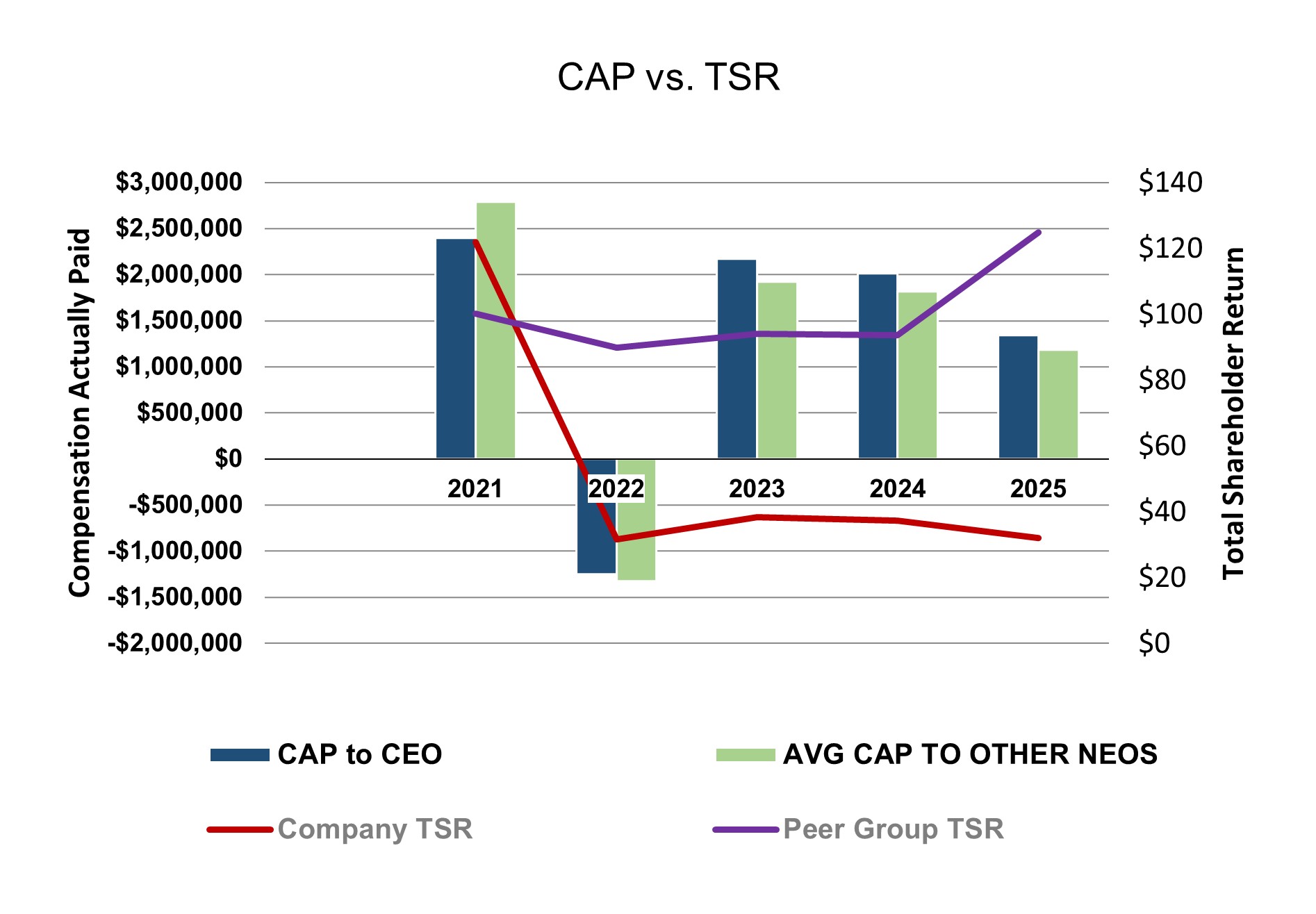
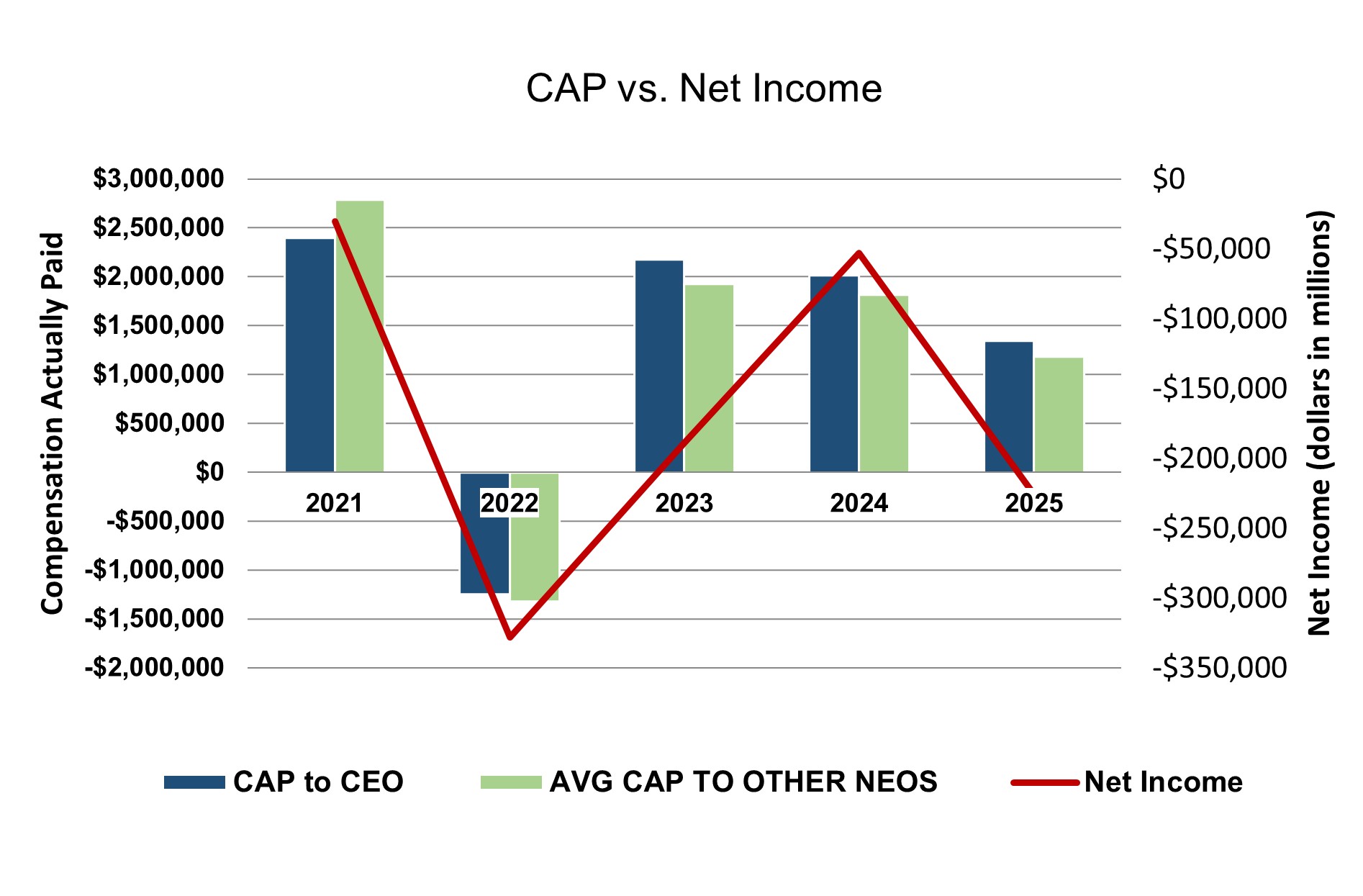
28
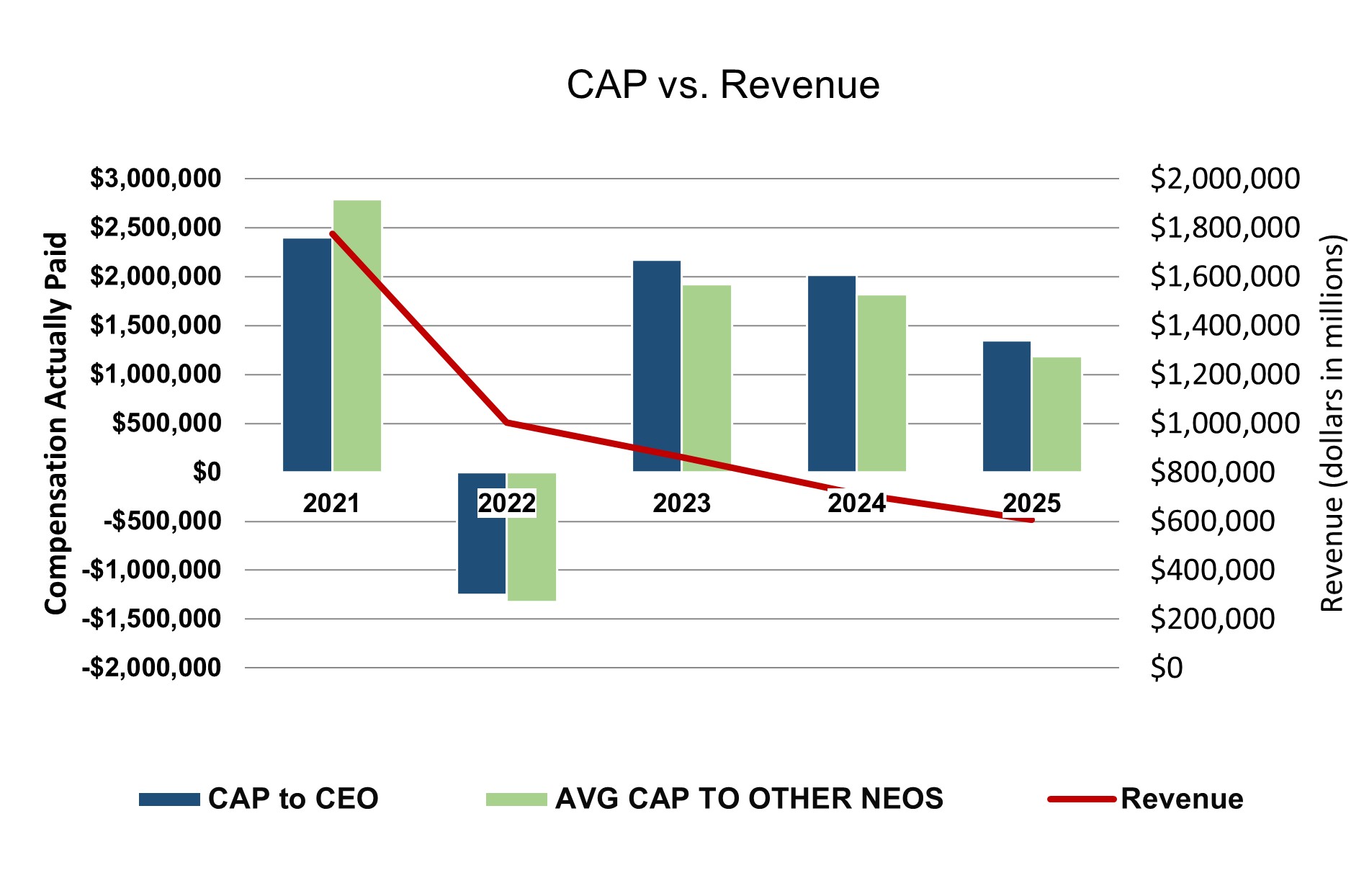
29
COMPENSATION COMMITTEE REPORT
The Compensation Committee of our Board has submitted the following report for inclusion in this proxy statement.
The Compensation Committee has reviewed and discussed the Compensation Discussion and Analysis contained in this proxy statement with management. Based on its review and discussions with management with respect to the Compensation Discussion and Analysis, the Compensation Committee recommended to the Board that the Compensation Discussion and Analysis be included in this proxy statement on Schedule 14A for filing with the Securities and Exchange Commission.
|
Compensation Committee |
|
Subbarao V. Uppaluri, Ph.D., Chairman |
|
Prem A. Lachman, M.D. |
|
Roger J. Medel, M.D. |
The Compensation Committee report above shall not be deemed to be “soliciting material” or to be “filed” with the Securities and Exchange Commission, nor shall such information be incorporated by reference into any future filing under the Securities Act of 1933 or the Securities Exchange Act of 1934, each as amended, except to the extent that we specifically incorporate it by reference into such filing.
Summary Compensation Table for 2023-2025
The following table sets forth information regarding compensation earned in or with respect to fiscal years 2025, 2024, and 2023 by:
We refer to these officers collectively as our Named Executive Officers.
|
|
|
|
|
|
|
|
|
|
Restricted |
|
|
Option |
|
|
All Other |
|
|
|
|
||||||
|
|
|
|
|
|
|
|
|
|
Stock Award(s) |
|
|
Award(s) |
|
|
Compensation |
|
|
|
|
||||||
Name and Principal Position |
|
Year |
|
Salary ($) |
|
|
Bonus ($) |
|
|
($)(1) |
|
|
($)(2) |
|
|
($)(3) |
|
|
Total ($) |
|
||||||
Phillip Frost, M.D. |
|
2025 |
|
|
960,000 |
|
|
|
480,000 |
|
|
|
— |
|
|
|
400,000 |
|
|
|
14,000 |
|
|
|
1,854,000 |
|
Chief Executive Officer |
|
2024 |
|
|
960,000 |
|
|
|
480,000 |
|
|
|
710,000 |
|
|
|
— |
|
|
|
13,800 |
|
|
|
2,163,800 |
|
|
|
2023 |
|
|
960,000 |
|
|
|
480,000 |
|
|
|
— |
|
|
|
824,000 |
|
|
|
13,200 |
|
|
|
2,277,200 |
|
|
|
|
|
|
|
|
|
|
|
|
|
|
|
|
|
|
|
|
|
|
||||||
Jane H. Hsiao, Ph.D. |
|
2025 |
|
|
900,000 |
|
|
|
450,000 |
|
|
|
— |
|
|
|
400,000 |
|
|
|
14,000 |
|
|
|
1,764,000 |
|
Chief Technical Officer |
|
2024 |
|
|
900,000 |
|
|
|
450,000 |
|
|
|
710,000 |
|
|
|
— |
|
|
|
13,800 |
|
|
|
2,073,800 |
|
|
|
2023 |
|
|
900,000 |
|
|
|
450,000 |
|
|
|
— |
|
|
|
824,000 |
|
|
|
13,200 |
|
|
|
2,187,200 |
|
|
|
|
|
|
|
|
|
|
|
|
|
|
|
|
|
|
|
|
|
|
||||||
Elias A. Zerhouni, M.D. |
|
2025 |
|
|
900,000 |
|
|
|
450,000 |
|
|
|
— |
|
|
|
400,000 |
|
|
|
14,000 |
|
|
|
1,764,000 |
|
President |
|
2024 |
|
|
900,000 |
|
|
|
450,000 |
|
|
|
710,000 |
|
|
|
— |
|
|
|
13,800 |
|
|
|
2,073,800 |
|
|
|
2023 |
|
|
900,000 |
|
|
|
450,000 |
|
|
|
— |
|
|
|
824,000 |
|
|
|
13,200 |
|
|
|
2,187,200 |
|
|
|
|
|
|
|
|
|
|
|
|
|
|
|
|
|
|
|
|
|
|
||||||
Steven D. Rubin |
|
2025 |
|
|
810,000 |
|
|
|
400,000 |
|
|
|
— |
|
|
|
350,000 |
|
|
|
14,000 |
|
|
|
1,574,000 |
|
Executive Vice President- |
|
2024 |
|
|
810,000 |
|
|
|
400,000 |
|
|
|
621,250 |
|
|
|
— |
|
|
|
13,800 |
|
|
|
1,845,050 |
|
Administration |
|
2023 |
|
|
810,000 |
|
|
|
400,000 |
|
|
|
— |
|
|
|
721,000 |
|
|
|
13,200 |
|
|
|
1,944,200 |
|
|
|
|
|
|
|
|
|
|
|
|
|
|
|
|
|
|
|
|
|
|
||||||
Adam Logal |
|
2025 |
|
|
700,000 |
|
|
|
475,000 |
|
|
|
— |
|
|
|
350,000 |
|
|
|
14,000 |
|
|
|
1,539,000 |
|
Senior Vice President |
|
2024 |
|
|
700,000 |
|
|
|
475,000 |
|
|
|
621,250 |
|
|
|
— |
|
|
|
13,800 |
|
|
|
1,810,050 |
|
and Chief Financial Officer |
|
2023 |
|
|
700,000 |
|
|
|
375,000 |
|
|
|
— |
|
|
|
721,000 |
|
|
|
13,200 |
|
|
|
1,809,200 |
|
30
Grants of Plan-Based Awards
The following table presents information concerning grants of plan-based awards to each of the Named Executive Officers during the year ended December 31, 2025. The exercise price per share of each such option equaled the closing price of our common stock on the date of the grant.
Name |
|
Grant Date |
|
All Other Option Awards: |
|
|
Exercise or Base Price of |
|
Grant Date Fair Value of |
|
Phillip Frost, M.D. |
|
5/27/2025 |
|
|
500,000 |
|
|
1.31 |
|
0.80 |
Jane H. Hsiao, Ph.D. |
|
5/27/2025 |
|
|
500,000 |
|
|
1.31 |
|
0.80 |
Elias A. Zerhouni, M.D. |
|
5/27/2025 |
|
|
500,000 |
|
|
1.31 |
|
0.80 |
Steven D. Rubin |
|
5/27/2025 |
|
|
437,500 |
|
|
1.31 |
|
0.80 |
Adam Logal |
|
5/27/2025 |
|
|
437,500 |
|
|
1.31 |
|
0.80 |
Outstanding Equity Awards at 2025 Fiscal Year-End
The following table sets forth information with respect to equity awards outstanding as of December 31, 2025.
31
|
|
Option Awards |
|
Stock Awards(1) |
|
|||||||||||||||||||||||||
|
|
|
|
|
|
|
|
|
|
|
|
|
|
|
|
|
|
|
|
|
|
|
Equity |
|
||||||
|
|
|
|
|
|
|
|
|
|
|
|
|
|
|
|
|
|
|
|
|
|
|
Incentive Plan |
|
||||||
|
|
|
|
|
|
|
|
|
|
|
|
|
|
|
|
|
|
|
|
|
|
|
Awards: |
|
||||||
|
|
|
|
|
|
|
|
|
|
|
|
|
|
|
|
|
|
|
|
|
Equity |
|
Market or |
|
||||||
|
|
|
|
|
|
|
|
|
|
|
|
|
|
|
|
|
|
|
|
|
Incentive Plan |
|
Payout |
|
||||||
|
|
|
|
|
|
|
|
|
|
|
|
|
|
|
|
|
|
|
|
|
Awards: |
|
Value of |
|
||||||
|
|
Number of |
|
Number of |
|
|
|
|
|
|
Number of |
|
|
Market Value |
|
|
Number of |
|
Unearned |
|
||||||||||
|
|
Securities |
|
Securities |
|
|
|
|
|
|
Shares or |
|
|
of Shares of |
|
|
Unearned |
|
Shares, Units |
|
||||||||||
|
|
Underlying |
|
Underlying |
|
|
|
|
|
|
Units of |
|
|
Units of |
|
|
Shares, Units or |
|
or Other |
|
||||||||||
|
|
Unexercised |
|
Unexercised |
|
Option |
|
|
Option |
|
Stock That |
|
|
Stock That |
|
|
Other Rights |
|
Rights That |
|
||||||||||
|
|
Options # |
|
Options |
|
Exercise |
|
|
Expiration |
|
Have Not |
|
|
Have Not |
|
|
That Have Not |
|
Have Not |
|
||||||||||
Name |
|
Exercisable |
|
(#) Unexercisable |
|
Price ($) |
|
|
Date |
|
Vested (#) |
|
|
Vested ($) |
|
|
Vested (#) |
|
Vested ($) |
|
||||||||||
Phillip Frost, M.D. |
|
|
500,000 |
|
(2) |
|
— |
|
|
|
|
10.41 |
|
|
3/31/2026 |
|
|
500,000 |
|
|
|
630,000 |
|
|
— |
|
|
630,000 |
|
|
|
|
|
500,000 |
|
(3) |
|
— |
|
|
|
|
4.46 |
|
|
6/20/2028 |
|
|
|
|
|
|
|
|
|
|
|
||||
|
|
|
350,000 |
|
(4) |
|
|
|
|
|
|
2.47 |
|
|
6/30/2029 |
|
|
|
|
|
|
|
|
|
|
|
||||
|
|
|
450,000 |
|
(5) |
|
— |
|
|
|
|
2.27 |
|
|
6/3/2030 |
|
|
|
|
|
|
|
|
|
|
|
||||
|
|
|
400,000 |
|
(7) |
|
— |
|
|
|
|
4.81 |
|
|
2/18/2031 |
|
|
|
|
|
|
|
|
|
|
|
||||
|
|
|
400,000 |
|
(8) |
|
|
400,000 |
|
(8) |
|
|
1.58 |
|
|
5/17/2033 |
|
|
|
|
|
|
|
|
|
|
|
|||
|
|
— |
|
|
|
|
500,000 |
|
(9) |
|
|
1.31 |
|
|
5/26/2035 |
|
|
|
|
|
|
|
|
|
|
|
||||
|
|
|
|
|
|
|
|
|
|
|
|
|
|
|
|
|
|
|
|
|
|
|
|
|
||||||
Jane H. Hsiao, Ph.D. |
|
|
450,000 |
|
(2) |
|
— |
|
|
|
|
10.41 |
|
|
3/31/2026 |
|
|
500,000 |
|
|
|
630,000 |
|
|
— |
|
|
630,000 |
|
|
|
|
|
500,000 |
|
(3) |
|
— |
|
|
|
|
4.46 |
|
|
6/20/2028 |
|
|
|
|
|
|
|
|
|
|
|
||||
|
|
|
350,000 |
|
(4) |
|
— |
|
|
|
|
2.47 |
|
|
6/30/2029 |
|
|
|
|
|
|
|
|
|
|
|
||||
|
|
|
450,000 |
|
(5) |
|
— |
|
|
|
|
2.27 |
|
|
6/3/2030 |
|
|
|
|
|
|
|
|
|
|
|
||||
|
|
|
400,000 |
|
(7) |
|
— |
|
|
|
|
4.81 |
|
|
2/18/2031 |
|
|
|
|
|
|
|
|
|
|
|
||||
|
|
|
400,000 |
|
(8) |
|
|
400,000 |
|
(8) |
|
|
1.58 |
|
|
5/17/2033 |
|
|
|
|
|
|
|
|
|
|
|
|||
|
|
— |
|
|
|
|
500,000 |
|
(9) |
|
|
1.31 |
|
|
5/26/2035 |
|
|
|
|
|
|
|
|
|
|
|
||||
|
|
|
|
|
|
|
|
|
|
|
|
|
|
|
|
|
|
|
|
|
|
|
|
|
||||||
Elias A. Zerhouni, M.D. |
|
|
26,192 |
|
(7) |
|
|
8,731 |
|
(7) |
|
|
3.19885 |
|
|
5/8/2032 |
|
|
500,000 |
|
|
|
630,000 |
|
|
— |
|
|
630,000 |
|
|
|
|
400,000 |
|
(8) |
|
|
400,000 |
|
(8) |
|
|
1.58 |
|
|
5/17/2033 |
|
|
|
|
|
|
|
|
|
|
|
|||
|
|
— |
|
|
|
|
500,000 |
|
(9) |
|
|
1.31 |
|
|
5/26/2035 |
|
|
|
|
|
|
|
|
|
|
|
||||
|
|
|
|
|
|
|
|
|
|
|
|
|
|
|
|
|
|
|
|
|
|
|
|
|
||||||
Steven D. Rubin |
|
|
450,000 |
|
(2) |
|
— |
|
|
|
|
10.41 |
|
|
3/31/2026 |
|
|
437,500 |
|
|
|
551,250 |
|
|
— |
|
|
551,250 |
|
|
|
|
|
300,000 |
|
(3) |
|
— |
|
|
|
|
4.46 |
|
|
6/20/2028 |
|
|
|
|
|
|
|
|
|
|
|
||||
|
|
|
250,000 |
|
(4) |
|
— |
|
|
|
|
2.47 |
|
|
6/30/2029 |
|
|
|
|
|
|
|
|
|
|
|
||||
|
|
|
350,000 |
|
(5) |
|
— |
|
|
|
|
2.27 |
|
|
6/3/2030 |
|
|
|
|
|
|
|
|
|
|
|
||||
|
|
|
350,000 |
|
(7) |
|
— |
|
|
|
|
4.81 |
|
|
2/18/2031 |
|
|
|
|
|
|
|
|
|
|
|
||||
|
|
|
350,000 |
|
(8) |
|
|
350,000 |
|
(8) |
|
|
1.58 |
|
|
5/17/2033 |
|
|
|
|
|
|
|
|
|
|
|
|||
|
|
— |
|
|
|
|
437,500 |
|
(9) |
|
|
1.31 |
|
|
5/26/2035 |
|
|
|
|
|
|
|
|
|
|
|
||||
|
|
|
|
|
|
|
|
|
|
|
|
|
|
|
|
|
|
|
|
|
|
|
|
|
||||||
Adam Logal |
|
|
250,000 |
|
(2) |
|
— |
|
|
|
|
10.41 |
|
|
3/31/2026 |
|
|
437,500 |
|
|
|
551,250 |
|
|
— |
|
|
551,250 |
|
|
|
|
|
300,000 |
|
(3) |
|
— |
|
|
|
|
4.46 |
|
|
6/20/2028 |
|
|
|
|
|
|
|
|
|
|
|
||||
|
|
|
250,000 |
|
(4) |
|
— |
|
|
|
|
2.47 |
|
|
6/30/2029 |
|
|
|
|
|
|
|
|
|
|
|
||||
|
|
|
350,000 |
|
(5) |
|
— |
|
|
|
|
2.27 |
|
|
6/3/2030 |
|
|
|
|
|
|
|
|
|
|
|
||||
|
|
|
350,000 |
|
(7) |
|
— |
|
|
|
|
4.81 |
|
|
2/18/2031 |
|
|
|
|
|
|
|
|
|
|
|
||||
|
|
|
350,000 |
|
(8) |
|
|
350,000 |
|
(8) |
|
|
1.58 |
|
|
5/17/2033 |
|
|
|
|
|
|
|
|
|
|
|
|||
|
|
— |
|
|
|
|
437,500 |
|
(9) |
|
|
1.31 |
|
|
5/26/2035 |
|
|
|
|
|
|
|
|
|
|
|
||||
32
(1) |
Each restricted stock unit represents a contingent right to receive one share of OPKO common stock upon the vesting of the award. The restricted stock units vest 50% on the second anniversary of the grant date, then 25% on each of the following two years. |
|
|
(2) |
Options were issued on April 1, 2016 and vest in four equal annual tranches beginning April 1, 2017. |
|
|
(3) |
Options were issued on June 21, 2018 and vest in four equal annual tranches beginning June 21, 2019. |
|
|
(4) |
Options were issued on July 1, 2019 and vest in four equal annual tranches beginning July 1, 2020. |
|
|
(5) |
Options were issued on June 4, 2020 and vest in four equal annual tranches beginning June 4, 2021. |
|
|
(6) |
Options were issued on February 19, 2021 and vest in four equal annual tranches beginning February 19, 2022. |
|
|
(7) |
Options were issued on May 9, 2022 and vest in four equal annual tranches beginning May 9, 2023. |
|
|
(8) |
Options were issued on May 18, 2023 and vest in four equal annual tranches beginning May 18, 2024. |
|
|
(9) |
Options were issued on May 27, 2025 and vest in four equal annual tranches beginning May 27, 2026. |
Option Exercises and Stock Vested
For fiscal 2025, no Named Executive Officer acquired any shares of common stock upon the exercise of stock options, nor did any restricted stock, restricted stock units or any similar instruments held by any Named Executive Officer vest.
Fiscal Year-End Equity Compensation Plan Information
The following table sets forth aggregated information concerning our equity compensation plans at December 31, 2025.
Plan Category |
|
Number of Securities to |
|
|
Weighted- Average |
|
|
Number of Securities |
|
|||
Equity Compensation Plans Approved by Stockholders |
|
|
60,440,095 |
|
|
$ |
2.42 |
|
|
|
19,148,162 |
|
Equity Compensation Plans Not Approved by Stockholders |
|
|
— |
|
|
|
— |
|
|
|
— |
|
Total |
|
|
60,440,095 |
|
|
$ |
2.42 |
|
|
|
19,148,162 |
|
Pension Benefits
None of our Named Executive Officers is covered by a pension plan or other similar benefit plan that provides for payments or other benefits at, following, or in connection with retirement.
Nonqualified Defined Contribution and Other Nonqualified Deferred Compensation Plan
None of our Named Executive Officers is covered by a nonqualified defined contribution or other nonqualified deferred compensation plan.
Employment Agreements and Change in Control Arrangements; Potential Payments Upon Termination or Change in Control
We have not entered into individual employment or change in control agreements with any of our executive officers other than offer letters entered into with Drs. Zerhouni and Nabel. Pursuant to the offer letters, each of Drs. Zerhouni and Nabel is entitled to twelve (12) months of applicable base salary and benefits if terminated without cause or if he terminates his employment for good reason (as defined in his offer letter). None of our Named Executive Officers are otherwise entitled to severance or change of control benefits; provided, however, that the 2007 Equity Incentive Plan, the 2016 Equity Incentive Plan,
33
and, if approved, the 2026 Equity Incentive Plan provide for accelerated vesting of all awards under the plan upon a Change in Control, as defined below.
Pursuant to both the 2007 Equity Incentive Plan, the 2016 Equity Incentive Plan, and, if approved, by our stockholders at the Annual Meeting, the OPKO Health, Inc. 2026 Equity Incentive Plan, if there is a Change in Control as defined below, each outstanding equity award under the applicable plan will accelerate so that such award shall, immediately prior to the effective date of the Change in Control, become fully vested with respect to the total number of shares of common stock subject to such award. Upon the consummation of any Change in Control, all outstanding awards under the 2007 Equity Incentive Plan, the 2016 Equity Incentive Plan, and, if approved, the OPKO Health, Inc. 2026 Equity Incentive Plan, shall to the extent not previously exercised, either be assumed by any successor corporation or parent thereof or be replaced with a comparable award with respect to shares of common stock of such successor corporation or parent thereof. Under the 2007 Equity Incentive Plan, the 2016 Equity Incentive Plan, and, if approved, the OPKO Health, Inc. 2026 Equity Incentive Plan, a “Change in Control” means the occurrence of any of the following events:
If we had experienced a Change in Control on December 31, 2025, the value of the acceleration of stock options held by Drs. Frost, Hsiao, Zerhouni, and Nabel and Messrs. Rubin and Logal would have been approximately $1.1 million, $1.1 million, $1.1 million, $900 thousand, $900 thousand, and $900 thousand, respectively.
Compensation Policies and Practices as Related to Risk Management
The Compensation Committee and management do not believe that the Company maintains compensation policies or practices that are reasonably likely to have a material adverse effect on the Company. Our employees’ base salaries are fixed in amount and thus we do not believe that they encourage excessive risk-taking. A significant portion of the compensation provided to our employees is in the form of long-term equity-based incentives that we believe are important to help align our employees’ interests with those of our stockholders. We do not believe that these equity-based incentives encourage unnecessary or excessive risk taking because their ultimate value is tied to our stock price.
Pay Ratio Disclosure
Our philosophy is to pay our employees competitively with similar positions in the applicable labor market. We follow this approach worldwide, whether it be an executive level position or hourly job at a foreign facility. As such, we benchmark by position from time to time and adjust compensation to match the applicable market. By doing so, we believe we maintain a high-quality, more stable workforce.
In accordance with Item 402(u) of Regulation S-K, promulgated in accordance with the Dodd-Frank Wall Street Reform Act and Consumer Protection Act of 2010, we are providing the following disclosure about the ratio of the annual total compensation of our chief executive officer to the median annual total compensation of our employees. For the year ended December 31, 2025:
34
We identified our median employee on December 31, 2025 using a multistep process in accordance with the SEC rules. We first examined the annual cash compensation paid to each of our employees during 2025, excluding our chief executive officer, which we gathered from our payroll data. This population consisted of all of our full-time, part-time and temporary employees who were employed by us on December 31, 2025. We believe the use of annual cash compensation, consisting of base pay and wages paid for all employees, is a consistently applied compensation measure because this measure reasonably represents the principal form of compensation delivered to all of our employees and because we typically do not widely distribute annual equity awards or pay bonuses to our employees. The total number of U.S. employees and non-U.S. employees, were 1,547, and 735, respectively, were considered for identifying the median employee. We also annualized the total cash compensation paid to those employees who commenced work with us during 2025, but did not work for us the entire calendar year. For purposes of this disclosure, compensation paid in foreign currencies was converted to U.S. dollars based on exchange rates in effect on December 31, 2025. Using this compensation measure, we were able to identify our median employee: a phlebotomist who works for one of our U.S. based subsidiaries. Once we identified our median employee, we then calculated the annual total compensation for such employee in accordance with the requirements of Item 402(c) of Regulation S-K. With respect to the annual total compensation of our chief executive officer, we used the amount reported in the “Total Compensation” column reported in the Summary Compensation Table included in this proxy statement.
Due to the use of estimates, assumptions, adjustments and statistical sampling permitted by Item 402(u), pay ratio disclosures may involve a degree of imprecision. Accordingly, our pay ratio is merely a reasonable estimate calculated in a manner consistent with Item 402(u) and may not be comparable to the pay ratio disclosures of other companies.
35
PROPOSAL TWO:
APPROVAL OF OPKO HEALTH, INC. 2026 EQUITY INCENTIVE PLAN
Overview
The Board is recommending approval by our stockholders of the OPKO Health, Inc. 2026 Equity Incentive Plan (the “2026 Equity Incentive Plan”), a copy of which is attached as Annex A to this Proxy Statement. Based upon the recommendation of the Compensation Committee, on February 20, 2026, our Board of Directors adopted the 2026 Equity Incentive Plan and recommended that it be submitted to the Company’s stockholders for their approval at the Annual Meeting.
Purpose
The purpose of the 2026 Equity Incentive Plan is to assist the Company and its related entities in attracting, motivating, retaining and rewarding high-quality executives, employees, officers, directors, and individual consultants who provide services to the Company or its related entities, by enabling such persons to acquire or increase a proprietary interest in the Company in order to strengthen the mutuality of interests between such persons and the Company’s stockholders, and providing such persons with performance incentives to expend their maximum efforts in the creation of stockholder value.
As of the date of this Proxy Statement, no Awards have been granted under the 2026 Equity Incentive Plan, which will not become effective unless and until it is approved by the Company’s stockholders.
The 2026 Equity Incentive Plan will replace our existing 2016 Equity Incentive Plan, which the Board will terminate upon receipt of stockholder approval of the 2026 Equity Incentive Plan. As of April 20, 2026, there were approximately 57,202,595 shares of our common stock subject to outstanding awards and approximately 19,008,162 shares of our common stock available for future awards under the 2016 Equity Incentive Plan. As a result, in the event the 2026 Equity Incentive Plan is not approved, the Company’s ability to use long-term equity-based compensation as a significant component of its overall compensation program would be materially limited.
The 2026 Equity Incentive Plan contains provisions that are designed to protect our stockholders’ interests and to reflect corporate governance best practices, including:
Description of the 2026 Equity Incentive Plan
The following is a summary of certain principal features of the 2026 Equity Incentive Plan. This summary is qualified in its entirety by reference to the complete text of the 2026 Equity Incentive Plan. Stockholders are urged to read the actual text of the 2026 Equity Incentive Plan in its entirety which is set forth as Annex A to this Proxy Statement.
36
Shares Available for Awards; Annual Per‑Person Limitations
Under the 2026 Equity Incentive Plan, the total number of shares of our common stock (the “Shares”) reserved and available for delivery at any time during the term of the 2026 Equity Incentive Plan (“Awards”) will be equal to 30,000,000 plus the number of Shares with respect to Awards previously granted under the 2016 Equity Incentive Plan that terminate without being exercised, expire unexercised, or are cancelled, forfeited or lapse for any reason, or are exchanged for Awards that do not involve Shares or are settled in cash in lieu of shares (the “Share Pool”), subject to adjustment as described below.
If any Shares subject to an Award are forfeited, expire or otherwise terminate without issuance of such Shares, or is settled for cash or otherwise does not result in the issuance of all or a portion of the Shares subject to such Award, the Shares to which those Awards were subject, will, to the extent of such forfeiture, expiration, termination, non-issuance or cash settlement, again be available for delivery with respect to Awards under the 2026 Equity Incentive Plan. However, Shares withheld from an Award to pay the exercise price and/or applicable tax withholdings with respect to an Award, will not go back into the Share Pool and will not be available for new grants.
Substitute Awards will not reduce the Shares authorized for delivery under the 2026 Equity Incentive Plan or authorized for delivery to a participant in any period. Additionally, in the event that a company acquired by the Company or any subsidiary or with which the Company or any subsidiary combines has shares available under a pre-existing plan approved by its stockholders and not adopted in contemplation of such acquisition or combination, the shares available for delivery pursuant to the terms of such pre-existing plan (as adjusted, to the extent appropriate, using the exchange ratio or other adjustment or valuation ratio or formula used in such acquisition or combination to determine the consideration payable to the holders of common stock of the entities party to such acquisition or combination) may be used for Awards under the 2026 Equity Incentive Plan and will not reduce the Shares authorized for delivery under the 2026 Equity Incentive Plan; provided, that Awards using such available shares will not be made after the date awards or grants could have been made under the terms of the pre-existing plan, absent the acquisition or combination, and will only be made to individuals who were not employees or directors of the Company or its related entities prior to such acquisition or combination.
The aggregate fair market value of Shares on the date of grant underlying incentive stock options that can be exercisable by any individual for the first time during any year cannot exceed $100,000 (or such other amount as specified in Section 422 of the Code). Any excess will be treated as a non-qualified stock option.
The maximum number of Shares that may be delivered under the 2026 Equity Incentive Plan as a result of the exercise of incentive stock options is 30,000,000 Shares, subject to certain adjustments.
In the event of any merger, consolidation, reorganization, recapitalization, extraordinary dividend or other distribution (whether in the form of cash, shares, or other property), forward or reverse split, spin-off, combination, repurchase, share exchange, liquidation, dissolution or other similar corporate transaction or event affects the shares of common stock and/or such other securities of the Company, the Committee (as defined below) has the discretion to make a proportionate adjustment to each outstanding award that the Committee considers appropriate, and the Committee has the authority to adjust: (i) the number and kind of shares which may be delivered in connection with Awards granted thereafter under the 2026 Equity Incentive Plan; (ii) the number and kind of shares of common stock by which annual per-person award limitations are measured; (iii) the number and kind of shares of common stock subject to or deliverable in respect of outstanding Awards granted under the 2026 Equity Incentive Plan; (iv) the exercise price, grant price or purchase price relating to any Award and/or make provision for payment of cash or other property in respect of any outstanding Award granted under the 2026 Equity Incentive Plan, and (v) any other aspect of any award that the Committee determines to be appropriate in order to prevent the reduction or enlargement of benefits under any Award granted under the 2026 Equity Incentive Plan.
Administration
The 2026 Equity Incentive Plan is to be administered by the Compensation Committee of the Board (the “Committee”); provided, however, that except as otherwise expressly provided in the 2026 Equity Incentive Plan, the Board may elect to exercise any power or authority granted to the Committee under the 2026 Equity Incentive Plan. Subject to the terms of the 2026 Equity Incentive Plan, the Committee is authorized to select eligible persons to receive Awards, grant Awards, determine the type, number and other terms and conditions of, and all other matters relating to, Awards, prescribe Award agreements (which need not be identical for each participant) and the rules and regulations for the administration of the 2026 Equity Incentive Plan, construe and interpret the 2026 Equity Incentive Plan and Award agreements, correct defects, supply omissions or reconcile inconsistencies therein, and make all other decisions and determinations as the Committee may deem necessary or advisable for the administration of the 2026 Equity Incentive Plan. The Committee may delegate to the members of the Board, officers or managers the authority to grant stock options and other awards to employees who are not subject to the reporting and other provisions of Section 16 of the Exchange Act, subject to certain limitations and guidelines. Decisions of the Committee shall be
37
final, conclusive and binding on all persons or entities, including the Company, any subsidiary or any participant or beneficiary, or any transferee under the 2026 Equity Incentive Plan or any other person claiming rights from or through any of the foregoing persons or entities.
Eligibility
Officers, employees, non-employee directors and other key persons (including consultants) as selected from time to time by the Committee in its discretion are eligible to participate in the 2026 Equity Incentive Plan; provided, however, that only employees of the Company or its subsidiaries are eligible to receive incentive stock options. Approximately 2,203 employees and 6 non-employee directors would be eligible to participate in the 2026 Equity Incentive Plan.
Stock Options
The Committee may grant options qualifying as incentive stock options within the meaning of Section 422 of the Code and/or non-qualified stock options in accordance with the terms and conditions set forth in the 2026 Equity Incentive Plan.
The 2026 Equity Incentive Plan permits the granting by the Committee of both options to purchase common stock intended to qualify as incentive stock options under Section 422 of the Code and options that do not so qualify. Options granted under the 2026 Equity Incentive Plan will be non-qualified options if they fail to qualify as incentive options or exceed the annual limit on incentive stock options. Incentive stock options may only be granted to employees of the Company and its related entities. Non-qualified options may be granted to any persons eligible to receive incentive options and to non-employee directors and key persons. The option exercise price of each option will be determined by the Committee but may not be less than 100% of the fair market value of the common stock on the date of grant and may not, in any event, be less than the par value of a share of common stock on the date of grant. The term of each option will be fixed by our Compensation Committee and may not exceed 10 years from the date of grant. The Committee will determine at what time or times each option may be exercised, including the ability to accelerate the vesting of such options.
Upon exercise of options, the option exercise price must be paid in full either in cash, by certified or bank check or other instrument acceptable to the Committee or by delivery (or attestation to the ownership) of shares of common stock that are beneficially owned by the optionee for at least six months or were purchased in the open market. Subject to applicable law, the exercise price may also be delivered by a broker pursuant to irrevocable instructions to the broker from the optionee. In addition, the Committee may permit options to be exercised using a net exercise feature which reduces the number of shares issued to the optionee by the number of shares with fair market value equal to the aggregate exercise price.
SARs
The Committee may award stock appreciation rights subject to such conditions and restrictions as it may determine. Stock appreciation rights entitle the recipient to shares of common stock, or cash, equal to the value of the appreciation in our stock price over the exercise price. The exercise price may not be less than 100% of the fair market value of our common stock on the date of grant. The term of each stock appreciation right will be fixed by the Committee and may not exceed ten years from the date of grant. The Committee will determine at what time or times each stock appreciation right may be exercised.
Stock Awards
The Committee is authorized to grant awards of stock pursuant to the terms of the 2026 Equity Incentive Plan as additional compensation or in lieu of other compensation for services to the Company. With respect to the shares of common stock subject to a stock award, the participant shall have all of the rights of a holder of shares of common stock, including the right to receive dividends and to vote the shares, unless the Committee determines otherwise on the date of grant.
Restricted Stock and Restricted Stock Units
The Committee is authorized to issue restricted shares of common stock and restricted stock units pursuant to the terms of the 2026 Equity Incentive Plan. A restricted stock unit is the right to receive shares of common stock, including restricted stock, cash measured based upon the value of shares of common stock, or a combination thereof. A restricted stock unit granted by the Committee shall occur upon expiration of the deferral period specified for such restricted stock unit award by the Committee (or, if permitted by the Committee, as elected by the participant in a manner that does not violate the requirements of Section 409A of the Code). A restricted stock unit award may be satisfied by delivery of shares, cash equal to the fair market value of the specified number of shares of common stock covered by the restricted stock units, or a combination thereof, as determined by the Committee at the date of grant or thereafter.
Performance Awards
38
The 2026 Equity Incentive Plan provides for performance-based awards, the grant or vesting of which is dependent upon attainment of objective performance targets relative to certain performance measures. The performance criteria to be achieved during any performance period, the length of the performance period, the performance goals to be achieved, and the amount of the award shall be determined by the Committee upon the grant of each performance award. Performance awards may be paid in a lump sum or in installments following the close of the performance period or, in accordance with procedures established by the Committee, on a deferred basis in a manner that does not violate the requirements of Section 409A of the Code.
Cash Awards
The Committee is authorized to grant cash awards pursuant to the terms of the 2026 Equity Incentive Plan as additional compensation or in lieu of other compensation for services to the Company and its related entities.
Other Terms of Awards
Awards may be settled in the form of cash, Shares, other Awards or other property, in the discretion of the Committee. The Committee may require or permit participants to defer the settlement of all or part of an Award in accordance with such terms and conditions as the Committee may establish, including payment or crediting of interest or dividend equivalents on deferred amounts, and the crediting of earnings, gains and losses based on deemed investment of deferred amounts in specified investment vehicles. The Committee is authorized to place cash, Shares or other property in trusts or make other arrangements to provide for payment of the Company’s obligations under the 2026 Equity Incentive Plan. The Committee may condition any payment relating to an Award on the withholding of taxes and may provide that a portion of any Shares or other property to be distributed will be withheld (or that previously acquired Shares or other property be surrendered by the participant) to satisfy withholding and other tax obligations. Awards granted under the 2026 Equity Incentive Plan generally may not be pledged or otherwise encumbered and are not transferable except by will or by the laws of descent and distribution, or to a designated beneficiary upon the participant’s death, except that the Committee may, in its discretion, permit transfers, subject to any terms and conditions the Committee may impose pursuant to the express terms of an Award agreement. A beneficiary, transferee, or other person claiming any rights under the 2026 Equity Incentive Plan from or through any participant will be subject to all terms and conditions of the 2026 Equity Incentive Plan and any Award agreement applicable to such participant, except as otherwise determined by the Committee, and to any additional terms and conditions deemed necessary or appropriate by the Committee.
Awards under the 2026 Equity Incentive Plan generally are granted without a requirement that the participant pay consideration in the form of cash or property for the grant (as distinguished from the exercise), except to the extent required by law. The Committee may, however, grant Awards in exchange for other Awards under the 2026 Equity Incentive Plan, awards under other Company plans, or other rights to payment from the Company, and may grant Awards in addition to and in tandem with such other Awards, rights or other awards.
Acceleration of Vesting; Change in Control
Subject to certain limitations set forth in the 2026 Equity Incentive Plan, the Committee may, in its discretion, accelerate the exercisability, the lapsing of restrictions or the expiration of deferral or vesting periods of any Award. In the event of a “change in control” of the Company, as defined in the 2026 Equity Incentive Plan, and only to the extent provided in any employment or other agreement between the participant and the Company or any related entity, or in any Award agreement, or to the extent otherwise determined by the Committee in its sole discretion in each particular case, (i) any option or stock appreciation right that was not previously vested and exercisable at the time of the “change in control” will become immediately vested and exercisable; (ii) any restrictions, deferral of settlement and forfeiture conditions applicable to a restricted stock award, restricted stock unit award or an other stock-based award subject only to future service requirements will lapse and such Awards will be deemed fully vested; and (iii) with respect to any outstanding Award subject to achievement of performance goals and conditions under the 2026 Equity Incentive Plan, the Committee may, in its discretion, consider such Awards to have been earned and payable based on achievement of performance goals or based upon target performance (either in full or pro-rata based on the portion of the performance period completed as of the “change in control”).
Subject to any limitations contained in the 2026 Equity Incentive Plan relating to the vesting of Awards in the event of any merger, consolidation or other reorganization in which the Company does not survive, or in the event of any “change in control,” the agreement relating to such transaction and/or the committee may provide for: (i) the continuation of the outstanding Awards by the Company, if the Company is a surviving entity, (ii) the assumption or substitution for outstanding Awards by the surviving entity or its parent or subsidiary pursuant to the provisions contained in the 2026 Equity Incentive Plan, (iii) full exercisability or vesting and accelerated expiration of the outstanding Awards, or (iv) settlement of the value of the outstanding Awards in cash or cash equivalents or other property followed by cancellation of such. The foregoing actions may be taken without the consent or agreement of a participant in the 2026 Equity Incentive Plan and without any requirement that all such participants be treated consistently.
39
Clawback of Benefits
The Company may (i) cause the cancellation of any Award, (ii) require reimbursement of any Award by a participant or beneficiary, and (iii) effect any other right of recoupment of equity or other compensation provided under the 2026 Equity Incentive Plan or otherwise in accordance with any Company policies that currently exist or that may from time to time be adopted or modified in the future by the Company and/or applicable law, which we refer to each as a “clawback policy.” In addition, a participant may be required to repay to the Company certain previously paid compensation, whether provided under the 2026 Equity Incentive Plan or an Award agreement or otherwise, in accordance with any clawback policy. By accepting an Award, a participant is also agreeing to be bound by any existing or future clawback policy adopted by the Company, or any amendments that may from time to time be made to the clawback policy in the future by the Company in its discretion (including without limitation any clawback policy adopted or amended to comply with applicable laws or stock exchange requirements) and is further agreeing that all of the participant’s Award agreements (and/or awards issued under the Prior Plan) may be unilaterally amended by the Company, without the participant’s consent, to the extent that the Company in its discretion determines to be necessary or appropriate to comply with any clawback policy.
Amendment and Termination
The Board may amend, alter, suspend, discontinue or terminate the 2026 Equity Incentive Plan or the Committee’s authority to grant Awards without the consent of stockholders or participants or beneficiaries, except that stockholder approval must be obtained for any amendment or alteration if such approval is required by law or regulation or under the rules of any stock exchange or quotation system on which Shares may then be listed or quoted; provided that, except as otherwise permitted by the 2026 Equity Incentive Plan or an Award agreement, without the consent of an affected participant, no such Board action may materially and adversely affect the rights of such participant under the terms of any previously granted and outstanding Award. The Committee may waive any conditions or rights under, or amend, alter, suspend, discontinue or terminate any Award theretofore granted and any Award agreement relating thereto, except as otherwise provided in the 2026 Equity Incentive Plan; provided that, except as otherwise permitted by the 2026 Equity Incentive Plan or Award agreement, without the consent of an affected participant, no such Committee or the Board action may materially and adversely affect the rights of such participant under terms of such Award. The 2026 Equity Incentive Plan will terminate at the earliest of (i) such time as no Shares remain available for issuance under the 2026 Equity Incentive Plan, (ii) termination of the 2026 Equity Incentive Plan by the Board, or (iii) the 10th anniversary of the effective date of the 2026 Equity Incentive Plan. Awards outstanding upon expiration of the 2026 Equity Incentive Plan will remain in effect until they have been exercised or terminated or have expired.
U.S. Federal Income Tax Consequences of Awards
The following is a general summary of the U.S. federal income tax consequences of Awards granted under the 2026 Equity Incentive Plan, based on current U.S. federal income tax laws. This summary does not constitute legal or tax advice and does not address municipal, state or foreign income tax consequences. The federal tax laws may change and the federal, state and local tax consequences for any participant will depend upon his or her individual circumstances. Each participant is encouraged to seek the advice of a qualified tax advisor regarding the tax consequences of participation in the 2026 Equity Incentive Plan.
The 2026 Equity Incentive Plan is not qualified under the provisions of section 401(a) of the Code and is not subject to any of the provisions of the Employee Retirement Income Security Act of 1974, as amended.
Nonqualified Stock Options
An optionee generally is not taxable upon the grant of a nonqualified stock option granted under the 2026 Equity Incentive Plan. On exercise of a nonqualified stock option granted under the 2026 Equity Incentive Plan, an optionee will recognize ordinary income equal to the excess, if any, of the fair market value on the date of exercise of the Shares acquired on exercise of the option over the exercise price. If the optionee is an employee of the Company or a subsidiary, that income will be subject to the withholding of Federal income tax. The optionee’s tax basis in those Shares will be equal to their fair market value on the date of exercise of the option, and his or her holding period for those Shares will begin on that date.
If an optionee pays for Shares on exercise of an option by delivering Shares, the optionee will not recognize gain or loss on the Shares delivered, even if their fair market value at the time of exercise differs from the optionee’s tax basis in them. The optionee, however, otherwise will be taxed on the exercise of the option in the manner described above as if he or she had paid the exercise price in cash. If a separate identifiable stock certificate or other indicia of ownership is issued for that number of Shares equal to the number of Shares delivered on exercise of the option, the optionee’s tax basis in the Shares represented by that certificate or other indicia of ownership will be equal to his or her tax basis in the Shares delivered, and his or her holding period for those Shares will include his or her holding period for the Shares delivered. The optionee’s tax basis and holding
40
period for the additional Shares received on exercise of the option will be the same as if the optionee had exercised the option solely in exchange for cash.
The Company generally will be entitled to a deduction for Federal income tax purposes equal to the amount of ordinary income taxable to the optionee, provided that amount constitutes an ordinary and necessary business expense for the Company and is reasonable in amount, and either the employee includes that amount in income or the Company timely satisfies its reporting requirements with respect to that amount.
Incentive Stock Options
Under the Code, an optionee generally is not subject to tax upon the grant or exercise of an incentive stock option. In addition, if the optionee holds a Share received on exercise of an incentive stock option for at least two years from the date the option was granted and at least one year from the date the option was exercised, which we refer to as the Required Holding Period, the difference, if any, between the amount realized on a sale or other taxable disposition of that Share and the holder’s tax basis in that Share will be long-term capital gain or loss.
If an optionee disposes of a Share acquired on exercise of an incentive stock option before the end of the Required Holding Period, which we refer to as a Disqualifying Disposition, the optionee generally will recognize ordinary income in the year of the Disqualifying Disposition equal to the excess, if any, of the fair market value of the Share on the date the incentive stock option was exercised over the exercise price. If, however, the Disqualifying Disposition is a sale or exchange on which a loss, if realized, would be recognized for Federal income tax purposes, and if the sales proceeds are less than the fair market value of the Share on the date of exercise of the option, the amount of ordinary income recognized by the optionee will not exceed the gain, if any, realized on the sale. If the amount realized on a Disqualifying Disposition exceeds the fair market value of the Share on the date of exercise of the option, that excess will be short-term or long-term capital gain, depending on whether the holding period for the Share exceeds one year.
An optionee who exercises an incentive stock option by delivering Shares acquired previously pursuant to the exercise of an incentive stock option before the expiration of the Required Holding Period for those Shares is treated as making a Disqualifying Disposition of those Shares. This rule prevents “pyramiding” or the exercise of an incentive stock option (that is, exercising an incentive stock option for one Share and using that Share, and others so acquired, to exercise successive incentive stock options) without the imposition of current income tax.
For purposes of the alternative minimum tax, the amount by which the fair market value of a Share acquired on exercise of an incentive stock option exceeds the exercise price of that option generally will be an adjustment included in the optionee’s alternative minimum taxable income for the year in which the option is exercised. If, however, there is a Disqualifying Disposition of the Share in the year in which the option is exercised, there will be no adjustment with respect to that Share. If there is a Disqualifying Disposition in a later year, no income with respect to the Disqualifying Disposition is included in the optionee’s alternative minimum taxable income for that year. In computing alternative minimum taxable income, the tax basis of a Share acquired on exercise of an incentive stock option is increased by the amount of the adjustment taken into account with respect to that Share for alternative minimum tax purposes in the year the option is exercised.
The Company is not allowed an income tax deduction with respect to the grant or exercise of an incentive stock option or the disposition of a Share acquired on exercise of an incentive stock option after the Required Holding Period. However, if there is a Disqualifying Disposition of a Share, the Company generally is allowed a deduction in an amount equal to the ordinary income includible in income by the optionee, provided that amount constitutes an ordinary and necessary business expense for the Company and is reasonable in amount, and either the employee includes that amount in income or the Company timely satisfies its reporting requirements with respect to that amount.
Stock Awards
Generally, the recipient of a stock award will recognize ordinary compensation income at the time the Shares are received equal to the excess, if any, of the fair market value of the Shares received over any amount paid by the recipient in exchange for the Shares. If, however, the Shares are not vested when they are received under the 2026 Equity Incentive Plan (for example, if the recipient is required to work for a period of time in order to have the right to sell the Shares), the recipient generally will not recognize income until the Shares become vested, at which time the recipient will recognize ordinary compensation income equal to the excess, if any, of the fair market value of the Shares on the date they become vested over any amount paid by the recipient in exchange for the Shares. A recipient may, however, file an election with the Internal Revenue Service, within 30 days of his or her receipt of the Award, to recognize ordinary compensation income, as of the date the recipient receives the Award, equal to the excess, if any, of the fair market value of the Shares on the date the Award is granted over any amount paid by the recipient in exchange for the Shares.
41
The recipient’s basis for the determination of gain or loss upon the subsequent disposition of Shares acquired as Awards will be the amount paid for the Shares plus any ordinary income recognized either when the Shares are received or when the Shares become vested. Upon the disposition of any Shares received as a Share Award under the 2026 Equity Incentive Plan, the difference between the sales price and the recipient’s basis in the Shares will be treated as a capital gain or loss and generally will be characterized as long-term capital gain or loss if the Shares have been held for more the one year from the date as of which he or she would be required to recognize any compensation income.
The Company generally will be entitled to a deduction for Federal income tax purposes equal to the amount of ordinary income taxable to the recipient, provided that amount constitutes an ordinary and necessary business expense for the Company, is reasonable in amount, and is not precluded by the deduction limitations imposed by Section 162(m) of the Code, and either the recipient includes that amount in income or the Company timely satisfies its reporting requirements with respect to that amount.
Stock Appreciation Rights
The Company may grant stock appreciation rights, separate from any other Award, which we refer to as Stand-Alone stock appreciation rights, or Tandem stock appreciation rights, under the 2026 Equity Incentive Plan. Generally, the recipient of a Stand-Alone stock appreciation right will not recognize any taxable income at the time the Stand-Alone stock appreciation right is granted.
With respect to Stand-Alone stock appreciation rights, if the recipient receives the appreciation inherent in the stock appreciation rights in cash, the cash will be taxable as ordinary compensation income to the recipient at the time that the cash is received. If the recipient receives the appreciation inherent in the stock appreciation rights in Shares, the recipient will recognize ordinary compensation income equal to the excess of the fair market value of the Shares on the day they are received over any amounts paid by the recipient for the Shares.
With respect to Tandem stock appreciation rights, if the recipient elects to surrender the underlying option in exchange for cash or Shares equal to the appreciation inherent in the underlying option, the tax consequences to the recipient will be the same as discussed above relating to the Stand-Alone stock appreciation rights. If the recipient elects to exercise the underlying option, the holder will be taxed at the time of exercise as if he or she had exercised a nonqualified stock option (discussed above), i.e., the recipient will recognize ordinary income for Federal tax purposes measured by the excess of the then fair market value of the Shares over the exercise price.
In general, there will be no Federal income tax deduction allowed to the Company upon the grant or termination of Stand-Alone stock appreciation rights or Tandem stock appreciation rights. Upon the exercise of either a Stand-Alone stock appreciation right or a Tandem stock appreciation right, however, the Company generally will be entitled to a deduction for Federal income tax purposes equal to the amount of ordinary income that the employee is required to recognize as a result of the exercise, provided that the deduction is not otherwise disallowed under the Code.
Dividend Equivalents
Generally, the recipient of a dividend equivalent award will recognize ordinary compensation income at the time the dividend equivalent award is received equal to the fair market value of the amount received. The Company generally will be entitled to a deduction for Federal income tax purposes equal to the amount of ordinary income that the recipient is required to recognize as a result of the dividend equivalent award, provided that the deduction is not otherwise disallowed under the Code.
Section 409A of the Code
The 2026 Equity Incentive Plan is intended to comply with Section 409A of the Code to the extent that such section would apply to any Award under the 2026 Equity Incentive Plan. Section 409A of the Code governs the taxation of deferred compensation. Any participant that is granted an Award that is deemed to be deferred compensation, such as a grant of restricted stock units that does not qualify for an exemption from Section 409A of the Code, and does not comply with Section 409A of the Code, could be subject to taxation on the Award as soon as the Award is no longer subject to a substantial risk of forfeiture (even if the Award is not exercisable) and an additional 20% tax (and a further additional tax based upon an amount of interest determined under Section 409A of the Code) on the value of the Award.
Section 280G Parachute Payments
The vesting of any portion of an Award that is accelerated due to the occurrence of a change in control may cause a portion of the payments with respect to such accelerated Awards to be treated as “parachute payments” as defined in Section 280G of the Code. Any such parachute payments may be non-deductible to the Company, in whole or in part, and may subject the recipient to a non-deductible 20% federal excise tax on all or a portion of such payment (in addition to other taxes ordinarily payable).
42
Limitation on Deductions
Under Section 162(m) of the Code, the Company’s deduction for awards under the 2026 Equity Incentive Plan may be limited to the extent that any “covered employee” (as defined in Section 162(m) of the Code) receives compensation in excess of $1 million a year.
Importance of Consulting Tax Adviser
The information set forth above is a summary only and does not purport to be complete. In addition, the information is based upon current Federal income tax rules and therefore is subject to change when those rules change. Moreover, because the tax consequences to any recipient may depend on his or her particular situation, each recipient should consult his or her tax adviser as to the Federal, state, local, foreign and other tax consequences of the grant or exercise of an Award or the disposition of Shares acquired as a result of an Award.
OUR BOARD RECOMMENDS A VOTE “FOR” APPROVAL OF THE OPKO HEALTH, INC. 2026 EQUITY INCENTIVE PLAN.
43
PROPOSAL THREE:
NON-BINDING ADVISORY RESOLUTION REGARDING THE COMPENSATION OF THE COMPANY’S NAMED EXECUTIVE OFFICERS (“SAY ON PAY”)
Background of the Proposal
Section 14A of the Exchange Act, which was added under the Dodd-Frank Wall Street Reform and Consumer Protection Act, enacted in July 2010, requires that all public companies hold a separate non-binding advisory stockholder vote to approve the compensation of executive officers as described in the Compensation Discussion and Analysis, the executive compensation tables and any related information in each such company’s proxy statement (commonly known as a “Say on Pay” proposal). Pursuant to Section 14A of the Exchange Act, we are holding a non-binding advisory vote on Say on Pay at the Annual Meeting.
We currently hold our Say on Pay vote every year. Stockholders will have an opportunity to cast a non-binding advisory vote on the frequency of Say on Pay votes every six years. The next advisory vote on the frequency of the Say on Pay vote will occur no later than the 2029 annual meeting of stockholders.
Say on Pay Proposal
As discussed in the “Compensation Discussion and Analysis” section of this proxy statement, our executive compensation program is primarily structured to (i) attract, motivate, and retain talented executives with the skill sets and expertise we need to meet our scientific and business objectives; (ii) be competitive in the marketplace; (iii) tie annual and long-term cash and equity incentives to the achievement of specified performance objectives that will result in increased stockholder value; and (iv) be cost-effective. The three primary elements of compensation used to support the above goals are base salary, discretionary annual bonus, and equity awards. Although we have not adopted any formal guidelines for allocating total compensation between equity compensation and cash compensation, we maintain compensation plans that tie a substantial portion of our executives’ overall compensation to the achievement of corporate goals and success of the Company. The Board believes that our compensation program for our executive officers is appropriately based upon our performance and the individual performance and level of responsibility of the executive officers. We urge you to read the “Executive Compensation” section of this proxy statement for details on the Company’s executive compensation programs.
The Say on Pay proposal is set forth in the following resolution:
“RESOLVED, that the compensation paid to OPKO Health, Inc.’s named executive officers, as disclosed pursuant to Item 402 of Regulation S-K, including the Compensation Discussion and Analysis, compensation tables and narrative discussion is hereby APPROVED.”
Because your vote on this proposal is advisory, it will not be binding on the Board, the Compensation Committee or the Company. However, the Compensation Committee will take into account the outcome of the vote when considering future executive compensation arrangements.
Vote Required
The Say on Pay proposal will be approved if the votes cast in favor of the proposal by the holders of shares of our common stock present or represented and entitled to vote on the proposal at the Annual Meeting at which a quorum is present exceed the votes cast against the proposal.
Recommendation
OUR BOARD RECOMMENDS A VOTE “FOR” THE FOREGOING RESOLUTION TO APPROVE ON A NON-BINDING ADVISORY BASIS THE COMPENSATION OF THE COMPANY’S NAMED EXECUTIVE OFFICERS.
44
PROPOSAL FOUR:
RATIFICATION OF APPOINTMENT OF INDEPENDENT REGISTERED PUBLIC ACCOUNTING FIRM
Ernst & Young LLP (“Ernst & Young”) has served as the Company’s independent registered public accounting firm since 2007. The Audit Committee has appointed Ernst & Young as the Company’s independent registered public accounting firm to audit our financial statements for the year ending December 31, 2026 and to express an opinion on the effectiveness of our internal control over financial reporting as of December 31, 2026, and recommends that stockholders vote in favor of the ratification of such appointment. We expect that a representative of Ernst & Young will attend the Annual Meeting, will have an opportunity to make a statement if he or she desires to do so, and will be available to respond to appropriate questions.
The following table presents fees for professional services provided by Ernst & Young for the fiscal years ended December 31, 2025 and 2024:
|
December 31, |
|
||||||
|
FY 2025 |
|
|
FY 2024 |
|
|||
Audit Fees |
$ |
|
3,621,699 |
|
|
$ |
3,280,107 |
|
Audit-Related Fees |
|
|
— |
|
|
|
— |
|
Tax Fees |
|
|
— |
|
|
|
— |
|
All Other Fees |
|
|
7,200 |
|
|
|
5,200 |
|
Total |
$ |
|
3,628,899 |
|
|
$ |
3,285,307 |
|
Audit Fees include fees for services rendered for the audit of our annual consolidated financial statements, the audit of internal control over financial reporting, the review of financial statements included in our quarterly reports on Form 10-Q, statutory audits required domestically and internationally, assistance with and review of documents filed with the SEC and consents and other services normally provided in connection with statutory and regulatory filings or engagements.
Audit-Related Fees principally include fees incurred for accounting consultations and other audits such as a benefit plan audit and a stand alone audit.
Tax Fees amounts include fees for services rendered for tax compliance and tax advice.
All Other Fees includes fees for a license to access online accounting research tools and fees that do not constitute Audit Fees, Audit-Related Fees, or Tax Fees.
Audit Committee Policy for Pre-approval of Independent Registered Public Accounting Firm Services
The Audit Committee of the Board is required to pre-approve all audit and non-audit services provided by the Company’s independent registered public accounting firm in order to assure that the provision of such services does not impair the independent registered public accounting firm’s independence. The Audit Committee has established a policy regarding pre-approval of permissible audit, audit-related, and other services provided by the independent registered public accounting firm, which services are periodically reviewed and revised by the Audit Committee. Unless a type of service has received general pre-approval under the policy, the service will require specific approval by the Audit Committee. The policy also includes pre-approved fee levels for specified services and any proposed service exceeding the established fee level must be specifically approved by the Audit Committee. All audit and permitted non-audit services and all fees associated with such services performed by our independent registered public accounting firm in fiscal 2025 and 2024 were approved by the Audit Committee consistent with the policy described above.
Vote Required
The ratification of the appointment of Ernst & Young will be approved if the votes cast in favor of the proposal by the holders of shares of our common stock present or represented and entitled to vote on the proposal at the Annual Meeting in which a quorum is present exceed the votes cast against the proposal.
Recommendation
OUR BOARD RECOMMENDS A VOTE “FOR” THE RATIFICATION OF APPOINTMENT OF THE INDEPENDENT REGISTERED PUBLIC ACCOUNTING FIRM.
45
AUDIT COMMITTEE REPORT
The following Audit Committee Report shall not be deemed to be “soliciting material” or to be “filed” with the Securities and Exchange Commission, nor shall such information be incorporated by reference into any future filing under the Securities Act of 1933 or the Securities Exchange Act of 1934, each as amended, except to the extent that we specifically incorporate it by reference into such filing.
The members of the Audit Committee of the Board are Messrs. Pfenniger and Paganelli and Dr. Lachman. Dr. Richard M. Krasno also served on the Audit Committee until his passing on March 13, 2026. The primary purpose of the Audit Committee is to assist the Board in its general oversight of the Company’s accounting and financial reporting processes. The Audit Committee’s functions are more fully described in its charter adopted by the Board, which is available on the Company’s website at www.opko.com. The Audit Committee reviews and reassesses the adequacy of its charter on an annual basis. The Board annually reviews the NASDAQ listing standards’ definition of independence for Audit Committee members and has determined that each member of the Audit Committee is independent under such standards.
Management is responsible for the preparation, presentation, and integrity of the Company’s financial statements, accounting and financial reporting principles, and internal controls and procedures designed to ensure compliance with accounting standards, applicable laws, and regulations.
The Company’s independent registered public accounting firm, Ernst & Young LLP, is responsible for performing an independent annual audit of the Company’s consolidated financial statements and expressing an opinion on both the conformity of those financial statements with United States generally accepted accounting principles and on the effectiveness of our internal control over financial reporting. The Audit Committee’s policy is that all services rendered by the Company’s independent registered public accounting firm are pre-approved by the Audit Committee and are monitored both as to spending level and work content to maintain the appropriate objectivity and independence of the independent registered public accounting firm. The Audit Committee’s policy provides that the Audit Committee has the ultimate authority to approve all audit engagement fees and terms and that the Audit Committee shall review, evaluate, and approve the engagement proposal of the independent registered public accounting firm.
In conjunction with its activities during fiscal 2025, the Audit Committee reviewed and discussed our interim results, audited financial statements, and the annual integrated audit of our financial statements and internal control over financial reporting with management and the Company’s independent registered public accounting firm with and without management present. The members of the Audit Committee discussed the quarterly review procedures and annual audit procedures performed by the independent registered public accounting firm in connection with the quarterly unaudited and annual audited financial statements and discussed and agreed upon procedures related to the audit of internal control over financial reporting with management of the Company and its independent registered public accounting firm. The members of the Audit Committee also discussed with the Company’s independent registered public accounting firm the matters required to be discussed pursuant to Auditing Standard No. 1301, Communications with Audit Committees, adopted by the Public Company Accounting Oversight Board (“PCAOB”). In addition, the Audit Committee received from the Company’s independent registered public accounting firm the written disclosures and the letter required by the PCAOB regarding the independent registered public accounting firm’s communications with the Audit Committee concerning independence and has discussed with the independent registered public accounting firm the independent registered public accounting firm’s independence. Based on the foregoing reviews and discussions, the Audit Committee recommended that the fiscal 2025 annual audited financial statements be included in the Company’s Annual Report on Form 10-K for fiscal 2025.
|
Audit Committee Richard C. Pfenniger, Jr., Chairman Prem A. Lachman, M.D. John A. Paganelli
|
46
OTHER INFORMATION
Deadlines for Stockholder Proposals and Nominations for the 2027 Annual Meeting
Pursuant to Rule 14a-8 under the Exchange Act, our stockholders may present proper proposals for inclusion in our proxy statement and form of proxy and for consideration at our 2027 annual meeting of stockholders (the “2027 Annual Meeting”) by submitting their proposals to us in a timely manner. Any stockholder of the Company who wishes to present a proposal for inclusion in the proxy statement and form of proxy for action at the 2027 Annual Meeting must comply with our Amended and Restated Bylaws and the rules and regulations of the SEC, each as then in effect. Such proposals must be mailed to us at our offices at 4400 Biscayne Blvd., Miami, Florida 33137, Attention: Secretary. Under Rule 14a-8, any stockholder proposal intended to be presented at the 2027 Annual Meeting must be received no later than December 31, 2026 in order to be considered for inclusion in our proxy statement and form of proxy relating to such meeting. Under our Amended and Restated Bylaws, a stockholder must follow certain procedures to nominate persons for election as directors or to introduce an item of business at an annual meeting of stockholders. In order to be timely, we must receive notice of your intention to introduce a nomination or propose an item of business at our 2027 Annual Meeting between March 20, 2027 and April 19, 2027.
If we receive notice of a stockholder proposal after March 16, 2027 and that proposal is in fact presented at the 2027 Annual Meeting, then our proxy holders will have the right to exercise discretionary authority with respect to voting on such proposal.
In addition, for stockholder nominees for directors to be considered timely for inclusion on a universal proxy card pursuant to Rule 14a-19 under the Exchange Act, such Rule requires that stockholders provide notice to us no later than April 19, 2027 containing the information required by Rule 14a-19 under the Exchange Act; however, such Rule’s notice requirement does not override or supersede any longer notice period that may be established by our Amended and Restated Bylaws, in which case such longer time period would control.
Expenses of Solicitation
The Company is making this solicitation and will bear the cost of this proxy solicitation. In addition to the use of the mails, some of our regular employees, without additional remuneration, may solicit proxies personally or by telephone or facsimile. We will reimburse brokers, dealers, banks, and other custodians, nominees, and fiduciaries for their reasonable expenses in forwarding solicitation materials to beneficial owners of our common stock.
Other Business
As of the date of this proxy statement, the Board knows of no business to be presented at the Annual Meeting other than as set forth in this proxy statement. If other matters properly come before the Annual Meeting, or any of its adjournments, the persons named as proxies will vote on such matters in their discretion.
Householding
The SEC has adopted rules that permit companies and intermediaries (e.g., brokers) to satisfy the delivery requirements for proxy statements and annual reports with respect to two or more stockholders sharing the same address by delivering a single proxy statement addressed to those stockholders. This process, which is commonly referred to as “householding,” potentially means extra convenience for stockholders and cost savings for companies.
This year, a number of brokers with account holders who are stockholders of our company will be “householding” our proxy materials. A single proxy statement may be delivered to multiple stockholders sharing an address unless contrary instructions have been received from the affected stockholders. Once a stockholder has received notification from its broker that it will be “householding” communications to such stockholder’s address, “householding” will continue until such stockholder is notified otherwise or until such stockholder notifies its broker or us that it no longer wishes to participate in “householding.” If, at any time, a stockholder no longer wishes to participate in “householding” and would prefer to receive a separate copy of the 2026 proxy statement and 2025 annual report and/or wishes to receive separate copies of these documents in the future, or if, at any time, stockholders who share an address and receive separate copies of the 2026 proxy statement and 2025 annual report would like to receive a single copy of these documents in the future, such stockholder or stockholders may (1) notify its broker or (2) direct its written or oral request to: OPKO Health, Inc., Corporate Secretary, 4400 Biscayne Blvd., Miami, Florida 33137, (305) 575-4100. Upon written or oral request of a stockholder at a shared address to which a single copy of the 2026 proxy statement and 2025 annual report was delivered, we will deliver promptly separate copies of these documents.
47
ANNEX a
2016 Equity Incentive Plan
See attached.
i
OPKO HEALTH, INC.
2026 EQUITY INCENTIVE PLAN
(Effective February 20, 2026)
ii
OPKO HEALTH, INC.
2026 EQUITY INCENTIVE PLAN
1. Purpose
2. Definitions
3. Administration.
4. Shares Subject to Plan.
5. Eligibility
6. Specific Terms of Awards.
7. Certain Provisions Applicable to Awards.
8. Change in Control.
9. General Provisions.
iii
OPKO HEalth, INC.
2026 EQUITY INCENTIVE PLAN
iv
v
vi
vii
viii
ix
x
xi
xii
xiii
xiv
xv
(j) Minimum Vesting Conditions. Notwithstanding anything to the contrary in this Plan, except for certain limited situations (including death, disability, a Change in Control referred to in Section 8, grants to new hires to replace forfeited compensation, grants representing payment of earned Performance Awards or other incentive compensation, Substitute Awards or grants to Directors), all Awards granted under this Plan shall be subject to a minimum vesting period of one (1) year (the “Minimum Vesting Condition”); provided, that such Minimum Vesting Condition will not be required on Awards covering, in the aggregate,
xvi
a number of Shares not to exceed 5% of the maximum Share pool limit set forth in Section 4(a) hereof (subject to adjustment as provided in Section 9(c) hereof).
xvii
(i) The Award Agreement for any Award that the Committee reasonably determines to constitute a “nonqualified deferred compensation plan” under Section 409A of the Code (a “Section 409A Plan”), and the provisions of the Section 409A Plan applicable to that Award, shall be construed in a manner consistent with the applicable requirements of Section 409A of the Code, and the Committee, in its sole discretion and without the consent of any Participant, may amend any Award Agreement (and the provisions of the Plan applicable thereto) if and to the extent that the Committee determines that such amendment is necessary or appropriate to comply with the requirements of Section 409A of the Code.
(ii) If any Award constitutes a Section 409A Plan, then the Award shall be subject to the following additional requirements, if and to the extent required to comply with Section 409A of the Code:
(A) Payments under the Section 409A Plan may be made only upon (u) the Participant’s “separation from service”, (v) the date the Participant becomes “disabled”, (w) the Participant’s death, (x) a “specified time (or pursuant to a fixed schedule)” specified in the Award Agreement at the date of the deferral of such compensation, (y) a “change in the ownership or effective control of the corporation, or in the ownership of a substantial portion of the assets” of the Company, or (z) the occurrence of an “unforeseeble emergency”;
(B) The time or schedule for any payment of the deferred compensation may not be accelerated, except to the extent provided in applicable Treasury Regulations or other applicable guidance issued by the Internal Revenue Service;
(C) Any elections with respect to the deferral of such compensation or the time and form of distribution of such deferred compensation shall comply with the requirements of Section 409A(a)(4) of the Code; and
xviii
(D) In the case of any Participant who is “specified employee”, a distribution on account of a “separation from service” may not be made before the date which is six months after the date of the Participant’s “separation from service” (or, if earlier, the date of the Participant’s death).
For purposes of the foregoing, the terms in quotations shall have the same meanings as those terms have for purposes of Section 409A of the Code, and the limitations set forth herein shall be applied in such manner (and only to the extent) as shall be necessary to comply with any requirements of Section 409A of the Code that are applicable to the Award.
(iii) Notwithstanding the foregoing, or any provision of this Plan or any Award Agreement, the Company does not make any representation to any Participant or Beneficiary that any Awards made pursuant to this Plan are exempt from, or satisfy, the requirements of, Section 409A of the Code, and the Company shall have no liability or other obligation to indemnify or hold harmless the Participant or any Beneficiary for any tax, additional tax, interest or penalties that the Participant or any Beneficiary may incur in the event that any provision of this Plan, or any Award Agreement, or any amendment or modification thereof, or any other action taken with respect thereto, is deemed to violate any of the requirements of Section 409A of the Code.
(i) Termination of Continuous Service Due to Death. Subject to the terms of the Plan, any written agreement between the Participant and the Company or Related Entity, and the applicable Award Agreement, if a Participant’s Continuous Service is terminated due to death: (A) all unvested portions of Awards held by the Participant on the date of the Participant’s death shall immediately be forfeited by such Participant as of such date; and (B) all vested portions of Options and Stock Appreciation Rights s held by the Participant on the date of the Participant’s death shall remain exercisable until the earlier of: (x) the end of the 12-month period following the date of the Participant’s death, or (y) the date the Option or Stock Appreciation Right would otherwise expire.
(ii) Termination of Continuous Service for Cause. Subject to the terms of the Plan, any written agreement between the Participant and the Company or Related Entity, and the applicable Award Agreement, if a Participant’s Continuous Service is terminated by the Company for Cause, all Awards held by a Participant on the date of the termination of his or her Continuous Service for Cause, whether vested or unvested, shall immediately be forfeited by such Participant as of such date. If a Participant’s Continuous Service is terminated for Cause during the six months following any exercise, payment or delivery pursuant to an Award, such exercise, payment or delivery may be rescinded within two years thereafter. In the event of any such rescission, the Participant shall pay to the Company the amount of any gain realized or payment received as a result of the rescinded exercise, payment or delivery, in such manner and on such terms and conditions as may be required, and the Company shall be entitled to set-off against the amount of any such gain any amount owed to the Participant by the Company.
(iii) Termination of Continuous Service Due to Retirement or Disability. Subject to the terms of the Plan, any written agreement between the Participant and the Company, and the applicable Award Agreement, if a Participant’s Continuous Service is terminated due to Retirement or Disability of the Participant: (A) all unvested portions of Awards held by the Participant on the date of the Participant’s Retirement or the date of the termination on account of Disability, as the case may be, shall immediately be forfeited by such Participant as of such date; and (B) all vested portions of Options and Stock Appreciation Right s held by the Participant on the date of the Participant’s Retirement or the date of the termination on account of Disability, as the case may be, shall remain exercisable until the earlier of: (x) the end of the
xix
36-month period following the date of the Participant’s Retirement or the date of the termination of on account of Disability, as the case may be, or (y) the date the Option or Stock Appreciation Right would otherwise expire.
(iv) Other Termination of Continuous Service. Subject to the terms of the Plan, any written agreement between the Participant and the Company, and the applicable Award Agreement, if a Participant’s Continuous Service is terminated for any reason other than for Cause, Retirement or due to death or Disability: (A) all unvested portions of Awards held by the Participant on the date of the termination of his or her Continuous Service shall immediately be forfeited by such Participant as of such date; and (B) all vested portions of Options and/or Stock Appreciation Right s held by the Participant on the date of the termination of his or her Continuous Service shall remain exercisable until the earlier of; (x) the end of the 12-month period following the date of the termination of the Participant’s Continuous Service, or (y) the date the Option or Stock Appreciation Right would otherwise expire.
(v) Change in Status. Notwithstanding anything to the contrary set forth in the Plan, if any Participant ceases for any reason to be an Employee but continues to perform services for the Company (whether as a Director, Consultant or otherwise), such Participant shall retain his or her Awards upon the original terms and conditions thereof; provided, however, that if such Participant thereafter ceases to perform any Continuous Services for the Company or any Related Entity then the provisions of this Section 7(f)(v) shall no longer apply and such Award shall thereafter be subject to the provisions of Sections 7(f)(i) through (iv), as applicable.
(vi) Committee Discretion. Notwithstanding anything contained in the Plan to the contrary, and without limiting the powers of the Committee under Section 3 of the Plan, the Committee may, in its sole discretion, provide that: (A) any or all unvested portions of Options and/or Stock Appreciation Right s held by the Participant on the date of the Participant’s death and/or the date of the termination of his or her Continuous Service shall immediately become exercisable as of such date and shall remain exercisable until a date that occurs on or prior to the date the Option or Stock Appreciation Right is scheduled to expire; (B) any or all vested portions of Options and/or Stock Appreciation Right s held by the Participant on the date of the Participant’s death and/or the date of the termination of his or her Continuous Service shall remain exercisable until a date that occurs on or prior to the date the Option or Stock Appreciation Right is scheduled to expire; and/or (C) any or all unvested portions of Awards other than Options or Stock Appreciation Right s held by the Participant on the date of the Participant’s death and/or the date of the termination of his or her Continuous Service shall immediately vest or shall become vested on a date that occurs on or prior to the date the Award is scheduled to vest.
(vii) Cancellation and Rescission of Awards Due to Detrimental Activity. Unless the Award Agreement specifies otherwise, and regardless of whether the Participant’s Continuous Service with the Company is terminated (whether for Cause or otherwise), the Committee may cancel, rescind, or otherwise withhold any Awards held by a Participant, whether vested or unvested, and any such Awards shall immediately be forfeited by such Participant at any time that the Participant is not in compliance with all applicable provisions of the Award Agreement and the Plan, or if the Participant engages in any Detrimental Activity. For purposes of this Plan, “Detrimental Activity” shall include: (i) the rendering of services, directly or indirectly, to or for the benefit of any organization or engaging directly or indirectly in any business which is competitive with the Company and its Related Entities , or which organization or business, or the rendering of services to or for the benefit of such organization, is prejudicial to or in conflict with the interests of the Company and its Related Entities; (ii) the disclosure to anyone outside the Company and its Related Entities, or the use in other than the Company’s business, without prior written authorization from the Company, of any “confidential information,” as defined in the Company’s Employee Handbook, acquired by the Participant either during or after employment with the Company and its Related Entities; (iii) the failure or
xx
refusal to disclose promptly and to assign exclusively to the Company, all right title and interest in any invention or idea, patentable or not, made or conceived by the Participant during Continuous Service with the Company and its Related Entities, relating in any manner to the actual or anticipated business, research or development work of the Company and its Related Entities or the failure or refusal to do anything reasonably necessary to enable the Company and its Related Entities to secure a patent where appropriate in the United States and in other countries; (iv) a violation of any rule, policy, procedure or guideline of the Company and its Related Entities, including but not limited to the Company’s Code of Conduct; (v) any attempt, directly or indirectly, to induce any employee of the Company or any Related Entity to be employed or render services other than for the Company and its Related Entities, or any attempt directly or indirectly to solicit the trade or business of any current or prospective customer, supplier, or partner of the Company and its Related Entities, other than in connection with the Company’s business; (vi) the Participant being convicted of, or entering a guilty plea with respect to a crime, whether or not connected with the Company and its Related Entities; (vii) any other conduct or act determined to be injurious, detrimental or prejudicial to any interest of the Company and its Related Entities or (viii) any agreement, whether or not in writing, to do any of the foregoing. Upon exercise, payment or delivery pursuant to an Award, the Participant may be required to certify, in a manner acceptable to the Committee, that he or she is in compliance with all of the terms and conditions of the Plan and is not and has not engaged in any Detrimental Activity. In the event a Participant fails to comply with the provisions of this Section 7(f)(vii) after the grant of the Award and prior to, or during the six months after any exercise, payment or delivery pursuant to an Award, such exercise, payment or delivery may be rescinded within two years thereafter. In the event of any such rescission, the Participant shall pay to the Company the amount of any gain realized or payment received as a result of the rescinded exercise, payment or delivery, in such manner and on such terms and conditions as may be required, and the Company shall be entitled to set-off against the amount of any such gain any amount owed to the Participant by the Company.
xxi
xxii
Notwithstanding anything to the contrary herein, the term “Change in Control” shall not include any sale of assets, a merger or other transaction effected exclusively for the purpose of changing the domicile of the Company. If required for compliance with Section 409A of the Code, in no event will a Change in Control be deemed to have occurred if such transaction is not also a “change in the ownership or effective control of” the Company or “a change in the ownership of a substantial portion of the assets of” the Company as determined under Treasury Regulation Section 1.409A-3(i)(5) (without regard to any alternative definition thereunder).
xxiii
xxiv
xxv
(ii) If the Participant, without the consent of the Company, while employed by or providing services to the Company or any Related Entity or after termination of such employment or service, violates a non-competition, non-solicitation or non-disclosure covenant or agreement or otherwise engages in activity that is in conflict with or adverse to the interest of the Company or any Related Entity, as determined by the Committee in its sole discretion, then (i) any outstanding, vested or unvested, earned or unearned portion of the Award may, at the Committee’s discretion, be canceled and (ii) the Committee, in its discretion, may require the Participant or other person to whom any payment has been made or Shares or other property have been transferred in connection with the Award to forfeit and pay over to the Company, on demand, all or any portion of the gain (whether or not taxable) realized upon the exercise of any Option or Stock Appreciation Right and the value realized (whether or not taxable) on the vesting or payment of any other Award during the time period specified in the Award Agreement or otherwise specified by the Committee.
xxvi
(n) Construction and Interpretation. Whenever used herein, nouns in the singular shall include the plural, and the masculine pronoun shall include the feminine gender. Headings of Articles and Sections hereof are inserted for convenience and reference and constitute no part of the Plan.
xxvii
(o) Severability. If any provision of the Plan or any Award Agreement shall be determined to be illegal or unenforceable by any court of law in any jurisdiction, the remaining provisions hereof and thereof shall be severable and enforceable in accordance with their terms, and all provisions shall remain enforceable in any other jurisdiction.
APPENDIX A
OPKO HEALTH, INC.
2026 Equity Incentive Plan
Israeli Subplan
“3(i) Award” means an Award that is subject to taxation pursuant to Section 3(i) of the ITO which has been granted to any person who is not an Eligible 102 Participant.
“102 Capital Gains Track” means the tax alternative set forth in Section 102(b)(2) and 102(b)(3) of the ITO.
“102 Capital Gains Track Grant” means a 102 Trustee Grant qualifying for the special tax treatment under the 102 Capital Gains Track.
“102 Ordinary Income Track” means the tax alternative set forth in Section 102(b)(1) of the ITO.
xxviii
“102 Ordinary Income Track Grant” means a 102 Trustee Grant qualifying for the ordinary income tax treatment under the 102 Ordinary Income Track.
“102 Trustee Grant” means Awards elected and designated by the Company as an Award granted pursuant to Section 102(b) of the ITO (includes both 102 Capital Gains Track Grants and 102 Ordinary Income Track Grants) and held in trust by a Trustee for the benefit of an Eligible 102 Participant.
“Award” solely for purposes of this Subplan, means any award of an Option, Stock Unit, Performance Based Option, or Performance Unit granted pursuant to the terms and conditions of the 2026 Plan and this Subplan, provided they are payable only or settled only using Shares.
“Controlling Shareholder” means a “controlling shareholder” within the meaning of Section 32(9) of the ITO, currently defined as an individual who, prior to the grant or as a result of the grant, exercise or vesting of any Award, holds or would hold, directly or indirectly, in his name or with a Relative (as defined in the ITO) (i) 10% of the outstanding Shares of the Company; (ii) 10% of the voting power of the Company; (iii) the right to hold or purchase 10% of the outstanding equity or voting power; (iv) the right to obtain 10% of the profits of the Company; or (v) the right to appoint a director of the Company.
“Election” means the Company’s choice of the type (as between the 102 Capital Gains Track or 102 Ordinary Income Track) of 102 Trustee Grants it will make under the 2026 Plan, as filed with the ITA.
“Eligible 102 Participant” means an Israeli Participant who is employed by an Israeli resident Subsidiary which is also an “Employer Company” within the meaning of Section 102 of the ITO, who is subject to the provisions of Section 102, including an individual who is serving as a director or an office holder but excluding any Controlling Shareholder.
“Employer Company” means an “Employer Company” as defined by Section 102, including a company that is a controlling member of the Company or of which the Company is a controlling member.
“Grant Date” means the date on which the Committee both (i) designates the Israeli Participant and (ii) specifies the material terms and conditions of the Award, such as the number of Shares subject to the Options and Stock Units and the conditions for the vesting of the Options and Stock Units.
“Israeli Fair Market Value” shall mean with respect to 102 Capital Gains Track Grants only, for the sole purpose of determining tax liability pursuant to Section 102(b)(3) of the ITO, if at Grant Date the Company’s Shares are listed on any established stock exchange or a national market system or if the Company’s Shares will be registered for trading within ninety (90) days following the Grant Date, the fair market value of the Shares at the Grant Date shall be determined in accordance with the average value of the Company’s Shares on the thirty (30) trading days preceding the Grant Date or on the thirty (30) trading days following the date of registration for trading, as the case may be.
“ITA” means the Israeli Tax Authority.
xxix
“ITO” means the Israeli Income Tax Ordinance [New Version], 1961 and the rules, regulations, orders or procedures promulgated thereunder and any amendments thereto, including specifically the Rules, all as may be amended from time to time, and any written approvals issued by the ITA.
“Non-Trustee Grant” means an Award granted to an Eligible 102 Participant pursuant to Section 102(c) of the ITO and not held in trust by a Trustee.
“Required Holding Period” means the requisite holding period prescribed by the ITO and the Rules, or such other period as may be required by the ITA, with respect to 102 Trustee Grants, during which 102 Trustee Grants granted or the Shares issued pursuant to the 102 Trustee Grant by the Company, must be held by the Trustee for the benefit of the person to whom it was granted in order for such grant to enjoy the tax benefits afforded to a 102 Trustee Grant. Currently, the Required Holding Period for 102 Capital Gains Track Grants is 24 months from the Grant Date, and for 102 Ordinary Income Track Grants is 12 months from the Grant Date.
“Rules” means the Income Tax Rules (Tax Benefits in Shares Issuance to Employees) 5763-2003.
“Section 102” means Section 102 of the ITO, as amended from time to time, including by the Law Amending the Income Tax Ordinance (Number 132), 2002, effective as of January 1, 2003 and by the Law Amending the Income Tax Ordinance (Number 147), 2005.
“Trustee” means a person or entity designated by the Committee to serve as a trustee of the 102 Trustee Grants and approved by the ITA in accordance with the provisions of Section 102(a) of the ITO and the Rules.
xxx
xxxi
xxxii
xxxiii
xxxiv
xxxv