10-K: Annual report [Section 13 and 15(d), not S-K Item 405]
Published on February 26, 2026
UNITED STATES
SECURITIES AND EXCHANGE COMMISSION
WASHINGTON, DC 20549
FORM
(Mark One)
ANNUAL REPORT PURSUANT TO SECTION 13 OR 15(d) OF THE SECURITIES EXCHANGE ACT OF 1934 |
For the fiscal year ended
OR
TRANSITION REPORT PURSUANT TO SECTION 13 OR 15(d) OF THE SECURITIES EXCHANGE ACT OF 1934 |
For the transition period from to .
Commission file number
(Exact Name of Registrant as Specified in Its Charter)
(State or Other Jurisdiction of |
(I.R.S. Employer |
(Address of Principal Executive Offices) (Zip Code) |
( |
(Registrant’s Telephone Number, Including Area Code) |
Securities registered pursuant to section 12(b) of the Act: |
||
|
|
|
Title of Each Class |
Trading Symbol |
Name of Each Exchange on Which Registered |
Securities registered pursuant to section 12(g) of the Act:
None
Indicate by check mark if the registrant is a well-known seasoned issuer, as defined in Rule 405 of the Securities Act.
Indicate by check mark if the registrant is not required to file reports pursuant to Section 13 or Section 15(d) of the Act. Yes ☐
Indicate by check mark whether the registrant (1) has filed all reports required to be filed by Section 13 or 15(d) of the Securities Exchange Act of 1934 during the preceding 12 months (or for such shorter period that the registrant was required to file such reports), and (2) has been subject to such filing requirements for the past 90 days.
Indicate by check mark whether the registrant has submitted electronically every Interactive Data File required to be submitted pursuant to Rule 405 of Regulation S-T (§ 232.405 of this chapter) during the preceding 12 months (or for such shorter period that the registrant was required to submit such files).
Indicate by check mark whether the registrant is a large accelerated filer, an accelerated filer, a non-accelerated filer, smaller reporting company or an emerging growth company. See the definitions of “large accelerated filer,” “accelerated filer,” “smaller reporting company,” and “emerging growth company” in Rule 12b-2 of the Exchange Act.
☒ |
Accelerated filer |
☐ |
|
Non-accelerated filer |
☐ |
Smaller reporting company |
|
|
|
Emerging growth company |
If an emerging growth company, indicate by check mark if the registrant has elected not to use the extended transition period for complying with any new or revised financial accounting standards provided pursuant to Section 13(a) of the Exchange Act. ☐
Indicate by check mark whether the registrant has filed a report on and attestation to its management’s assessment of the effectiveness of its internal control over financial reporting under Section 404(b) of the Sarbanes-Oxley Act (15 U.S.C. 7262(b)) by the registered public accounting firm that prepared or issued its audit report.
If securities are registered pursuant to Section 12(b) of the Act, indicate by check mark whether the financial statements of the registrant included in the filing reflect the correction of an error to previously issued financial statements.
Indicate by check mark whether any of those error corrections are restatements that required a recovery analysis of incentive- based compensation received by any of the registrant’s executive officers during the relevant recovery period pursuant to §240.10D-1(b). ☐
Indicate by check mark whether the registrant is a shell company (as defined in Rule 12b-2 of the Act). Yes
The aggregate market value of the voting and non-voting common equity held by non-affiliates computed by reference to the price at which the common equity was last sold, as of the last business day of the registrant’s most recently completed second fiscal quarter was: $
As of January 30, 2026, the registrant had
Documents Incorporated by Reference
Portions of the registrant’s definitive proxy statement for its 2025 Annual Meeting of Stockholders are incorporated by reference in Items 10, 11, 12, 13, and 14 of Part III of this Annual Report on Form 10-K.
TABLE OF CONTENTS
|
|
Page |
|
6 |
|
Item 1. |
6 |
|
Item 1A. |
27 |
|
Item 1B. |
52 |
|
Item 1C. |
52 |
|
Item 2. |
53 |
|
Item 3. |
53 |
|
Item 4. |
54 |
|
|
55 |
|
Item 5. |
55 |
|
Item 6. |
56 |
|
Item 7. |
Management’s Discussion and Analysis of Financial Condition and Results of Operations |
57 |
Item 7A. |
78 |
|
Item 8. |
80 |
|
Item 9. |
Changes in and Disagreements with Accountants on Accounting and Financial Disclosure |
133 |
Item 9A. |
133 |
|
Item 9B. |
133 |
|
Item 9C. |
Disclosure regarding Foreign Jurisdictions that Prevent Inspections. |
133 |
|
134 |
|
Item 10. |
134 |
|
|
135 |
|
Item 15. |
135 |
|
Item 16. |
138 |
|
|
139 |
|
Certifications |
|
|
EX-21 |
|
|
EX-23.1 |
|
|
EX-31.1 |
|
|
EX-31.2 |
|
|
EX-32.1 |
|
|
EX-32.2 |
|
|
EX-101. INS Inline XBRL Instance Document |
|
|
EX-101.SCH Inline XBRL Taxonomy Extension Schema With Embedded Linkbase Documents |
|
|
2
CAUTIONARY STATEMENT REGARDING FORWARD-LOOKING STATEMENTS
This Annual Report on Form 10-K contains “forward-looking statements,” as that term is defined under the Private Securities Litigation Reform Act of 1995 (“PSLRA”), Section 27A of the Securities Act of 1933, as amended (the “Securities Act”), and Section 21E of the Securities Exchange Act of 1934, as amended (the “Exchange Act”). Forward-looking statements include statements about our expectations, beliefs or intentions regarding our product development efforts, business, financial condition, results of operations, strategies or prospects, operating results, cash flows and/or financial condition. You can identify forward-looking statements by the fact that these statements do not relate strictly to historical or current matters. Rather, forward-looking statements relate to anticipated or expected events, activities, trends or results as of the date they are made. Because forward-looking statements relate to matters that have not yet occurred, these statements are inherently subject to risks and uncertainties that could cause our actual results to differ materially from any future results expressed or implied by the forward-looking statements. Many factors could cause our actual activities or results to differ materially from the activities and results anticipated in forward-looking statements. These factors include those described below and in “Item 1A-Risk Factors” of this Annual Report on Form 10-K. We do not undertake an obligation to update forward-looking statements. We intend that all forward-looking statements be subject to the safe-harbor provisions of the PSLRA. These forward-looking statements are only predictions and reflect our views as of the date they are made with respect to future events and financial performance.
Risks and uncertainties, the occurrence of which could adversely affect our business, include the following:
3
4
Risk Factor Summary
Our business is subject to numerous risks and uncertainties, including those described in Item 1A “Risk Factors”. These risks include, but are not limited to the following:
5
PART I
Unless the context otherwise requires, all references in this Annual Report on Form 10-K to the “Company”, “OPKO”, “we”, “our”, “ours”, and “us” refer to OPKO Health, Inc., a Delaware corporation, including our wholly-owned subsidiaries.
ITEM 1. BUSINESS
OVERVIEW
We are a diversified healthcare company that seeks to establish industry-leading positions in large and rapidly growing medical markets. Our pharmaceutical business features NGENLA® (somatrogon-ghla), also referred to as Somatrogon (hGH-CTP), a once-weekly human growth hormone injection. We have partnered with Pfizer Inc. (“Pfizer”) for further development and commercialization of Somatrogon (hGH-CTP). Regulatory approvals for Somatrogon (hGH-CTP) for the treatment of children and adolescents as young as three years of age with growth disturbance due to insufficient secretion of growth hormone, have been secured in more than 50 markets worldwide, including in the United States, European Union Member States, Japan, Canada, and Australia under the brand name NGENLA®.
Through our pharmaceutical business, we manufacture and sell Rayaldee, a U.S. Food and Drug Administration (“FDA”) approved treatment for secondary hyperparathyroidism (“SHPT”) in adults with stage 3 or 4 chronic kidney disease (“CKD”) and vitamin D insufficiency. Rayaldee has secured marketing authorizations in 11 European countries, and we are advancing its development in mainland China through our strategic partners.
Our subsidiary, ModeX Therapeutics, Inc. (“ModeX”), is a biotechnology company focused on developing innovative multi-specific immune therapies for cancer and infectious disease candidates. ModeX has a robust early-stage pipeline with assets in key areas of immuno-oncology and infectious diseases, and we intend to further expand our pharmaceutical product pipeline through ModeX’s portfolio of development candidates.
We operate established, revenue-generating pharmaceutical platforms in Spain, Ireland, Chile, and Mexico, which contribute to positive cash flow and facilitate future market entry for our products currently in development. Our Irish subsidiary, EirGen Pharma, Ltd. ("EirGen") specializes in the development and commercial supply of high-potency oral solid dose pharmaceutical products and exports to over 60 countries.
Our diagnostics business, BioReference Health, LLC (“BioReference”), is a highly specialized laboratory in the United States that we have recently strategically realigned to focus on its core clinical testing operations and high-value specialty products. In 2024 and 2025, we completed two separate divestitures of non-core laboratory assets for total aggregate consideration of up to $462.5 million, including approximately $32.5 million in potential earnout consideration. These transactions included the sale of BioReference's clinical diagnostics, reproductive health, and women's health businesses across the United States, excluding New York and New Jersey, as well as its oncology diagnostics business and related clinical testing services and assets. Following these divestitures, BioReference has continued to operate its core clinical and women's health testing business in the New York and New Jersey regions and maintains its national specialty urology franchise, including the proprietary 4Kscore® prostate cancer test.
We believe our highly experienced management team, with extensive development, regulatory and commercialization expertise, provides us with the necessary leadership to capitalize on these diverse commercial opportunities.
All product or service marks appearing in type form different from that of the surrounding text are trademarks or service marks owned, licensed to, promoted or distributed by OPKO, its subsidiaries or affiliates, except as noted. All other trademarks or services marks are those of their respective owners.
GROWTH STRATEGY
Our objective is to build a leading portfolio of next-generation therapies and diagnostics by leveraging our proprietary peptide modification and MSTAR technologies. We intend to drive long-term shareholder value through the following strategic pillars:
6
CORPORATE INFORMATION
We were originally incorporated in Delaware in October 1991 under the name Cytoclonal Pharmaceutics, Inc., which was later changed to eXegenics, Inc. On March 27, 2007, we were part of a merger with Froptix Corporation and Acuity Pharmaceuticals, Inc., both research and development companies. On June 8, 2007, we changed our name to OPKO Health, Inc. Our shares are publicly traded on the NASDAQ Stock Market under the ticker “OPK” and on the Tel Aviv Stock Exchange under the ticker “OPK”. Our principal executive offices are located in leased office space in Miami, Florida.
We currently manage our operations in two reportable segments: diagnostics and pharmaceuticals. The pharmaceutical segment consists of the pharmaceutical operations we operate in Chile, Mexico, Ireland, Israel, Spain, Ecuador, France, the United States, and our global pharmaceutical research and development operations. The diagnostics segment primarily consists of the clinical laboratory operations of BioReference. There are no significant inter-segment sales. We evaluate the performance of each segment based on operating profit or loss. There is no inter-segment allocation of interest expense or income taxes. Refer to Note 18 of our audited consolidated financial statements contained in this Annual Report on Form 10-K (the “Consolidated Financial Statements”) for financial information about our segments and geographic areas.
CURRENT PRODUCTS AND SERVICES AND RELATED MARKETS
Pharmaceutical Business
We have two commercial stage pharmaceutical products and several pharmaceutical compounds and technologies in various stages of research and development for a broad range of indications and conditions, as described below.
ModeX Therapeutics
In May 2022, we acquired ModeX, a biotech company developing multi-specific immune therapies focused on oncology, immunology and infectious diseases. ModeX utilizes several platforms in furtherance of its targets: the multispecific antibody platform MSTAR, which we believe can reliably and rapidly generate candidates that target up to six distinct biological pathways in a single molecule; and the Nanoparticle Vaccine platform, built on naturally occurring and self-assembling ferritin molecules, which ensures the right combination of antigens are presented in the right amount and in the right place to enhance the immune response. We believe the versatility and potency of our approaches will enable us to produce therapeutic candidates against complex diseases.
In Vivo CAR-T Program
ModeX is developing an off-the-shelf therapy designed to generate in vivo CAR T cells for the treatment of cancer and autoimmune diseases. ModeX utilizes a proprietary antibody-conjugated lipid nanoparticle (Ab-LNP) technology that selectively delivers CAR encoding mRNA to T cells via antibody targeting. The Ab-LNP platform offers a modular and
7
scalable approach for the development of next generation CAR-T cell products for both autoimmune and oncology indications.
Oncology and Immunology Pipeline
ModeX has advanced multiple candidates into clinical development using its proprietary T-cell engager and expander technologies:
Infectious Disease and Vaccine Programs
BARDA Contract
On September 28, 2023, ModeX was awarded a contract (as amended, the “BARDA Contract”) by the Biomedical Advanced Research and Development Authority (“BARDA”), part of the Administration for Strategic Preparedness and Response at the U.S. Department of Health and Human Services. This contract aims to advance a platform and product candidates addressing various public health threats, specifically in viral infectious diseases. The funding enables the research, development, and clinical evaluation of multispecific antibodies based on ModeX's proprietary MSTAR technology. Under this contract, ModeX has developed MDX2301tetravalent bispecific antibody targeting the receptor-binding domain (RBD) of the SARS-CoV-2 spike protein. The antibody is intended for pre-exposure prophylaxis to prevent symptomatic COVID-19. The first-in-human clinical trial is expected to initiate in 2026. In addition, under the BARDA contract, ModexX is developing a multispecific influenza antibody candidate. Pursuant to an HHS notification received last year, all mRNA-related activities were discontinued; however, protein-based development efforts are ongoing and progressing toward lead candidate selection.
EBV Nanoparticle Vaccine
ModeX’s Epstein Barr Virus (“EBV”) vaccine is developed using a nanoparticle vaccine platform built on naturally occurring and self-assembling ferritin molecules which enables the presentation of a 24-symmetrical array of each antigen that enhances the presentation of key components of the virus and stimulate durable protective immunity. The EBV vaccine
8
presents antigens from four viral proteins involved in viral entry into host cells. These include an antigen based on the proteins gH, gL and gp42, as well as an antigen derived from gp350. By using ModeX’s multi-targeted approach, this combination is designed to elicit antibodies that inhibit infection in two cell types, B cells and epithelial cells.
In March 2023, ModeX, OPKO, and Merck entered into a License and Research Collaboration Agreement (the “Merck Agreement”), pursuant to which ModeX granted to Merck an exclusive, sublicensable, royalty-bearing license to certain patent rights and know-how in connection with the development of ModeX’s preclinical nanoparticle vaccine candidate targeting the Epstein-Barr Virus. In January 2025, ModeX announced that the first participant had been dosed in a Phase 1 study of an EBV vaccine candidate.
Renal Products
Rayaldee
Rayaldee is a patented extended-release product for oral administration containing 30 mcg of a prohormone called calcifediol (25-hydroxyvitamin D3). Rayaldee was approved by the FDA in June 2016 and launched in the U.S. in November 2016 for the treatment of secondary hyperparathyroidism (“SHPT”) in adults with stage 3 or 4 chronic kidney disease “CKD” and vitamin D insufficiency. Final data from multi-site phase 3 studies were published in the American Journal of Nephrology in 2016, 2019 and 2024.
Vitamin D insufficiency can arise in CKD from many causes including obesity, proteinuria, and lifestyle changes that reduce exposure to sunlight. Studies in CKD patients have demonstrated that currently available over-the-counter and prescription vitamin D supplements (i.e., cholecalciferol or ergocalciferol) cannot reliably and sufficiently raise serum 25-hydroxyvitamin D concentrations to effectively prevent or treat SHPT, a condition commonly associated with declining kidney function in which the parathyroid glands secrete excessive amounts of parathyroid hormone (“PTH”). Prolonged elevation of blood PTH causes excessive calcium and phosphorus to be released from bone, leading to elevated serum calcium and phosphorus levels, softening of the bones (osteomalacia) or resulting in a loss of bone mineral density (osteoporosis), calcification of vascular and renal tissues, and acceleration of dialysis onset. SHPT affects 33% and 54% of patients with stage 3 and 4 CKD respectively, and approximately 95% of patients with stage 5 CKD.
Strategic Partnerships and Global Commercial Status
We leverage strategic partnerships to expand the global reach of Rayaldee:
We believe the CKD patient population is large and growing as a result of obesity, hypertension and diabetes; therefore, this patient population represents a significant global market opportunity. According to the 2025 U.S. Renal Data System Annual Report, CKD afflicts one in seven (14%) of U.S. adults and its prevalence is highest in non-Hispanic Black individuals (18.8%). An estimated 71-83% of CKD patients have vitamin D insufficiency which usually leads to SHPT and its debilitating consequences. Ineffective (or lack of) treatment for SHPT accelerates the onset of dialysis. Human and healthcare costs related to CKD represent a significant economic burden, which increases with disease severity, highlighting an urgent need to forestall CKD progression.
Oxyntomodulin and Peptides
Our product development program leverages proprietary long-acting analogs of oxyntomodulin and GLP-2 for the treatment of obesity, metabolic disorders, and rare malabsorption conditions.
Oxyntomodulin (OPK-88006)
9
Oxyntomodulin ("OXM") is a naturally occurring peptide hormone with dual agonist activity for the glucagon-like peptide-1 (“GLP-1”) and glucagon receptors, which work together to regulate appetite, food intake, and energy utilization. Stimulating both receptors, OPK88006 (formerly OPK88003) has demonstrated the potential to regulate blood glucose and reduce body weight.
Strategic Collaboration with LeaderMed Health Group Limited
On September 14, 2021, we formed a joint venture with LeaderMed Health Group Limited (“LeaderMed”), a pharmaceutical development company based in Asia. Under this agreement:
Strategic Collaboration with Entera Bio Ltd.
We have developed proprietary long acting therapeutic peptides, including GLP1, GLP1/Glucagon dual agonist (OPK-88006), GLP2, Parathyroid hormone (PTH) and growth hormone antagonist. Given that oral formulations are sometimes more desirable than injections, we have aimed to develop oral products. Accordingly, we have expanded our peptide portfolio through a series of strategic agreements between OPKO Biologics and Entera. These collaborations combine our advanced protein chemistry and long-acting peptide capabilities with Entera’s proprietary N-Tab® oral delivery technology to develop first-in-class oral tablet formulations for proteins and peptides that currently require injections.
Our partnership with Entera is currently focused on three core programs:
Key Milestones and Technology
10
Biologics-General
Our biologics business focuses on developing long-acting proprietary variants of approved therapeutic proteins or peptides. One of our innovative platform technologies uses a small peptide, carboxyl terminal peptide (“CTP”) which is part of endogenous human chorionic gonadotropin hormone ("GH") produced by the placenta during pregnancy. The effect of the additional CTP to GH is to increase the circulating half-life of luteinizing hormone. We have successfully developed a long acting growth hormone using the CTP technology. We have successfully developed a CTP- attached human growth hormone, Somatrogon (hGH-CTP), which is approved in over 50 countries and marketed by Pfizer.
NGENLA® Somatrogon (hGH-CTP)
Our lead product candidate utilizing CTP, Somatrogon (hGH-CTP), is a recombinant human growth hormone product developed for the long-term treatment of pediatric patients with growth hormone deficiency (“GHD”). GHD is a pituitary disorder resulting in short stature and other physical ailments caused by insufficient endogenous growth hormone secretion. NGENLA® utilizes our proprietary technology to increase the circulating half-life of the hormone, allowing for a once-weekly subcutaneous injection via a prefilled disposable pen that replaces the traditional standard of daily injections.
Strategic Partnership with Pfizer Inc.
In December 2014, we entered into an exclusive worldwide agreement with Pfizer Inc. (“Pfizer”) for the development and commercialization of Somatrogon (hGH-CTP) (the “Pfizer Transaction”).
Regulatory Status and Market Approvals
NGENLA® has secured marketing authorizations in more than 50 countries, establishing a broad global regulatory footprint.
Global Commercial Performance
The Pfizer Transaction continues to deliver significant non-dilutive cash flow:
Market Position and Outlook
Based on our internal estimates and industry data utilized in our strategy, the global hGH market was valued at approximately $7.4 billion in 2024 and is expected to expand by up to 12.3% annually through 2030. We believe NGENLA®
11
is positioned to gain significant worldwide share as the market consolidates from seven daily treatments to three long-acting therapies that offer improved patient adherence.
Commercial Operations
We continue to leverage our global commercialization expertise to manage a geographically diverse portfolio of pharmaceutical businesses. Our international operations have provided a stable revenue base and specialized manufacturing capabilities that complement our domestic therapeutic pipeline.
EirGen Pharma Ltd. (Ireland)
Based in Waterford, Ireland, EirGen specializes in the development and commercial supply of high-potency, high-barrier-to-entry oral solid dose pharmaceutical products.
OPKO Health Europe (Spain)
Our European operations, centered in Spain, have more than 25 years of experience in the development, manufacture, and marketing of pharmaceutical, nutraceutical, and veterinary products. OPKO Health Europe provides an established platform for the commercialization of our products throughout the European Union and Latin America.
Latin American Operations (Mexico & Chile)
We maintain a significant commercial presence in Latin America through our subsidiaries in Mexico and Chile.
Diagnostics
BioReference Health, LLC
BioReference has a legacy of scientific excellence, innovation, and world-class service in laboratory testing solutions. Healthcare has changed in recent years, and BioReference has evolved by adapting our services and solutions aimed at addressing the needs of today’s customers. Laboratory testing and diagnostic excellence remain the cornerstones of the services we provide. As we challenge the limits of specialty diagnostics, we are engaged in strategic efforts to continue to drive innovation and cultivate a unique customer experience while simultaneously focusing on expanding our reach to match the dynamic needs of an ever-changing healthcare system.
At BioReference, we offer comprehensive laboratory testing services utilized by healthcare providers in the detection, diagnosis, evaluation, monitoring, and treatment of diseases, including, but not limited to, the following: esoteric testing, molecular diagnostics, anatomical pathology, genetics, women’s health and correctional healthcare. BioReference provides these services to physician offices, clinics, hospitals, employers, health plans, academic institutions, and governmental
12
agencies. Our clinical and women’s health testing services are concentrated in New York and New Jersey. For urology (4Kscore Test) and corrections health services, we continue to offer a full service menu with a national scope.
BioReference’s laboratory testing business consists of routine and esoteric testing. Routine tests measure various health parameters, such as the functions of the heart, kidney, liver, thyroid and other organs, including such tests as blood cell counts, cholesterol levels, pregnancy, substance abuse and urinalysis. BioReference is in-network with the largest health plans in the United States and many regional plans throughout the country. BioReference typically operates 24 hours per day, 365 days per year and perform and report most routine test results within 24 hours.
The esoteric tests BioReference performs require sophisticated equipment and materials, highly skilled personnel and professional attention. Esoteric tests are ordered less frequently than routine tests and typically are priced higher than routine tests. Esoteric tests include tests related to endocrinology, immunology, microbiology, HIV tests, molecular diagnostics, next generation sequencing, serology, and toxicology.
Additionally, BioReference operates the following highly specialized laboratory departments:
Divestiture of Assets to Labcorp
Over the past two years, we have re-calibrated BioReference's organization and cost structure to position it for sustained growth and profitability. This transformation has been driven by two significant divestitures of assets to Labcorp:
These divestitures represented approximately $200 million in annual revenues prior to the sales. Following these transactions, we have streamlined operations by closing laboratory facilities in California, Texas, Florida, and Maryland. We have also reduced our BioReference workforce to approximately 1,373 full-time employees as of December 31, 2025, down from approximately 3,300 prior to the restructurings.
BioReference's focused core now centers on clinical testing operations in the New York and New Jersey markets, as well as our national 4Kscore Test franchise and correctional healthcare services.
Our near-term goals for BioReference include:
4Kscore Test
We offer the 4Kscore test through BioReference. The 4Kscore test is a laboratory-developed test that measures the blood levels of four prostate-derived kallikrein proteins: Total PSA, Free PSA, Intact PSA, and Human Kallikrein-2 (“hK2”). These biomarkers, along with the age and prior prostate clinical information, are processed using a proprietary algorithm (now FDA-approved) to calculate the individualized probability of finding clinically significant prostate cancer to aid the biopsy decision between a patient and the healthcare provider.
13
Following the strategic sale of BioReference’s oncology and other clinical testing assets to Labcorp in September 2025, we have retained the 4Kscore test franchise as a core component of our streamlined diagnostics business.
FDA Approval and Label Expansion
The 4Kscore test was originally approved by the FDA in December 2021 for use in men aged 45 and older. In 2025, the FDA approved a supplemental application that expanded the clinical utility of the test by enabling its use without digital rectal examination (“DRE”) information. All supportive clinical validity data and demonstration of robustness test methods are available on the FDA's website.
Market Growth and Reimbursement
Driven by the 2025 label expansion and increased physician adoption, 4Kscore test revenue increased by more than 13% year-over-year for the year ended December 31, 2025.
Strategic Investments
We have and may continue to make investments in other early stage companies that we perceive to have valuable proprietary technology and significant potential to create value for OPKO as a shareholder.
RESEARCH AND DEVELOPMENT EXPENSES
During the years ended December 31, 2025, 2024, and 2023, we incurred $124.0 million, $105.2 million, and $89.6 million, respectively, of research and development expenses related to our various product candidates. During the years ended December 31, 2025, 2024 and 2023, our research and development expenses primarily consisted of a pipeline of immuno-oncology and infectious disease programs, hGH-CTP, and Rayaldee development programs.
INTELLECTUAL PROPERTY
We believe that technological innovation is driving breakthroughs in healthcare. We have adopted a comprehensive intellectual property strategy which blends the efforts to innovate in a focused manner with the efforts of our business development activities to strategically in-license intellectual property rights. We develop, protect, and defend our own intellectual property rights as dictated by the developing competitive environment. We value our intellectual property assets and believe we have benefited from early and insightful efforts at understanding diagnostics, as well as the disease and the molecular basis of potential pharmaceutical intervention.
We actively seek, when appropriate and available, protection for our products and proprietary information by means of U.S. and foreign patents, trademarks, trade secrets, copyrights, and contractual arrangements. Patent protection in the
14
pharmaceutical and diagnostic fields, however, can involve complex legal and factual issues. There can be no assurance that any steps taken to protect such proprietary information will be effective.
We own or license-in thousands of U.S. and foreign patents and applications for our products, product candidates and our outlicensed product candidates. These patents cover pharmaceuticals, diagnostics and other products and their uses, pharmaceutical and diagnostic compositions and formulations and product manufacturing processes. Our patents are filed in various locations worldwide as is appropriate to the particular patent and its use
Rayaldee
We have multiple U.S. patent families relating to Rayaldee. These patents are also filed in multiple countries worldwide. One patent family claims a sustained release oral dosage formulation and a method of treating 25-hydroxyvitamin D insufficiency or deficiency and will not expire until at least February 2027. A second patent family claims a method of administering 25-hydroxyvitamin D3 by controlled release, a formulation for controlled release of a vitamin D compound, a controlled release oral dosage formulation of a vitamin D compound and a method of treatment, and will not expire until at least April 2028. We also have additional patents and patent applications pending relating to the sustained release formulation and its use which will expire in 2034. The patents issued in the U.S. covering Rayaldee are listed in the Approved Drug Products with Therapeutic Equivalence Evaluations, or the Orange Book. OPKO and/or its affiliates have entered into exclusive license agreements with respect to Rayaldee patents in certain territories outside of North America with VFMCRP (Europe and many other countries throughout the rest of the world), and Nicoya Macau Limited (China). We intend to seek patent term extensions in those countries for which such protection is potentially available. We also continue to file and seek patent protection on various uses of extended release dosage forms of 25-hydroxyvitamin D3 and new formulations or presentations of this drug.
NGENLA® -- Somatrogon (hGH-CTP)
The hGH-CTP line of patents, which is exclusively licensed to Pfizer, includes multiple U.S. patent families that cover modified human grown hormone (Somatrogon), uses of Somatrogon (hGH-CTP) in adult and pediatric patient populations, and methods of making Somatrogon (hGH-CTP). Equivalent patents have also been filed in multiple countries around the world. One patent family covers certain CTP modified hGH polypeptides relating to growth hormones and their method of use and expires in February of 2027 (with the exception of two U.S. patents, namely US 8304386 and US 8097435, which expire in January 2028 and April 2027, respectively, due to Patent Term Adjustment for each). Additional U.S. patent applications are pending which cover Somatrogon (hGH-CTP) formulations, methods of manufacture and pediatric dosing regimens and, if granted, would expire in 2033. Equivalent patents are granted in Europe and Japan and which expire in 2032 and 2034. A subset of cases in the patent estate covers cytokine-based polypeptides relating to human growth hormone treatment and will expire in February 2027 (in the U.S., these cases include registered patents 8,048,849; 8,426,166; 8,999,670; and 9,896,494, and no Patent Term Adjustment was issued). Multiple other U.S. patents cover Somatrogon (hGH-CTP) and its uses or methods of making including U.S. Pat. Nos. 7,553,941; 8,450,269; 8,946,155; 10,351,615; and 11,197,915, where no Patent Term Adjustment was awarded by the USPTO. The equivalent foreign patents and applications are granted or pending in several major market countries and regions. In addition to the CTP patents and applications licensed to Pfizer, OPKO has multiple patent families covering similar biologicals with patents and applications pending in the U.S. and internationally. Patent term extensions and/or similar extensions such as supplementary protection certificates (SPCs) have been filed in the United States Patent and Trademark Office (USPTO) and in multiple foreign jurisdictions where NGENLA® (Somatrogon) has been approved and have been granted and/or are pending.
OPK88003 and OPK88004
In 2016, we acquired Transition Therapeutics, which was developing multiple drug candidates that included OPK88003 (a long acting oxyntomodulin) and OPK88004 (SARM), each of which is licensed from Eli Lilly and has patents granted worldwide covering the compounds and their use in their respective indications. U.S. Pat. No. 8367607 covers OPK88003 and expires in December 2030, without extension. OPKO has also filed a formulation patent on a long acting oxyntomodulin formulation. U.S. Pat. No. 7968587 covers OPK88004 (SARM) and expires, without extension, in November 2027. In addition to the molecule patent covering the selective androgen receptor modulator, Transition Therapeutics exclusively licensed a method of use patent family covering its use in treating androgen deprivation therapy associated symptoms. These patents expire in 2035. OPKO has also filed additional patent applications on expanded uses of OPK88004. In addition, Transition Therapeutics and its affiliates have patented compounds (scyllo-inositol) for the treatment of Alzheimer’s disease. The patents are pending or granted in many countries of the world. OPKO and/or its affiliates or licensees will seek all available patent term extensions for our product candidates and products.
15
New patents and applications continue to be filed covering new compositions of matter and/or new uses of the above compounds or variants thereof.
Multispecific Antibodies and Vaccines
Our affiliate, ModeX has multiple patents and/or patent applications either owned or co-owned by ModeX or licensed-in from a third party such as Sanofi, and which cover vaccine candidates such as a bivalent Epstein-Barr virus vaccine and its use in multiple indications (out-licensed to Merck & Co) or covers therapeutic multispecific antibodies for the treatment of various diseases or conditions such as infectious disease or cancer. ModeX has and will continue to file patent applications covering compositions and indications within their development program.
Because the patent positions of pharmaceutical, biotechnology, and diagnostics companies are highly uncertain and involve complex legal and factual questions, the patents owned and licensed by us, or any future patents, may not prevent other companies from developing similar or therapeutically equivalent products or ensure that others will not be issued patents that may prevent the sale of our products or require licensing and the payment of significant fees or royalties. Furthermore, to the extent that any of our future products or methods are not patentable, that such products or methods infringe upon the patents of third parties, or that our patents or future patents fail to give us an exclusive position in the subject matter claimed by those patents, we will be adversely affected. We may be unable to avoid infringement of third party patents and may have to obtain a license, defend an infringement action, or challenge the validity of the patents in court. A license may be unavailable on terms and conditions acceptable to us, if at all. Patent litigation is costly and time consuming, and we may be unable to prevail in any such patent litigation or devote sufficient resources to even pursue such litigation.
LICENSES AND COLLABORATIVE RELATIONSHIPS
Our strategy is to develop a portfolio of product candidates through a combination of internal development, acquisition, and external partnerships. Collaborations are key to our strategy and we continue to build relationships and forge partnerships in various areas where unmet medical needs and commercial opportunities exist.
In December 2014, we entered into the Pfizer Transaction for the development and commercialization of our long-acting hGH-CTP for the treatment of GHD. In May 2021, VFMCRP entered into an agreement with us, pursuant to which it assumed our prior strategic partner's rights to develop and commercialize Rayaldee for the treatment of SHPT in Japan. Under the VFMCRP Agreement, as amended from time to time, we have a license and collaboration agreement for the development and commercialization of Rayaldee in Europe, Australia, and certain other international markets.
In June 2021, we entered into a license agreement with Nicoya to distribute and sell Rayaldee in China. In September 2021, we also entered into specific arrangements with LeaderMed in certain countries in Asia with respect to OPK-88003 and Factor VIIa.
We have entered into a collaboration agreement with Entera to advance an oral GLP-1/Glucagon tablet candidate into clinical development for the treatment of obesity and other metabolic disorders. This partnership leverages Entera's proprietary oral delivery technology to develop oral peptide tablet formulations, including an oral GLP-2 tablet for the treatment of Short Bowel Syndrome. In February 2026, we expanded our partnership with Entera to develop a first-in-class oral long-acting parathyroid hormone (LA-PTH) analog as a once-daily tablet for patients with hypoparathyroidism. Additionally, we maintain a license agreement with Eli Lilly and Company (“Eli Lilly”), under which we receive royalty payments for certain licensed intellectual property.
ModeX and Sanofi are parties to the Sanofi In-License Agreement, pursuant to which ModeX licenses certain intellectual property underlying its Epstein-Barr Virus (EBV) technology. In March 2023, ModeX and Merck entered into the Merck Agreement, pursuant to which ModeX granted Merck an exclusive license for the development of a preclinical nanoparticle vaccine candidate targeting EBV. In October 2025, ModeX entered into the Regeneron Collaboration Agreement with Regeneron to discover and develop multispecific antibodies for several therapeutic indications. This collaboration leverages ModeX’s proprietary MSTAR platform and Regeneron’s proprietary binders to develop antibody candidates that target multiple distinct biological pathways in a single molecule.
Previously, we (or entities we have acquired) have completed strategic licensing transactions with the President and Fellows of Harvard College, Academia Sinica, The Scripps Research Institute, TESARO, INEOS Healthcare, and Arctic Partners, among others.
COMPETITION
The pharmaceutical and diagnostic testing industries are highly competitive and require an ongoing, extensive search for technological innovation. The industries are characterized by rapidly advancing technologies, intense competition and a strong emphasis on proprietary products. They also require, among other things, the ability to effectively discover, develop,
16
test and obtain regulatory approvals for products, as well as the ability to effectively commercialize, market and promote approved products.
Numerous companies, including major pharmaceutical companies, specialty pharmaceutical companies and specialized biotechnology companies, are engaged in the development, manufacture and marketing of pharmaceutical products competitive with those that we are or intend to commercialize ourselves and through our partners. Competitors to our diagnostics business include major diagnostic companies, reference laboratories, molecular diagnostic firms, universities and research institutions. Most of these companies have substantially greater financial and other resources, larger research and development staffs and more extensive marketing and manufacturing organizations than ours. This enables them, among other things, to make greater research and development investments and efficiently utilize their research and development costs, as well as their marketing and promotion costs, over a broader revenue base. This also provides our competitors with a competitive advantage in connection with the highly competitive product acquisition and product in-licensing process, which may include auctions in which the highest bidder wins. Our competitors may also have more experience and expertise in obtaining marketing approvals from the FDA and other regulatory authorities. In addition to product development, testing, approval, and promotion, other competitive factors in the pharmaceutical and diagnostics industry include industry consolidation, product quality and price, product technology, reputation, customer service, and access to technical information.
With regard to our pharmaceutical products, Rayaldee’s competition includes, among other products, activated (1-alpha-hydroxylated) vitamin D analogs such as calcitriol, doxercalciferol, and paricalcitol, and vitamin D supplements such as ergocalciferol and cholecalciferol. Although we believe that Rayaldee offers substantial benefits over these products, Rayaldee may be competing with these and other lower priced products and products which are marketed by larger pharmaceutical companies with substantially greater resources.
There are pharmaceutical and biopharmaceutical companies, including Ascendis Pharma A/S, a biopharmaceutical company, and Novo Nordisk A/S, a global pharmaceutical company, that have successfully developed and commenced commercialization of long‑acting human growth hormone products addressing areas that we are targeting with our long‑acting hGH‑CTP. In addition, a number of companies currently market generic daily human growth hormone products for the treatment of growth hormone deficiency.
In our clinical laboratory operations, we compete with three types of providers in a highly fragmented and competitive industry: hospital laboratories, physician-office laboratories and other independent clinical laboratories. Our major competitors in the New York metropolitan area include national laboratories. Although we are much smaller than these national laboratories, we believe that we compete successfully with them in our region due to our innovative testing services and our level of service.
We are commercializing our 4Kscore product in the U.S. in a laboratory setting. Competitors to our diagnostics business are many and include major diagnostic companies, molecular diagnostic firms, universities, and research institutions.
Pricing and reimbursement coverage positions could substantially impact the competitiveness of the 4Kscore test and our other diagnostic products. Our ability to commercialize our pharmaceutical and diagnostic test product candidates and compete effectively will depend, in large part, on:
17
GOVERNMENT REGULATION
The U.S. government regulates healthcare through various agencies, including but not limited to the following: (i) the FDA, which administers the Federal Food, Drug and Cosmetic Act (“FDCA”), as well as other relevant laws; (ii) the Centers for Medicare & Medicaid Services (“CMS”), which administers the Medicare and Medicaid programs; (iii) the Office of Inspector General (“OIG”), which enforces various laws aimed at curtailing fraudulent or abusive practices, including by way of example, the Anti-Kickback Statute, the Physician Self-Referral Law, commonly referred to as the Stark law, the Civil Monetary Penalty Law (including the beneficiary inducement prohibition) (“CMP”), and the laws that authorize the OIG to exclude healthcare providers and others from participating in federal healthcare programs; and (iv) the Office of Civil Rights, which administers the privacy aspects of the Health Insurance Portability and Accountability Act of 1996. All of the aforementioned are agencies within the Department of Health and Human Services (“HHS”). Healthcare is also provided or regulated, as the case may be, by the Department of Defense through its TRICARE program, the Department of Veterans Affairs, especially through the Veterans Health Care Act of 1992, the Public Health Service within HHS under Public Health Service Act § 340B (42 U.S.C. § 256b), the Department of Justice through the Federal False Claims Act (the “False Claims Act”) and various criminal statutes, and state governments under the Medicaid and other state sponsored or funded programs and their internal laws regulating all healthcare activities.
The testing, manufacture, distribution, advertising, and marketing of drug and diagnostic products and medical devices, as well as the performance of clinical testing services, are subject to extensive regulation by federal, state, and local governmental authorities in the U.S., including the FDA, and by similar agencies in other countries. Any drug, diagnostic, or device product that we develop must receive all relevant regulatory approvals or clearances, as the case may be, before it may be marketed in a particular country.
Clinical Laboratory Operations
Our clinical laboratory operations are subject to regulations, which are designed to ensure the quality and reliability of clinical laboratories by mandating specific standards in the areas of personnel qualifications, administration and participation in proficiency testing, patient test management, quality control, quality assurance and inspections. Laboratories must undergo on-site surveys at least every two years, which may be conducted by CMS under the CLIA program or by a private CMS approved accrediting agency. The sanction for failure to comply with CLIA requirements may be suspension, revocation or limitation of a laboratory’s CLIA certificate, which is necessary to conduct business, as well as significant fines and/or criminal penalties. We are also subject to regulation of laboratory operations under state clinical laboratory laws. State clinical laboratory laws may require that laboratories and/or laboratory personnel meet certain qualifications, specify certain quality controls or require maintenance of certain records. Certain states, such as New York, California, Maryland, Pennsylvania, and Rhode Island, each require that we obtain licenses to test specimens from patients residing in those states and additional states may require similar licenses in the future. Only Washington and New York State are exempt under CLIA, as these states have established laboratory quality standards at least as stringent as CLIA’s. Potential sanctions for violation of these statutes and regulations include significant fines and the suspension or loss of various licenses, certificates and authorizations.
Our clinical laboratory operations are subject to complex laws, regulations and licensure requirements relating to billing and payment for laboratory services, sales and marketing interactions with ordering physicians and other health care providers, security and confidentiality of health information, and environmental and occupational safety, among others. Changes in regulations often increase the cost of testing or processing claims. Also, these laws may be interpreted or applied by a prosecutorial, regulatory or judicial authority in a manner that could require us to make changes in our operations, including in our pricing, billing and/or marketing practices in a manner that could adversely affect operations.
18
Drug Development
The regulatory process, which includes overseeing preclinical studies and clinical trials of each pharmaceutical compound to establish its safety and efficacy and confirmation by the FDA that good laboratory, clinical, and manufacturing practices were maintained during testing and manufacturing, can take many years, requires the expenditure of substantial resources, and gives larger companies with greater financial resources a competitive advantage over us. Delays or terminations of clinical trials that we undertake would likely impair our development of product candidates. Delays or terminations could result from a number of factors, including stringent enrollment criteria, slow rate of enrollment, size of patient population, having to compete with other clinical trials for eligible patients, geographical considerations, failure to meet anticipated clinical success, patient safety concerns, and others.
Although accelerated pathways for approval exist for certain drugs, generally, FDA review processes can be lengthy and unpredictable, and we may encounter delays or rejections of our applications when submitted. Generally, in order to gain FDA approval, we must first conduct preclinical studies in a laboratory and in animal models to obtain preliminary information on a compound and to identify any safety problems. The results of these studies are submitted as part of an IND application that the FDA must review before human clinical trials of an investigational drug can commence.
Clinical trials are normally done in three sequential phases and generally take two to five years or longer to complete. phase 1 consists of testing the drug product in a small number of humans, normally healthy volunteers, to determine preliminary safety and tolerable dose range. Phase 2 usually involves studies in a limited patient population to evaluate the effectiveness of the drug product in humans having the disease or medical condition for which the product is indicated, determine dosage tolerance and optimal dosage, and identify possible common adverse effects and safety risks. Phase 3 consists of additional controlled testing at multiple clinical sites to establish clinical safety and effectiveness in an expanded patient population of geographically dispersed test sites to evaluate the overall benefit-risk relationship for administering the product and to provide an adequate basis for product labeling. Phase 4 clinical trials may be conducted- and are sometimes required - after approval to gain additional experience from the treatment of patients in the intended therapeutic indication. There are also certain situations when drugs and biologics are eligible for one of FDA’s expedited approval programs, designed to shorten review and development time.
After completion of clinical trials of a new drug product, FDA and foreign regulatory authority marketing approval must be obtained. Assuming that the clinical data support the product’s safety and effectiveness for its intended use, a BLA or an NDA is submitted to the FDA for its review. Since the early 1990s, the FDA has managed a user fee program whereby sponsors of drug applications pay a fee to the agency and the agency commits to meeting a series of performance goals designed to reduce drug review times. Generally, it takes one to three years to obtain approval. If questions arise during the FDA review process, approval may take a significantly longer period of time. The testing and approval processes require substantial time and effort and we may not receive approval on a timely basis, if at all, or the approval that we receive may be for a narrower indication than we had originally sought, potentially undermining the commercial viability of the product. Even if regulatory approvals are obtained, a marketed product is subject to continual review, and later discovery of previously unknown problems or failure to comply with the applicable regulatory requirements may result in restrictions on the marketing of a product or withdrawal of the product from the market as well as possible civil or criminal sanctions. For marketing outside the U.S., we also will be subject to foreign regulatory requirements governing human clinical trials and marketing approval for pharmaceutical products. The requirements governing the conduct of clinical trials, product licensing, pricing, and reimbursement vary widely from country to country.
In addition to clinical trial rules, FDA imposes other requirements on applicants including obligations related to Good Manufacturing Practices (GMPs), proper labeling, and other issues related to manufacturing and marketing a drug.
Other than NGENLA® (Somatrogon), which has been approved in the U.S., EU, Japan, Canada and Australia, Rayaldee is our only other proprietary pharmaceutical product under development that has been approved for marketing in the U.S. or elsewhere. We may not be able to obtain regulatory approval for any of our other products under development in a timely manner, if at all. Failure to obtain requisite governmental approvals or failure to obtain approvals of the scope requested will delay or preclude us, or our licensees or marketing partners, from marketing our products, or limit the commercial use of our products, and thereby would have a material adverse effect on our business, financial condition, and results of operations. See “Risk Factors — The results of pre-clinical trials and previous clinical trials for our products may not be predictive of future results, and our current and planned clinical trials may not satisfy the requirements of the FDA or other non-U.S. regulatory authorities.”
Device Development
Medical devices are subject to varying levels of premarket regulatory control, the most comprehensive of which requires human clinical trials be conducted before a device receives approval for commercial distribution. The FDA classifies
19
medical devices into one of three classes based upon their risk profile (both to the patient and provider): Class I devices are relatively simple “low risk” technologies, and can be manufactured and distributed with general controls without a premarket clearance or approval from the FDA; Class II devices are somewhat more complex “moderate risk” devices, and require greater scrutiny from the agency, requiring a premarket clearance from the FDA before market entry; Class III devices are “high risk” technologies inserted or implanted in the body, intended to treat life sustaining functions. These Class III technologies require a premarket approval from the FDA before market entry.
In the U.S., a company generally can obtain permission to distribute a new device in one of two ways. The first applies to a Class II device that is substantially equivalent to a device first marketed prior to May 1976, or to another device marketed after that date, but which was substantially equivalent to a pre-May 1976 device. To obtain FDA permission to distribute the device, a company generally must submit a section 510(k) premarket notification, and receive an FDA order finding substantial equivalence to a predicate device (pre-May 1976 or post-May 1976 device that was substantially equivalent to a pre-May 1976 device) and permitting commercial distribution of that device for its intended use. A 510(k) submission must provide information supporting a claim of substantial equivalence to the predicate device. If clinical data from human experience are required to support the 510(k) submission, these data must be gathered in compliance with investigational device exemption (“IDE”), regulations for investigations performed in the U.S. The 510(k) process is normally used for products of the type that the Company proposes distributing. The FDA review process for premarket notifications submitted pursuant to section 510(k) takes, on average, about 90 days, but it can take substantially longer if the FDA has concerns, and there is no guarantee that the FDA will “clear” the device for marketing, in which case the device cannot be distributed in the U.S. There is also no guarantee that the FDA will deem the applicable device subject to the 510(k) process, as opposed to the more time-consuming, resource-intensive and problematic, PMA process described below.
The second, more comprehensive, PMA process, which can take a year or longer, applies to a new device that is not substantially equivalent to a pre-1976 product or that is to be used in supporting or sustaining life or preventing impairment. These devices are normally Class III devices. For example, most implantable devices are subject to the approval process. Two steps of FDA approval are generally required before a company can market a product in the U.S. that is subject to approval, as opposed to clearance. First, a company must comply with IDE regulations in connection with any human clinical investigation of the device. These regulations permit a company to undertake a clinical study of a “non-significant risk” device without formal FDA approval. Prior express FDA approval is required if the device is a significant risk device. Second, the FDA must review the company’s PMA application, which contains, among other things, clinical information acquired under the IDE. The FDA will approve the PMA application if it finds there is reasonable assurance that the device is safe and effective for its intended use. The PMA process takes substantially longer than the 510(k) process and it is conceivable that the FDA would not agree with our assessment that a device that we propose to distribute should be a Class I or Class II device. If that were to occur we would be required to undertake the more complex and costly PMA process. However, for either the 510(k) or the PMA process, the FDA could require us to run clinical trials, which would pose all of the same risks and uncertainties associated with the clinical trials of drugs, described above.
Even when a clinical study has been approved by the FDA or deemed approved, the study is subject to factors beyond a manufacturer’s control, including, but not limited to the fact that the institutional review board at a given clinical site might not approve the study, might decline to renew approval which is required annually, or might suspend or terminate the study before the study has been completed. Also, the interim results of a study may not be satisfactory, leading the sponsor to terminate or suspend the study on its own initiative or the FDA may terminate or suspend the study. There is no assurance that a clinical study at any given site will progress as anticipated; there may be an insufficient number of patients who qualify for the study or who agree to participate in the study or the investigator at the site may have priorities other than the study. Also, there can be no assurance that the clinical study will provide sufficient evidence to assure the FDA that the product is safe and effective, a prerequisite for FDA approval of a PMA, or substantially equivalent in terms of safety and effectiveness to a predicate device, a prerequisite for clearance under 510(k). Even if the FDA approves or clears a device, it may limit its intended uses in such a way that manufacturing and distributing the device may not be commercially feasible. For marketing outside the U.S., we also will be subject to foreign regulatory requirements governing clinical trials and marketing approval for medical devices. The requirements governing the conduct of clinical trials, device clearance/approval, pricing, and reimbursement vary widely from country to country. In addition to the regulatory clearance and approval processes described herein, the FDA periodically issues draft guidance documents designed to provide additional detail on or reform aspects of the 510(k) and PMA clearance and approval processes. To the extent the FDA finalizes and implements these documents, the average 510(k) and PMA submission requirements and review times may change and devices that might previously have been cleared under the 510(k) process may require approval under the PMA process (and vice-versa). Additionally, since 2012, the FDA has collected user fees for the review of certain premarket submissions received on or after October 1, 2012, including 510(k) and PMA applications. These fees are intended to improve the device review process, but it is still too early to assess the actual impact on the industry.
After clearance or approval to market is given, the FDA and foreign regulatory agencies, upon the occurrence of certain events, are authorized under various circumstances to withdraw the clearance or approval or require changes to a device, its manufacturing process or its labeling or additional proof that regulatory requirements have been met.
20
A manufacturer of a device approved through the PMA is not permitted to make changes to the device, which affects its safety or effectiveness without first submitting a supplement application to its PMA and obtaining FDA approval for that supplement. In some instances, the FDA may require clinical trials to support a supplement application. A manufacturer of a device cleared through the 510(k) process must submit another premarket notification if it intends to make a change or modification in the device that could significantly affect the safety or effectiveness of the device, such as a significant change or modification in design, material, chemical composition, energy source or manufacturing process. Any change in the intended uses of a PMA device or a 510(k) device requires an approved PMA supplement or a cleared premarket notification. Exported devices are subject to the regulatory requirements of each country to which the device is exported, as well as certain FDA export requirements.
A company that intends to manufacture medical devices is required to register with the FDA before it begins to manufacture the device for commercial distribution. As a result, we and any entity that manufactures products on our behalf will be subject to periodic inspection by the FDA for compliance with the FDA’s Quality System Regulation requirements and other regulations. In the European Community, we will be required to maintain certain International Organization for Standardization (“ISO”), certifications in order to sell products and we or our manufacturers undergo periodic inspections by notified bodies to obtain and maintain these certifications. These regulations require us or our manufacturers to manufacture products and maintain documents in a prescribed manner with respect to design, manufacturing, testing and control activities. Further, we are required to comply with various FDA and other agency requirements for labeling and promotion. The Medical Device Reporting regulations require that we provide information to the FDA whenever there is evidence to reasonably suggest that a device may have caused or contributed to a death or serious injury or, if a malfunction were to occur, could cause or contribute to a death or serious injury. In addition, the FDA prohibits us from promoting a medical device for unapproved indications.
Diagnostic Products
Certain of our diagnostic products in development are subject to regulation by the FDA and similar international health authorities. For these products, we have an obligation to adhere to the FDA’s current good manufacturing practices (“cGMP”) regulations. Additionally, we are subject to periodic FDA inspections, quality control procedures, and other detailed validation procedures. If the FDA finds deficiencies in the validation of our manufacturing and quality control practices, it may impose restrictions on marketing these specific products until corrected.
Regulation by governmental authorities in the U.S. and other countries may be a significant factor in how we develop, test, produce and market our diagnostic test products. Diagnostic tests like ours may not fall squarely within the regulatory approval process for pharmaceutical or device products as described above, and the regulatory pathway is not as clear. Although the FDA regulates in vitro diagnostic devices, some laboratory companies have successfully commercialized diagnostic tests for various conditions and disease states without seeking clearance or approval for such tests through a 510(k) or PMA approval process. These tests are known as laboratory developed tests (“LDTs”) and are designed, manufactured, and used within a single laboratory that is certified under the CLIA. CLIA is a federal law that regulates clinical laboratories that perform testing on specimens derived from humans for the purpose of providing information for diagnostic, preventative or treatment purpose. Such LDT testing is currently under the purview of CMS and state agencies that provide oversight of the safe and effective use of LDTs. A large number of laboratory testing in the United States consists of LDTs.
On April 29, 2024, the FDA announced a final rule on LDTs. Under this final rule, FDA clarified that LDTs are regulated devices, subject to the FDA's oversight and regulation under the Federal Food, Drug, and Cosmetic Act. The FDA adopted a four-year phasing out of its blanket enforcement discretion policy for LDTs. At each phase out stage, FDA expects LDTs will become subject to specific regulatory requirements.
Previously, the FDA has consistently asserted that it has the regulatory authority to regulate LDTs despite historically exercising enforcement discretion. In furtherance of that position, the FDA issued two draft guidance documents in October 2014: (1) Framework for Regulatory Oversight of Laboratory Developed Tests; and (2) FDA Notification and Medical Device Reporting for Laboratory Developed Tests, but has taken no action on the draft guidance. Rather, Congress is considering various legislation that, if enacted, could formalize an FDA oversight role for LDTs, including both the Verifying Accurate Leading-edge IVCT Development (VALID) Act, and the Verified Innovative Testing in American Laboratories (VITAL) Act. The FDA has informally indicated that it is giving Congress the opportunity to develop a legislative solution.
If enacted, legislation such as the VALID Act or the VITAL Act may have a materially adverse effect on the time, cost, and risk associated with the Company’s development and commercialization of LDTs for the U.S. market, and there can be no assurance that clearances or approvals sought by the Company will be granted and maintained. However, the FDA’s authority to regulate LDTs continues to be challenged, the proposed VALID Act and VITAL Act have faced opposition, and
21
the regulatory situation remains fluid. The FDA has indicated that it will continue dialogue with the industry, and the timeline and process for action by Congress or the FDA is unknown.
On March 31, 2025, the U.S. District Court for the Eastern District of Texas vacated the final rule in its entirety, ruling that the FDA exceeded its statutory authority under the FD&C Act. The court held that LDTs are more akin to professional laboratory services (regulated under CLIA by CMS) rather than "devices" subject to FDA regulation, a decision which the FDA did not appeal within its appeal window.
Accordingly, the FDA continues to exercise its longstanding enforcement discretion for LDTs (meaning most LDTs are not currently subject to FDA device requirements like premarket review) and laboratories offering LDTs remain primarily regulated under CLIA by CMS for quality and performance standards.
We will continue to monitor changes to all domestic and international LDT regulatory policy so as to ensure compliance with the current regulatory scheme.
Impact of Regulation
The FDA in the course of enforcing the FDCA may subject a company to various sanctions for violating FDA regulations or provisions of the FDCA, including requiring recalls, issuing Warning Letters, seeking to impose civil money penalties, seizing devices that the agency believes are non-compliant, seeking to enjoin distribution of a specific drug or device seeking to revoke a clearance or approval, seeking disgorgement of profits and seeking to criminally prosecute a company and its officers and other responsible parties.
The levels of revenues and profitability of biopharmaceutical companies may be affected by the continuing efforts of government and third party payors to contain or reduce the costs of health care through various means. For example, in certain foreign markets, pricing or profitability of therapeutic and other pharmaceutical products is subject to governmental control. In the U.S., there have been, and we expect that there will continue to be, a number of federal and state proposals to implement similar governmental control. In addition, in the U.S. and elsewhere, sales of therapeutic and other pharmaceutical products are dependent in part on the availability and adequacy of reimbursement from third party payors, such as the government or private insurance plans. Third party payors are increasingly challenging established prices, and new products that are more expensive than existing treatments may have difficulty finding ready acceptance unless there is a clear therapeutic benefit. On April 1, 2014, the Protecting Access to Medicare Act of 2014 (“PAMA”) was enacted into law. Under PAMA, Medicare payment for clinical diagnostic laboratory tests are established by calculating a weighted mean of private payor rates with new rates. Effective January 1, 2018, clinical laboratory fee schedule rates were based on weighted median private payor rates as required by PAMA. We cannot assure you that any of our products will be considered cost effective, or that reimbursement will be available or sufficient to allow us to sell them competitively and profitably.
State and Federal Security and Privacy Regulations
The privacy and security regulations under the Health Insurance Portability and Accountability Act of 1996, as amended by the Health Information Technology for Economic and Clinical Health Act of 2009 ( the “HITECH Act”, and collectively, “HIPAA”), establish comprehensive federal standards with respect to the uses and disclosures of protected health information, or PHI, by health plans and health care providers, in addition to setting standards to protect the confidentiality, integrity and availability of electronic PHI. The regulations establish a complex regulatory framework on a variety of subjects, including:
The final omnibus rule implementing the HITECH Act took effect on March 26, 2013. The rule is broad in scope, but certain provisions are particularly significant in light of our business operations. For example, the final “omnibus” rule implementing the HITECH Act:
22
As a provider of clinical laboratory services and as we launch commercial diagnostic tests, we must continue to implement policies and procedures related to compliance with the HIPAA privacy and security regulations, as required by law. The privacy and security regulations provide for significant fines and other penalties for wrongful use or disclosure of PHI, including potential civil and criminal fines and penalties.
Additionally, as we operate in Europe, we may be subject to laws governing the collection, use, disclosure and transmission of personal and/or patient information. In December 2015, the European Union approved a General Data Protection Regulation (“GDPR”) to replace the current data protection directive, Directive 95/46/EC, which took effect May 25, 2018. The GDPR governs the use and transfer of personal data and imposes enhanced penalties for noncompliance. We have made, and will continue to make, certain adjustments to our operations so as to comply with the GDPR.
Anti-Kickback Laws, Physician Self-Referral Laws, False Claims Act, Civil Monetary Penalties
We are also subject to various federal, state, and international laws pertaining to health care “fraud and abuse,” including anti-kickback laws and false claims laws. The federal Anti-Kickback Statute prohibits anyone from knowingly and willfully soliciting, receiving, offering, or paying any remuneration with the intent to refer, or to arrange for the referral or order of, services or items payable under a federal health care program, including the purchase or prescription of a particular drug or the use of a service or device. Recognizing that the Anti-Kickback Statute is broad and may technically prohibit many innocuous or beneficial arrangements, Congress authorized the U.S. Department of Health and Human Services Office of Inspector General, or OIG, to issue a series of regulations, known as “safe harbors.” These safe harbors set forth requirements that, if met in their entirety, will assure health care providers and other parties that they will not be prosecuted under the Anti-Kickback Statute. The failure of a transaction or arrangement to fit precisely within one or more safe harbors does not necessarily mean that it is illegal, or that prosecution will be pursued. However, conduct and business arrangements that do not fully satisfy each applicable safe harbor may result in increased scrutiny by government enforcement authorities, such as the OIG.
Violations of the Anti-Kickback Statute are punishable by the imposition of criminal fines, civil money penalties, treble damages, and/or exclusion from participation in federal health care programs. Many states have also enacted similar anti-kickback laws. The Anti-Kickback Statute and similar state laws and regulations are expansive. If the government were to allege against or convict us of violating these laws, there could be a material adverse effect on our business, results of operations, financial condition, and our stock price. Even an unsuccessful challenge could cause adverse publicity and be costly to respond to, which could have a materially adverse effect on our business, results of operations and financial condition. We will consult counsel concerning the potential application of these and other laws to our business and our sales, marketing and other activities and will make good faith efforts to comply with them. However, given the broad reach of federal and state anti-kickback laws and the increasing attention given by law enforcement authorities, we are unable to predict whether any of our activities will be challenged or deemed to violate these laws.
We are also subject to the physician self-referral laws, commonly referred to as the Stark law, which is a strict liability statute that generally prohibits physicians from referring Medicare patients to providers of “designated health services,” including clinical laboratories, with whom the physician or the physician’s immediate family member has an ownership interest or compensation arrangement, unless an applicable exception applies. Moreover, many states have adopted or are considering adopting similar laws, some of which extend beyond the scope of the Stark law to prohibit the payment or receipt of remuneration for the prohibited referral of patients for designated healthcare services and physician self-referrals, regardless of the source of the payment for the patient’s care. If it is determined that certain of our practices or operations violate the Stark law or similar statutes, we could become subject to civil and criminal penalties, including exclusion from the Medicare programs and loss of government reimbursement. The imposition of any such penalties could harm our business.
Another development affecting the health care industry is the increased use of the federal civil False Claims Act and, in particular, actions brought pursuant to the False Claims Act’s “whistleblower” or “qui tam” provisions. The False Claims
23
Act, as amended by the Fraud Enforcement and Recovery Act of 2009 and the Patient Protection and Affordable Care Act of 2010 (“Affordable Care Act”), imposes liability on any person or entity who, among other things, knowingly presents, or causes to be presented, a false or fraudulent claim for payment by a federal health care program. We submit claims for services performed at our laboratories. The qui tam provisions of the False Claims Act allow a private individual to bring actions on behalf of the federal government alleging that the defendant has submitted a false claim to the federal government, and to share in any monetary recovery. In recent years, the number of suits brought by private individuals has increased dramatically. In addition, various states have enacted false claim laws analogous to the False Claims Act. Many of these state laws apply where a claim is submitted to any third-party payor and not merely a federal health care program. When an entity is determined to have violated the False Claims Act, it may be required to pay up to three times the actual damages sustained by the government, plus civil penalties for each separate false claim. There are many potential bases for liability under the False Claims Act. Liability arises, primarily, when an entity knowingly submits, or causes another to submit, a false claim for reimbursement to the federal government. The False Claims Act has been used to assert liability on the basis of inadequate care, kickbacks and other improper referrals, improper use of Medicare numbers when detailing the provider of services, and allegations as to misrepresentations with respect to the services rendered. Our activities relating to the sale and marketing of our products may be subject to scrutiny under these laws. We are unable to predict whether we would be subject to actions under the False Claims Act or a similar state law, or the impact of such actions. However, the costs of defending such claims, as well as any sanctions imposed, could significantly adversely affect our financial performance.
Further, the beneficiary inducement prohibition of the federal Civil Monetary Penalty Law prohibits any entity from offering or transferring to a Medicare or Medicaid beneficiary any remuneration that the entity knows or should know is likely to influence the beneficiary’s selection of a particular provider, practitioner or supplier of Medicare or Medicaid payable items or services, including waivers of copayments and deductible amounts (or any part thereof) and transfers of items or services for free or for other than fair market value. On December 7, 2016, the OIG released amendments to the CMP. Some of the amendments may impact our business, such as allowing certain remuneration to financially needy individuals. Entities found in violation may be liable for civil monetary penalties of up to $10,000 for each wrongful act. Although we believe that our sales and marketing practices are in material compliance with all applicable federal and state laws and regulations, relevant regulatory authorities may disagree and violation of these laws, or, our exclusion from such programs as Medicaid and other governmental programs as a result of a violation of such laws, could have a material adverse effect on our business, results of operations, financial condition and cash flows.
Open Payments Program
With the launch of Rayaldee, part of our business is now subject to the federal Physician Payments Sunshine Act under the Affordable Care Act, and its implementing regulations, which is implemented though the physicians Open Payments Program (the “Open Payments Program”). The Open Payments Program requires manufacturers of drugs, devices, biological and medical supplies covered by Medicare, Medicaid or the Children’s Health Insurance Program, to report information related to certain payments or other transfers of value made or distributed to physicians and teaching hospitals, or to entities or individuals at the request of, or designated on behalf of, the physicians and teaching hospitals. Manufacturers must also report, on an annual basis, certain ownership and investment interests held by physicians and their immediate family members and payments or other “transfers of value” made to such physician owners. A failure to report each payment, other transfer of value, or ownership/investment interest in a timely, accurate, and complete manner may result in civil monetary penalties of up to $150,000 annually. Further, the “knowing” failure to report each payment, other transfer of value, or ownership/investment interest may result in a one million dollar annual penalty. Several other states and a number of countries worldwide have adopted or are considering the adoption of similar transparency laws. Any failure by us to implement proper procedures to track and report on a timely basis transfers of value to physicians and teaching hospitals could result in substantial penalties.
Foreign Corrupt Practices Act
We are also subject to the U.S. Foreign Corrupt Practices Act (“FCPA”), which prohibits corporations and individuals from paying, offering to pay, or authorizing the payment of anything of value to any foreign government official, government staff member, political party, or political candidate in an attempt to obtain or retain business or to otherwise influence a person working in an official capacity. The FCPA also requires public companies to make and keep books and records that accurately and fairly reflect their transactions and to devise and maintain an adequate system of internal accounting controls. Our international activities create the risk of unauthorized payments or offers of payments by our employees, consultants, sales agents or distributors, even though they may not always be subject to our control. We discourage these practices from our employees and agents. However, our existing safeguards and any future improvements may prove to be less than effective, and our employees, consultants, sales agents or distributors may engage in conduct for which we might be held responsible. Any failure by us to adopt appropriate compliance procedures and ensure that our employees and agents comply with the FCPA and applicable laws and regulations in foreign jurisdictions could result in substantial penalties or restrictions on our ability to conduct business in certain foreign jurisdictions.
24
MANUFACTURING AND QUALITY
Our current pharmaceutical manufacturing facilities are located in Waterford, Ireland, Guadalajara, Mexico, and Banyoles, Spain. In addition to such facilities, we have entered into agreements with various third parties for the formulation and manufacture of our pharmaceutical clinical supplies. These suppliers and their manufacturing facilities must comply with FDA regulations, current good laboratory practices and current good manufacturing practices (“cGMPs”). We plan to continue to outsource the manufacturing and formulation of our clinical supplies.
The FDA and similar regulatory bodies may inspect our facilities and the facilities of those who manufacture on our behalf worldwide. If the FDA or similar regulatory bodies inspecting our facilities or the facilities of our suppliers find regulatory violations in manufacturing and quality control practices or procedures they may require us to cease partial or complete manufacturing operations until the violations are corrected. They may also impose restrictions on distribution of specific products until the violations are corrected.
We are committed to providing high quality products to our customers, and we plan to meet this commitment by working diligently to continue implementing updated and improved quality systems and concepts throughout our organization.
SALES & MARKETING
Our diagnostics business includes BioReference’s United States based sales and marketing team to drive growth and leverage new products. We have a highly specialized, field based sales and marketing team in the United States dedicated to the commercialization of Rayaldee. We also have limited sales and marketing personnel in Ireland, Chile, Spain, Mexico and Israel.
HUMAN CAPITAL RESOURCES
Employees and Labor Relations
As of December 31, 2025, we had 2,275 full-time employees worldwide. With the exception of an immaterial number of employees of OPKO Spain, none of our employees are represented by a collective bargaining agreement. Overall, we consider our employee relations to be good.
Health and Safety
As a company in the healthcare industry, employee safety is a key focus of our leadership, communications, and training. We are required to comply with the College of American Pathologists and CLIA laboratory safety requirements in addition to OSHA regulations. With a clear leader in our EHS Manager, direction, standards of practice, training and auditing are consolidated and then disseminated to our managers, supervisors and all employees. We continually align our health and safety goals with those prescribed by applicable regulatory agencies and balance these goals with the needs of our employees. For example, during the COVID-19 pandemic, we transitioned non-essential workers from the office to working from home, worked to ensure proper personal protective equipment using guidance provided by the CDC and OSHA where applicable, and we optimized our essential worker stations in our laboratories and other key process areas to provide for appropriate sanitation, social distancing and other appropriate measures to address the risks of the pandemic.
Competitive Pay and Benefits
We are committed to fair pay and we offer competitive medical benefits to all of our employees. Our U.S. health benefits package is above the competitive range for similar companies in our comparative industries and is one of the key tools we use for recruitment.
Talent Development
We recognize it is important that our employees are able to develop and grow their careers. We have a Head of Learning and Training whose responsibility is to enhance employee training and development as well as to ensure compliance while working in a collaborative environment. In addition, we have changed recruitment strategies to source from more diverse channels, which we anticipate will lead to more candidate hiring options, enhance our recruitment platform and eventually strengthen employee retention.
25
Available Information
We are required to file annual, quarterly and current reports, proxy statements and other information with the SEC. Information that we file with the Securities and Exchange Commission is available at the SEC’s web-site at www.sec.gov. We also make available free of charge on or through our web site, at www.opko.com, our Annual Reports on Form 10-K, Quarterly Reports on Form 10-Q, Current Reports on Form 8-K and all amendments to those reports as soon as reasonably practicable after such material is electronically filed with the SEC. The information on our website is not, and shall not be deemed to be, a part hereof or incorporated into this or any of our other filings with the SEC.
26
ITEM 1A. RISK FACTORS.
You should carefully consider the risks described below, as well as other information contained in this report, including the Consolidated Financial Statements and the notes thereto and “Management’s Discussion and Analysis of Financial Condition and Results of Operations.” The occurrence of any of the events discussed below could significantly and adversely affect our business, prospects, results of operations, financial condition, and cash flows.
RISKS RELATED TO OUR BUSINESS
We have had a history of operating losses and may not be able to achieve profitability in the near future.
Other than for the fiscal years ended December 31, 2020 and 2021, during which time BioReference conducted a substantial number of COVID-19 tests, our consolidated operations have not historically been profitable. Our pharmaceutical business has historically generated only limited revenue from operations and we may not generate substantial revenue from the sale of proprietary pharmaceutical products or certain of our diagnostic products for some time, if at all. Other than NGENLA® (Somatrogon), which has been approved in many territories including the U.S., EU, Japan, Canada and Australia, Rayaldee is our only other proprietary pharmaceutical product that has been approved for marketing in the U.S. or elsewhere. We continue to incur substantial research and development and general and administrative expenses related to our operations including our pre-clinical development activities and clinical trials. We may continue to incur losses from our operations in the future and these losses could increase as we continue our research activities and conduct development of, and seek regulatory approvals and clearances for, our product candidates, particularly if we are unable to generate or sustain profits and cash flow from sales of Rayaldee, NGENLA®, or our operations at BioReference. If we are unable to generate or sustain profits and cash flow from our operations, our product candidates fail in clinical trials or do not gain regulatory approval or clearance, or if our approved products and product candidates do not achieve market acceptance, we may not achieve profitability. In particular, if we are unable to successfully commercialize Rayaldee or NGENLA®, we may never generate substantial revenues from Rayaldee or NGENLA®.
We may require additional funding, which may not be available to us on acceptable terms, or at all.
As of December 31, 2025, we had cash, cash equivalents and restricted cash of $382.7 million. Prior to 2020, we had not generated sustained positive cash flows sufficient to offset our operating and research and development expenses, and our primary sources of cash were the public and private placement of stock, the issuance of convertible notes, and credit facilities available to us.
If we are unable to generate a sufficient amount of product and service revenue to finance our cash requirements for research, development and operations, we will need to finance future cash needs primarily through public or private equity offerings, debt financings, or strategic collaborations. Our ability to obtain additional capital may depend on prevailing economic conditions and financial, business and other factors beyond our control, as well as our ability to comply with credit facilities and other loan requirements.
On July 17, 2024, the Company completed a private offering of $250 million aggregate principal amount of senior secured notes (the “2044 Notes”), pursuant to a note purchase agreement dated July 17, 2024 (the “2044 Note Purchase Agreement”), by and among the Company, certain purchasers from time to time party thereto, the Company’s wholly owned subsidiaries OPKO Biologics (“OBL”) and EirGen as guarantors (OBL and EirGen collectively, the “2044 Note Guarantors”), and HCR Injection SPV, LLC, as agent. The 2044 Note Purchase Agreement contains customary terms and covenants, including negative covenants, such as limitations on indebtedness, liens, amendments to certain material contracts and disposition of assets. Our ability to comply with these restrictions and covenants and similar provisions in agreements governing our indebtedness from time to time is uncertain and will be affected by the levels of cash flow from operations and other events or circumstances beyond our control. If market or other economic conditions deteriorate, our ability to comply with these covenants may be impaired. If we violate any provisions of our agreements governing such indebtedness that are not cured or waived within the appropriate time periods provided in such agreements, a significant portion of our indebtedness may become immediately due and payable. We might not have, or be able to obtain, sufficient funds to make these accelerated payments, which could have a material adverse effect on our financial condition.
Disruptions in the U.S. and global financial markets may also adversely impact the availability and cost of credit, as well as our ability to raise money in the capital markets. Economic conditions have been, and continue to be, volatile. Continued instability in these market conditions may limit our ability to replace, in a timely manner, maturing liabilities and access the capital necessary to fund and grow our business.
27
There can be no assurance that additional capital will be available to us on acceptable terms, or at all, which could adversely impact our business, results of operations, liquidity, capital resources and financial condition. If we are not able to secure additional funding when needed, we may have to delay, reduce the scope of, or eliminate one or more of our clinical trials or research and development programs or cease operations altogether. To the extent that we raise additional funds by issuing equity securities, our stockholders may experience additional significant dilution, and debt financing, if available, may involve restrictive covenants and other onerous terms. To the extent that we raise additional funds through collaboration and licensing arrangements, it may be necessary to relinquish some rights to our technologies or our products and product candidates or grant licenses on terms that may not be favorable to us.
Our research and development activities may not result in commercially viable products.
Many of our product candidates are in the early stages of development and are prone to the risks of failure inherent in drug, diagnostic, and medical device product development. These risks further include the possibility that such products would:
The results of pre-clinical trials and previous clinical trials for our products may not be predictive of future results, and our current and planned clinical trials may not satisfy the requirements of the FDA or other non-U.S. regulatory authorities.
Positive results from pre-clinical studies and early clinical trial experience should not be relied upon as evidence that later-stage or large-scale clinical trials will succeed. Likewise, there can be no assurance that the results of studies conducted by collaborators or other third parties will be viewed favorably or are indicative of our own future study results. We may be required to demonstrate with substantial evidence through well-controlled clinical trials that our product candidates are either (i) with respect to drugs [or Class III devices,] safe and effective for use in a diverse population for their intended uses or [(ii) with respect to Class I or Class II devices, are substantially equivalent in terms of safety and effectiveness to devices that are already marketed under section 510(k) of the Food, Drug and Cosmetic Act]. Success in early clinical trials does not mean that future clinical trials will be successful because product candidates in later-stage clinical trials may fail to demonstrate sufficient safety and efficacy to the satisfaction of the FDA and other non-U.S. regulatory authorities despite having progressed through initial clinical trials.
Further, our drug candidates may not be approved or cleared even if they achieve their primary endpoints in phase 3 clinical trials or registration trials. In addition, our diagnostic test candidates may not be approved or cleared, as the case may be, even though clinical or other data are, in our view, adequate to support an approval or clearance. The FDA or other non-regulatory authorities may disagree with our trial design and our interpretation of data from pre-clinical studies and clinical trials. In addition, any of these regulatory authorities may change requirements for the approval or clearance of a product candidate even after reviewing and providing comment on a protocol for a pivotal clinical trial that has the potential to result in FDA and other non-U.S. regulatory authorities’ approval. Any of these regulatory authorities may also approve or clear a product candidate for fewer or more limited indications or uses than we request or may grant approval or clearance contingent on the performance of costly post-marketing clinical trials. The FDA or other non-U.S. regulatory authorities may not approve the labeling claims necessary or desirable for the successful commercialization of our product candidates.
The results of our clinical trials may show that our product candidates may cause undesirable side effects, which could interrupt, delay or halt clinical trials, resulting in the denial of regulatory approval by the FDA and other non-U.S. regulatory authorities.
28
We rely on licensing agreements with VFMCRP, Nicoya, and international partners for the international development and marketing of Rayaldee. Failure to maintain these license agreements could prevent us from successfully developing and commercializing Rayaldee worldwide.
In May 2016, EirGen, our wholly-owned subsidiary, partnered with VFMCRP through a Development and License Agreement for the development and marketing of Rayaldee in Europe, Canada, Mexico, Australia, South Korea and certain other international markets. The license to VFMCRP potentially covers all therapeutic and prophylactic uses of the product in human patients, provided that initially the license is for the use of the product for the treatment or prevention of secondary hyperparathyroidism related to patients with stage 3 or 4 chronic kidney disease and vitamin D insufficiency/deficiency. Effective May 5, 2020, we entered into the VFMCRP Amendment, pursuant to which the parties agreed to exclude Mexico, South Korea, the Middle East and all of the countries of Africa from the VFMCRP Territory (as defined in the VFMCRP Agreement). In May 2021, we further amended the VFMCRP Agreement for VFMCRP to assume all the rights to Rayaldee in Japan that had been previously granted to Japan Tobacco. In addition, the parties agreed to certain amendments to the milestone structure and to reduce minimum royalties payable. As revised, the Company is eligible to receive up to $15 million in regulatory milestones and $200 million in milestone payments tied to launch, pricing and sales of Rayaldee, and tiered, double-digit royalties. The success of the Development and License Agreement with VFMCRP is dependent in part on, among other things, the skills, experience and efforts of VFMCRP’s employees responsible for the project, VFMCRP’s commitment to the arrangement, including following its restructuring, and the financial condition of VFMCRP, all of which are beyond our control. In the event that VFMCRP, for any reason, including but not limited to early termination of the agreement, fails to devote sufficient resources to successfully develop and market Rayaldee internationally, our ability to earn milestone payments or receive royalty payments would be adversely affected, which could have a material adverse effect on our financial condition and prospects.
On June 18, 2021, EirGen and Nicoya entered into the Nicoya Agreement granting Nicoya the exclusive rights for the development and commercialization of the Nicoya Product in the Nicoya Territory. The license grant to Nicoya covers the therapeutic and preventative use of the Nicoya Product for SHPT in non-dialysis and hemodialysis chronic kidney disease patients. EirGen received an initial upfront payment of $5 million and was eligible to receive an additional $5 million upon the first to occur of (A) a predetermined milestone and (B) the first anniversary of the effective date (the “First Milestone”). However, the parties amended the Nicoya Agreement to provide that Nicoya pay $2.5 million plus accrued interest by October 31, 2022 in partial satisfaction of the First Milestone, and $2.5 million upon the earlier of (i) submission of the investigational new drug application by Nicoya or its affiliated party, and (ii) February 15, 2023. EirGen received the additional $2.5 million upon Nicoya's submission of an investigation new drug (IND) application to the center for drug evaluation of China in March 2023. EirGen is also eligible to receive up to an additional aggregate amount of $115 million upon the achievement of certain development, regulatory and sales-based milestones by Nicoya for the Nicoya Product in the Nicoya Territory. EirGen will also receive tiered, double digit royalty payments at rates in the low double digits on net product sales within the Nicoya Territory and in the Nicoya Field. Nicoya will, at its sole cost and expense, be responsible for performing all development activities necessary to obtain all regulatory approvals for the Nicoya Product in the Nicoya Territory and for all commercial activities pertaining to the Nicoya Product in the Nicoya Territory. The success of the Nicoya Agreement is dependent in part on, Nicoya's financial condition, Nicoya’s commitment to the product and our collaboration, as well as the experience of its employees, all of which are beyond our control.
Our exclusive worldwide agreement with Pfizer is important to our business. If Pfizer does not successfully commercialize Somatrogon (hGH-CTP ), our business could be adversely affected.
In December 2014, we entered into a development and commercialization agreement with Pfizer relating to our long-acting hGH-CTP for the treatment of GHD in adults and children (the “Original Pfizer Agreement”). Under the Restated Pfizer Agreement (defined below), we are eligible to receive an aggregate of up to $275 million upon the achievement of certain regulatory milestones, of which the Company has received $175 million to date. We are also we are eligible to receive a regional, tiered gross profit share based upon sales of both Somatrogon (hGH-CTP) and Pfizer’s Genotropin® (somatropin) following the launch of Somatrogon (hGH-CTP) for pediatric GHD and contingent upon certain other sales criteria. We are responsible for the development program and are obligated to pay for the development up to an agreed cap, which has been exceeded. In May 2020, we entered into an Amended and Restated Development and Commercialization License Agreement (the “Restated Pfizer Agreement”) with Pfizer, effective January 1, 2020, pursuant to which the parties agreed, among other things, to share all costs for Manufacturing Activities, as defined in the Restated Pfizer Agreement, for developing a licensed product for the three indications included in the Restated Pfizer Agreement. The Restated Pfizer Agreement did not change the milestone payments, royalties and profit share provisions under the Original Pfizer Agreement. hGH-CTP has been approved in the U.S., EU, Japan, Canada and Australia under the name NGENLA®. We are substantially dependent on Pfizer for the successful commercialization of such product. The success of the collaboration arrangement with Pfizer is dependent in part on, among other things, the skills, experience and efforts of Pfizer’s employees responsible for the project and Pfizer’s commitment to the arrangement. The Restated Pfizer Agreement is terminable for any reason by Pfizer upon ninety days
29
written notice to OPKO. In the event that Pfizer terminates the Restated Pfizer Agreement or fails to devote sufficient resources to continue to successfully develop and commercialize any product resulting from the collaboration arrangement, our ability to earn milestone payments or receive royalty or profit sharing payments would be adversely affected, which would have a material adverse effect on our financial condition and prospects and the trading prices of our securities.
Our business is substantially dependent on our ability to achieve regulatory approval for the marketing of Somatrogon (hGH-CTP) in pediatric patients and the commercial success of this product.
In June 2023, the FDA approved NGENLA® (Somatrogon (hGH-CTP)) for the treatment of pediatric GHD in the United States. However, there can be no assurance that NGENLA® (Somatrogon (hGH-CTP)) for the treatment of pediatric GHD will be commercially successful in the United States or that we will obtain marketing approval for the adult indication. Before it can be marketed, Somatrogon (hGH-CTP) for the adult indication must be approved by the FDA or similar foreign governmental agencies. The process for obtaining FDA marketing approval is both time-consuming and costly, with no certainty of a successful outcome. If we are unable to successfully commercialize NGENLA® (Somatrogon (hGH-CTP)) to treat pediatric GHD and/or receive regulatory approval for hGH-CTP to treat adults with GHD, our business could be significantly adversely impacted.
NGENLA® has been approved in over 50 territories for the long-term treatment of pediatric patients with growth disturbance. NGENLA® may nevertheless fail to be successfully commercialized in these territories which would adversely impact our anticipated milestone payments under the Restated Pfizer Agreement and negatively affect our business, financial condition and results of operations.
Discontinuation or recalls of existing testing products, failure to develop, or acquire, licenses for new or improved testing technologies or our clients using new technologies to perform their own tests could adversely affect our business.
From time to time, manufacturers discontinue or recall reagents, test kits or instruments used by us to perform laboratory testing. Such discontinuations or recalls could adversely affect our costs, testing volume and revenue.
The clinical laboratory industry is subject to changing technology and new product introductions. Our success in maintaining a leadership position in advanced testing technologies will depend, in part, on our ability to develop, acquire or license new and improved technologies on favorable terms and to obtain appropriate coverage and reimbursement for these technologies. We may not be able to negotiate acceptable licensing arrangements and it cannot be certain that such arrangements will yield commercially successful diagnostic tests. If we are unable to license these testing methods at competitive rates, our research and development costs may increase as a result. In addition, if we are unable to license or develop new or improved technologies to expand our esoteric testing operations, our testing methods may become outdated when compared with our competition and testing volume and revenue may be materially and adversely affected.
Currently, most clinical laboratory testing is categorized as “high” or “moderate” complexity, and thereby is subject to extensive and costly regulation under CLIA. The cost of compliance with CLIA makes it impractical for most physicians to operate clinical laboratories in their offices, and other laws limit the ability of physicians to have ownership in a laboratory and to refer tests to such a laboratory. Manufacturers of laboratory equipment and test kits could seek to increase their sales by marketing point-of-care laboratory equipment to physicians and by selling test kits approved for home or physician office use to both physicians and patients. Diagnostic tests approved for home use are automatically deemed to be “waived” tests under CLIA and may be performed in physician office laboratories as well as by patients in their homes with minimal regulatory oversight. Other tests meeting certain FDA criteria also may be classified as “waived” for CLIA purposes. The FDA has regulatory responsibility over instruments, test kits, reagents and other devices used by clinical laboratories and has taken responsibility from the Centers for Disease Control for classifying the complexity of tests for CLIA purposes. Increased approval of “waived” test kits could lead to increased testing by physicians in their offices or by patients at home, which could affect our market for laboratory testing services and negatively impact our revenues. If our competitors develop and market products that are more effective, safer or less expensive than our products and product candidates, our net revenues, profitability and commercial opportunities will be negatively impacted.
If our competitors develop and market products or services that are more effective, safer or less expensive than our current and future products or services, our revenues, profitability and commercial opportunities will be negatively impacted.
Numerous companies, including major pharmaceutical companies, specialty pharmaceutical companies and specialized biotechnology companies, are engaged in the development, manufacture and marketing of pharmaceutical products competitive with those that we intend to commercialize ourselves and through our partners. Competitors to our diagnostics business include major diagnostic companies, reference laboratories, molecular diagnostic firms, universities and research
30
institutions. Most of these companies have substantially greater financial and other resources, larger research and development staffs and more extensive marketing and manufacturing organizations than ours. This enables them, among other things, to make greater research and development investments and efficiently utilize their research and development costs, as well as their marketing and promotion costs, over a broader revenue base. This also provides our competitors with a competitive advantage in connection with the highly competitive product acquisition and product in-licensing process. Our competitors may also have more experience and expertise in obtaining marketing approvals from the FDA and other regulatory authorities. We cannot predict with accuracy the timing or impact of the introduction of potentially competitive products or their possible effect on our sales. In addition to product development, testing, approval, and promotion, other competitive factors in the pharmaceutical and diagnostics industry include industry consolidation, product quality and price, product technology, reputation, customer service, and access to technical information.
The clinical laboratory business is intensely competitive both in terms of price and service. Pricing of laboratory testing services is often one of the most significant factors used by health care providers and third-party payors in selecting a laboratory. As a result of the clinical laboratory industry undergoing significant consolidation, larger clinical laboratory providers are able to increase cost efficiencies afforded by large-scale automated testing. This consolidation results in greater price competition. We may be unable to increase cost efficiencies sufficiently, if at all, and as a result, our net earnings and cash flows could be negatively impacted by such price competition. Additionally, we may also face changes in contracting with third party payors, fee schedules, competitive bidding for laboratory services or other actions or pressures reducing payment schedules as a result of increased or additional competition.
If our competitors market products that are more effective, safer, easier to use or less expensive than our current products and product candidates, or that reach the market sooner than our products and product candidates, we may not achieve commercial success. In addition, the biopharmaceutical, diagnostic, medical device, and laboratory industries are characterized by rapid technological change. Because our research approach integrates many technologies, it may be difficult for us to stay abreast of the rapid changes in each technology. If we fail to stay at the forefront of technological change, we may be unable to compete effectively. Technological advances or products developed by our competitors may render our technologies, products or product candidates obsolete or less competitive.
Our product development activities could be delayed or stopped.
We do not know whether our current or planned pre-clinical and clinical studies will be completed on schedule, or at all. Furthermore, we cannot guarantee that our planned pre-clinical and clinical studies will begin on time or at all. The commencement of our planned clinical trials could be substantially delayed or prevented by several factors, including:
31
The completion of our clinical trials could also be substantially delayed or prevented by several factors, including:
Our clinical trials may be suspended or terminated at any time by the FDA, other regulatory authorities, the IRB for any given site, or us. Additionally, changes in regulatory requirements and guidance may occur and we may need to amend clinical trial protocols to reflect these changes with appropriate regulatory authorities. Amendments may require us to resubmit our clinical trial protocols to IRBs for re-examination, which may impact the costs, timing, or successful completion of a clinical trial. Any failure or significant delay in commencing or completing clinical trials for our product candidates could materially harm our results of operations and financial condition, as well as the commercial prospects for our product candidates.
Our inability to meet regulatory quality standards applicable to our manufacturing and quality processes and to address quality control issues in a timely manner could delay the production and sale of our products or result in recalls of products.
Manufacturing or design defects, unanticipated use of our products, or inadequate disclosure of risks relating to the use of our products could lead to injury or other adverse events. These events could lead to recalls or safety alerts relating to our products (either voluntary or required by governmental authorities) and could result, in certain cases, in the removal of a product from the market. Any recall could result in significant costs as well as negative publicity that could reduce demand for our products. Personal injuries relating to the use of our products can also result in product liability claims being brought against us. In some circumstances, such adverse events could also cause delays in new product approvals.
We are committed to providing high quality products to our customers, and we plan to meet this commitment by working diligently to continue implementing updated and improved quality systems and concepts throughout our organization. We cannot assure you that we will not have quality control issues in the future, which may result in warning letters and citations from the FDA. If we receive any warning letters from the FDA in the future, there can be no assurances regarding the length of time or cost it will take us to resolve such quality issues to our satisfaction and to the satisfaction of the FDA. If our remedial actions are not satisfactory to the FDA, we may have to devote additional financial and human resources to our efforts, and the FDA may take further regulatory actions against us including, but not limited to, assessing civil monetary penalties or imposing a consent decree on us, which could result in further regulatory constraints, including the governance of our quality system by a third party. Our inability to resolve these issues or the taking of further regulatory action by the FDA may weaken our competitive position and have a material adverse effect on our business, results of operations and financial condition.
We manufacture pharmaceutical products in Ireland, Mexico, Spain, and Israel. Any quality control issues at our facilities may weaken our competitive position and have a material adverse effect on our business results of operations and financial condition.
As a medical device manufacturer, we are required to register with the FDA and are subject to periodic inspection by the FDA for compliance with its Quality System Regulation (“QSR”) requirements, which require manufacturers of medical devices to adhere to certain regulations, including testing, quality control and documentation procedures. Compliance with applicable regulatory requirements is subject to continual review and is monitored rigorously through periodic inspections by the FDA. In addition, most international jurisdictions have adopted regulatory approval and periodic renewal requirements for medical devices, and we must comply with these requirements in order to market our products in these jurisdictions. In the European Community, we are required to maintain certain ISO certifications in order to sell our products and must
32
undergo periodic inspections by notified bodies to obtain and maintain these certifications. Further, some emerging markets rely on the FDA’s Certificate for Foreign Government (“CFG”) in lieu of their own regulatory approval requirements. Our failure, or our manufacturers’ failure to meet QSR, ISO, or any other regulatory requirements or industry standards could delay production of our products and lead to fines, difficulties in obtaining regulatory clearances, recalls or other consequences, which could, in turn, have a material adverse effect on our business, results of operations, and our financial condition.
Failure to establish, and perform to, appropriate quality standards to assure that the highest level of quality is observed in the performance of our testing services could adversely affect the results of our operations and adversely impact our reputation.
The provision of clinical testing services, including anatomic pathology services, and related services, and the design, manufacture and marketing of diagnostic products involve certain inherent risks. The services that we provide and the products that we design, manufacture and market are intended to provide information for healthcare providers in providing patient care. Therefore, users of our services and products may have a greater sensitivity to errors than the users of services or products that are intended for other purposes.
Similarly, negligence in performing our services can lead to injury or other adverse events. We may be sued under physician liability or other liability law for acts or omissions by our pathologists, laboratory personnel and other employees. We are subject to the attendant risk of substantial damages awards and risk to our reputation.
Even after we receive regulatory approval or clearance to market our product candidates, the market may not be receptive to our products.
Our products may not gain market acceptance among physicians, patients, health care payors and/or the medical community. We believe that the degree of market acceptance will depend on a number of factors, including:
In addition, our efforts to educate the medical community and health care payors on the benefits of our products and product candidates may require significant resources and may never be successful. If our products do not gain market acceptance, it would have a material adverse effect on our business, results of operations, and financial condition.
If our products are not covered and eligible for reimbursement from government and third party payors, we may not be able to generate significant revenue or achieve or sustain profitability.
The coverage and reimbursement status of newly approved or cleared drugs, diagnostic and laboratory tests is uncertain, and failure of our pharmaceutical products, diagnostic tests or laboratory tests to be adequately covered by insurance and eligible for adequate reimbursement could limit our ability to market any future product candidates we may develop and decrease our ability to generate revenue from any of our existing and future product candidates that may be approved or cleared. The commercial success of our existing and future products in both domestic and international markets
33
will depend in part on the availability of coverage and adequate reimbursement from third-party payors, including government payors, such as the Medicare and Medicaid programs, managed care organizations, and other third-party payors, as well as our ability to obtain in network status with such payors. The government and other third-party payors are increasingly attempting to contain health care costs by limiting both insurance coverage and the level of reimbursement for new drugs and diagnostic tests and restricting in network status of laboratory providers. As a result, they may not cover or provide adequate payment for our product candidates. These payors may conclude that our products are less safe, less effective, or less cost-effective than existing or later-introduced products. These payors may also conclude that the overall cost of the procedure using one of our devices exceeds the overall cost of the competing procedure using another type of device, and third-party payors may not approve our products for insurance coverage and adequate reimbursement or approve our laboratory for in network status.
The failure to obtain adequate coverage or any reimbursement for our products, or health care cost containment initiatives that limit or restrict reimbursement for our products, may reduce any future product revenue. Even though a drug (not administered by a physician) may be approved by the FDA, this does not mean that a Prescription Drug Plan (“PDP”), a private insurer operating under Medicare Part D, will list that drug on its formulary or will set a reimbursement level. PDPs are not required to make every FDA-approved drug available on their formularies. If our drug products are not listed on sufficient number of PDP formularies or if the PDPs’ levels of reimbursement are inadequate, our business, results of operations and financial condition could be materially adversely affected. Private health plans, such as managed care plans and pharmacy benefit management programs may also not include our products on formularies, and may use other techniques that restrict access to our products or set a lower reimbursement rate than anticipated.
A significant portion of our revenues come from government subsidized healthcare programs such as Medicaid and Medicare. Our failure to comply with applicable Medicare, Medicaid and other governmental payor rules could result in our inability to participate in a governmental payor program, our returning funds already paid to us, civil monetary penalties, criminal penalties and/or limitations on the operational function of our laboratory.
If we were unable to receive reimbursement under a governmental payor program, a substantial portion of our consolidated revenues would be lost, which would adversely affect our results of operations and financial condition. In addition, if a federal government shutdown were to occur for a prolonged period of time, federal government payment obligations, including its obligations under Medicaid and Medicare, may be delayed. Similarly, if state government shutdowns were to occur, state payment obligations may be delayed. If the federal or state governments fail to make payments under these programs on a timely basis, our business could suffer, and our financial position, results of operations or cash flows may be materially affected.
Our success is dependent to a significant degree upon the involvement, efforts and reputation of our Chairman and Chief Executive Officer, Phillip Frost, M.D.
Our success is dependent to a significant degree upon the efforts of our Chairman and CEO, Phillip Frost, M.D., who is essential to our business. The departure of our CEO for whatever reason or the inability of our CEO to continue to serve in his present capacity could have a material adverse effect upon our business, financial condition and results of operations. Our CEO has a highly regarded reputation in the pharmaceutical and medical industry and attracts business opportunities and assists both in negotiations with acquisition targets, investment targets and potential joint venture partners. Our CEO has also provided financing to us, both in terms of a credit agreement and equity investments. If we lost his services or if his reputation was damaged for whatever reason, including, but not limited to, as a result of the allegations underlying various past SEC and shareholder lawsuits against us and Dr. Frost, our relationships with acquisition and investment targets, joint ventures, customers and investors, as well as our ability to obtain additional funding on acceptable terms, or at all, may suffer and could cause a material adverse impact on our operations, financial condition and the value of our Common Stock.
If we fail to attract and retain key management and scientific personnel, we may be unable to successfully operate our business and develop or commercialize our products and product candidates.
We will need to expand and effectively manage our managerial, operational, sales, financial, development, and other resources in order to successfully operate our business and pursue our research, development, and commercialization efforts for our products and product candidates. Our success depends on our continued ability to attract, retain, and motivate highly qualified management and pre-clinical and clinical personnel. The loss of the services or support of any of our senior management could delay or prevent the development and commercialization of our products and product candidates.
Business combinations may disrupt our business, distract our management, may not proceed as planned, and may also increase the risk of potential third party claims and litigation.
34
One aspect of our business strategy calls for acquisitions of businesses and assets that complement or expand our current business and potential disposition of assets and businesses that may no longer help us meet our objectives, which may present greater risks for us than those faced by peer companies that do not consider acquisitions or dispositions as a part of their business strategy. We may not be able to identify attractive acquisition opportunities or, when we decide to sell assets or a business, we may encounter difficulty in finding buyers or alternative exit strategies on acceptable terms in a timely manner, or at all. Even if we do identify attractive opportunities, we or the buyer may not be able to complete the acquisition due to financing or other market constraints. If we acquire an additional business, we could have difficulty integrating its operations, systems, management and other personnel and technology with our own. There may also be unasserted claims or assessments that we failed or were unable to discover or identify in the course of performing due diligence investigations of target businesses, resulting in a loss of value. Dispositions may increase our exposure to third parties claims or litigation that may require expenditure of additional resources or negatively affect the successful outcome of the disposition. Dispositions may also involve continued financial involvement in the divested business, such as through guarantees, indemnities or other financial obligations. Under these arrangements, performance by the divested businesses or other conditions outside of our control could affect our future financial results. Moreover, seeking acquisition and divestiture opportunities and evaluating and completing them require significant investment of time and resources, may disrupt the Company’s business and distract management’s attention from day-to-day business operations.
If the FDA or other applicable regulatory authorities approve generic products that compete with any of our products or product candidates, the sale of our products or product candidates may be adversely affected.
Once an NDA is approved, the product covered thereby becomes a “listed drug” which, in turn can be relied upon by potential competitors in support of an approval of an abbreviated new drug application, or ANDA, or 505(b)(2) application. U.S. laws and other applicable policies provide incentives to manufacturers to create modified, non-infringing versions of a drug to facilitate the approval of an ANDA or other application for a generic substitute. These manufacturers might only be required to conduct a relatively inexpensive study to show that their product has the same active ingredient(s), dosage form, strength, route of administration, and conditions of use, or labeling, as our product or product candidate and that the generic product is bioequivalent to ours, meaning it is absorbed in the body at the same rate and to the same extent as our product or product candidate. These generic equivalents, which must meet the same quality standards as branded pharmaceuticals, would be significantly less costly than ours to bring to market and companies that produce generic equivalents are generally able to offer their products at lower prices. Thus, after the introduction of a generic competitor, a significant percentage of sales of any branded product is typically lost to the generic product. Accordingly, competition from generic equivalents to our products or product candidates would materially adversely impact our revenues, profitability and cash flows and substantially limit our ability to obtain a return on the investments that we have made in our products and product candidates.
We rely on third parties to manufacture and supply our pharmaceutical and diagnostic products and product candidates.
If our manufacturing partners are unable to produce our products in the amounts that we require, we may not be able to establish a contract and obtain a sufficient alternative supply from another supplier on a timely basis and in the quantities we require. We expect to continue to depend on third-party contract manufacturers for the foreseeable future.
Our products and product candidates require precise, high quality manufacturing. Any of our contract manufacturers will be subject to ongoing periodic unannounced inspection by the FDA and other non-U.S. regulatory authorities to ensure strict compliance with QSR regulations for devices or cGMPs for drugs, and other applicable government regulations and corresponding standards relating to matters such as testing, quality control, and documentation procedures. If our contract manufacturers fail to achieve and maintain high manufacturing standards in compliance with QSR or cGMPs, we may experience manufacturing errors resulting in patient injury or death, product recalls or withdrawals, delays or interruptions of production or failures in product testing or delivery, delay or prevention of filing or approval of marketing applications for our products, cost overruns, or other problems that could seriously harm our business.
Any performance failure on the part of our contract manufacturers could delay clinical development or regulatory approval or clearance of our product candidates or commercialization of our products and product candidates, depriving us of potential product revenue and resulting in additional losses. In addition, our dependence on a third party for manufacturing may adversely affect our future profit margins. Our ability to replace an existing manufacturer may be difficult because the number of potential manufacturers is limited and the FDA must approve any replacement manufacturer before it can begin manufacturing our products or product candidates. Such approval would result in additional non-clinical testing and compliance inspections. It may be difficult or impossible for us to identify and engage a replacement manufacturer on acceptable terms in a timely manner, or at all.
Independent clinical investigators and contract research organizations that we engage to conduct our clinical trials may not be diligent, careful or timely.
35
We depend on independent clinical investigators to conduct our clinical trials. Contract research organizations may also assist us in the collection and analysis of data. These investigators and contract research organizations are independent contractors and we will not be able to control, other than by contract, the amount of resources, including time, that they devote to products that we develop. If independent investigators fail to devote sufficient resources to the development of product candidates or clinical trials, or if their performance is substandard, it will delay the marketing approval or clearance and commercialization of any products that we develop. Further, the FDA requires that we comply with standards, commonly referred to as good clinical practice, for conducting, recording and reporting clinical trials to assure that data and reported results are credible and accurate and that the rights, integrity, and confidentiality of trial subjects are protected. If our independent clinical investigators and contract research organizations fail to comply with good clinical practice, the results of our clinical trials could be called into question and the clinical development of our product candidates could be delayed.
Failure of clinical investigators or contract research organizations to meet their obligations to us or comply with federal regulations and good clinical practice procedures could adversely affect the clinical development of our product candidates and harm our business, results of operations, and financial condition.
Failure to timely or accurately bill and collect for our services could have a material adverse effect on our revenues and our business.
Billing for laboratory testing services is extremely complicated and is subject to extensive and non-uniform rules and administrative requirements. Depending on the billing arrangement and applicable law, we bill various payors, such as patients, insurance companies, Medicare, Medicaid, physicians, hospitals and employer groups. Changes in laws and regulations and payor practices increase the complexity and cost of our billing process. Additionally, in the U.S., third-party payors generally require billing codes on claims for reimbursement that describe the services provided. For laboratory services, the American Medical Association establishes most of the billing codes using a data code set called Current Procedural Terminology, or CPT, codes and the World Health Organization establishes diagnostic codes using a data set called International Statistical Classification of Diseases, or ICD-10, codes. Each third-party payor generally develops payment amounts and coverage policies for their beneficiaries or members that ties to the CPT code established for the laboratory test and the ICD-10 code selected by the ordering or performing physician. Therefore, coverage and reimbursement may differ by payor even if the same billing code is reported for claims filing purposes. For laboratory tests without a specific billing code, payors often review claims on a claim-by-claim basis and there are increased uncertainties as to coverage and eligibility for reimbursement.
In addition to the items described above, third-party payors, including government programs, may decide to deny payment or recoup payments for testing that they contend was improperly billed or not medically necessary, against their coverage determinations, or for which they believe they have otherwise overpaid (including as a result of their own error), and we may be required to refund payments already received. Our revenues may be subject to retroactive adjustment as a result of these factors among others, including without limitation, differing interpretations of billing and coding guidance and changes by government agencies and payors in interpretations, requirements, and “conditions of participation” in various programs.
We have in the ordinary course of business been the subject of recoupments by payors and have from time to time identified and reimbursed payors for overpayments.
Incorrect or incomplete documentation and billing information, as well as the other items described above, among other factors, could result in non-payment for services rendered or having to pay back amounts incorrectly billed and collected. Further, the failure to timely or correctly bill could lead to various penalties, including: (1) exclusion from participation in the CMS and other government programs; (2) asset forfeitures; (3) civil and criminal fines and penalties; and (4) the loss of various licenses, certificates and authorizations necessary to operate our business, any of which could have a material adverse effect on our results of operations or cash flows.
The information technology systems that we rely on may be subject to unauthorized tampering, cyberattack or other data security incidents that could impact our billing processes or disrupt our operations.
In addition to our internal information technology systems, we rely on the IT systems of certain third parties to whom we outsource certain of our services or functions, or with whom we store confidential information, including patient data. These IT systems are subject to potential cyberattacks or other security breaches. If such attacks are successful, they could disrupt our operations and result in unauthorized persons gaining access to confidential or proprietary information. A breach or security incident affecting these third parties could harm our business, results of operations and reputation, and subject us to liability, governmental investigation, significant damage to our reputation or otherwise adversely affect our business.
36
Although the Company has security measures implemented, cyber-attacks and threats against us and our third-party providers continue to evolve and are often not recognized until such attacks are launched against a potential target. Such attacks also may be further enhanced in frequency or effectiveness through threat actors' use of artificial intelligence ("AI"). As with many innovations, AI presents risks, challenges, and unintended consequences that could affect its adoption, and therefore our business. AI algorithms and training methodologies may be flawed, ineffective or inadequate. The rapid evolution of AI, particularly the anticipated government regulation of AI, could require significant resources for compliance, whether in the development, testing, or maintenance of such systems or software. AI development or deployment practices by us or third -party providers could increase vulnerability to cybersecurity risks and require additional resources to implement heightened cybersecurity measures to protect the security of our data.
A successful cybersecurity attack or other data security incident could result in the misappropriation and/or loss of confidential or personal information, create system interruptions, or deploy malicious software that attacks our systems. The unauthorized dissemination of sensitive personal information or proprietary or confidential information due to a breach of these IT systems could expose us or other third-parties to regulatory fines or penalties, litigation and potential liability, or otherwise harm our business. Any mitigation or remediation efforts that we undertake may require expenditures of significant resources and the diversion of the attention of management. In addition, we have taken, and continue to take, precautionary measures to reduce the risk of, and detect and respond to, future cyber threats, and prevent or minimize vulnerabilities in our IT systems. We have also taken, and will continue to take, measures to assess the cybersecurity protections implemented by our third-party providers. There can be no assurances that our precautionary measures or measures used by our third-party providers will prevent, contain or successfully defend against cyber or information security threats that could have a significant impact on our business, results of operations and reputation and subject us to liability.
Healthcare plans have taken steps to control the utilization and reimbursement of healthcare services, including clinical test services.
We also face efforts by non-governmental third-party payors, including healthcare plans, to reduce utilization and reimbursement for clinical testing services.
The healthcare industry has experienced a trend of consolidation among healthcare insurance plans, resulting in fewer but larger insurance plans with significant bargaining power to negotiate fee arrangements with healthcare providers, including clinical testing providers. These healthcare plans and independent physician associations, may demand that clinical testing providers accept discounted fee structures or assume all or a portion of the financial risk associated with providing testing services to their members through capped payment arrangements. In addition, some healthcare plans limit the laboratory network to only a single national or regional laboratory to obtain improved fee-for-service pricing. There is also an increasing number of patients enrolling in consumer driven products and high deductible plans that involve greater patient cost-sharing.
The increased consolidation among healthcare plans also has increased the potential adverse impact of ceasing to be a contracted provider with any such insurer.
We expect continuing efforts to limit the number of participating laboratories in payor networks, reduce reimbursements, to impose more stringent cost controls and to reduce utilization of clinical test services. These efforts, including future changes in third-party payor rules, practices and policies, or failing to become a contracted provider or ceasing to be a contracted provider to a healthcare plan, may have a material adverse effect on our business.
If we are unable to obtain and enforce patent protection for our products, our business could be materially harmed.
Our success depends, in part, on our ability to protect proprietary methods and technologies that we develop or license under the patent and other intellectual property laws of the U.S. and other countries, so that we can prevent others from unlawfully using our inventions and proprietary information. However, we may not hold proprietary rights to some patents required for us to commercialize our products and product candidates. Because certain U.S. patent applications are confidential, third parties may have filed patent applications for technology covered by our pending patent applications without our being aware of those applications, and our patent applications may not have priority over those applications. For this and other reasons, we or our third-party collaborators may be unable to secure desired patent rights, thereby losing desired exclusivity. If licenses are not available to us on acceptable terms, we may not be able to market the affected products or conduct the desired activities, unless we challenge the validity, enforceability, or infringement of the third-party patent or otherwise circumvent the third-party patent.
Our strategy depends on our ability to rapidly identify and seek patent protection for our discoveries. In addition, we will rely on third-party collaborators to file patent applications relating to proprietary technology that we develop jointly
37
during certain collaborations. The process of obtaining patent protection is expensive and time-consuming. If our present or future collaborators fail to file and prosecute all necessary and desirable patent applications at a reasonable cost and in a timely manner, our business will be adversely affected. Unauthorized parties may be able to obtain and use information that we regard as proprietary.
The issuance of a patent does not guarantee that it is valid or enforceable. Any patents we have obtained, or obtain in the future, may be challenged, invalidated, unenforceable, or circumvented. In addition, court decisions may introduce uncertainty in the enforceability or scope of patents owned by biotechnology, pharmaceutical, and medical device companies. Any challenge to, finding of unenforceability or invalidation or circumvention of, our patents or patent applications would be costly, would require significant time and attention of our management, and could have a material adverse effect on our business, results of operations and financial condition.
We cannot assure you that any patents that have issued, that may issue, or that may be licensed to us will be enforceable or valid, or will not expire prior to the commercialization of our products and product candidates, thus allowing others to more effectively compete with us. Therefore, any patents that we own or license may not adequately protect our products and product candidates or our future products, which could have a material adverse effect on our business, results of operations, and financial condition. We cannot be assured that our filings for patent term extensions or supplementary protection certificates to potentially extend a patent term of a patent covering an approved drug or biological product will be granted in any particular jurisdiction in which the Company or its licensee obtains approval for a drug or biological product.
If we are unable to protect the confidentiality of our proprietary information and know-how, the value of our technology and products could be adversely affected.
In addition to patent protection, we also rely on other proprietary rights, including protection of trade secrets, know-how, and confidential and proprietary information. To maintain the confidentiality of trade secrets and proprietary information, we will seek to enter into confidentiality agreements with our employees, consultants, and collaborators upon the commencement of their relationships with us. These agreements generally require that all confidential information developed by the individual or made known to the individual by us during the course of the individual’s relationship with us be kept confidential and not disclosed to third parties. Our agreements with employees also generally provide that any inventions conceived by the individual in the course of rendering services to us shall be our exclusive property.
However, we may not obtain these agreements in all circumstances, and individuals with whom we have these agreements may not comply with their terms. In the event of unauthorized use or disclosure of our trade secrets or proprietary information, these agreements, even if obtained, may not provide meaningful protection, particularly for our trade secrets or other confidential information. To the extent that our employees, consultants, or contractors use technology or know-how owned by third parties in their work for us, disputes may arise between us and those third parties as to the rights in related inventions.
Adequate remedies may not exist in the event of unauthorized use or disclosure of our confidential information. The disclosure of our trade secrets would impair our competitive position and may materially harm our business, financial condition, and results of operations.
We will rely heavily on licenses from third parties. Failure to comply with the provisions of these licenses could result in the loss of our rights under the license agreements.
Many of the patents and patent applications in our patent portfolio are not owned by us, but are licensed from third parties. Such license agreements give us rights for the commercial exploitation of the patents resulting from the respective patent applications, subject to certain provisions of the license agreements. Failure to comply with these provisions could result in the loss of our rights under these license agreements. Our inability to rely on these patents and patent applications, which are the basis of our technology, would have a material adverse effect on our business, results of operations and financial condition.
We license patent rights to certain of our technology from third-party owners. If such owners do not properly maintain or enforce the patents underlying such licenses, our competitive position and business prospects will be harmed.
We have obtained and may in the future obtain licenses from third party owners that are necessary or useful for our business. We cannot guarantee that no third parties will step forward and assert inventorship or ownership in our in-licensed patents. In some cases, we may rely on the assurances of our licensors that all ownership rights have been secured and that all necessary agreements are intact or forthcoming.
38
Our success will depend in part on our ability or the ability of our licensors to obtain, maintain, and enforce patent protection for our licensed intellectual property and, in particular, those patents to which we have secured exclusive rights in our field. We or our licensors may not successfully prosecute the patent applications which are licensed to us. Even if patents issue in respect of these patent applications, we or our licensors may fail to maintain these patents or may determine not to pursue litigation against other companies that are infringing these patents. Without protection for the intellectual property we have licensed, other companies might be able to offer substantially identical products for sale, which could adversely affect our competitive business position and harm our business, results of operations and financial condition.
Our commercial success depends significantly on our ability to operate without infringing the patents and other proprietary rights of third parties.
Other entities may have or obtain patents or proprietary rights that could limit our ability to develop, manufacture, use, sell, offer for sale or import products, or impair our competitive position. In addition, other entities may have or obtain patents or proprietary rights that cover our current research and preclinical studies. The U.S. case law pertaining to statutory exemptions to patent infringement for those who are using third party patented technology in the process of pursuing FDA regulatory approval changes over time. Lawsuits involving such exemptions are very fact intensive and it is currently unclear under U.S. case law whether preclinical studies would always qualify for such an exemption, and whether such exemptions would apply to research tools. To the extent that our current research and preclinical studies may be covered by the patent rights of others, the risk of suit may continue after such patents expire because the statute of limitations for patent infringement runs for six years. To the extent that a third party develops and patents technology that covers our products, we may be required to obtain licenses to that technology, which licenses may not be available or may not be available on commercially reasonable terms, if at all. If licenses are not available to us on acceptable terms, we will not be able to market the affected products or conduct the desired activities, unless we challenge the validity, enforceability or infringement of the third-party patent, or circumvent the third-party patent, which would be costly and would require significant time and attention of our management. Third parties may have or obtain by license or assignment valid and enforceable patents or proprietary rights that could block us from developing products using our technology. Our failure to obtain a license to any technology that we require may materially harm our business, financial condition, and results of operations.
If we become involved in patent litigation or other proceedings related to a determination of rights, we could incur substantial costs and expenses, substantial liability for damages or be required to stop our product development and commercialization efforts.
Third parties may sue us for infringing their patent rights. Likewise, we may need to resort to litigation to enforce a patent issued or licensed to us or to determine the scope and validity of proprietary rights of others. In addition, a third-party may claim that we have improperly obtained or used its confidential or proprietary information. Furthermore, in connection with our third-party license agreements, we may have agreed to indemnify the licensor for costs incurred in connection with litigation relating to intellectual property rights. The cost to us of any litigation or other proceeding relating to intellectual property rights, even if resolved in our favor, could be substantial, and the litigation would divert our management’s efforts. Some of our competitors may be able to sustain the costs of complex patent litigation more effectively than we can because they have substantially greater resources. Uncertainties resulting from the initiation and continuation of any litigation could limit our ability to continue our operations. Our involvement in patent litigation and other proceedings could have a material adverse effect on our business, results of operations, and financial condition.
If any parties successfully claim that our creation or use of proprietary technologies infringes upon their intellectual property rights, we might be forced to pay damages, potentially including treble damages, if we are found to have willfully infringed on such parties’ patent rights. In addition to any damages we might have to pay, a court could require us to stop the infringing activity or obtain a license. Any license required under any patent may not be made available on commercially acceptable terms, if at all. In addition, such licenses are likely to be non-exclusive and, therefore, our competitors may have access to the same technology licensed to us. If we fail to obtain a required license and are unable to design around a patent, we may be unable to effectively market some of our technology and products, which could limit our ability to generate revenues or achieve profitability and possibly prevent us from generating revenue sufficient to sustain our operations.
We have faced, and may in the future face, intellectual property infringement claims that could be time-consuming and costly to defend, and could result in our loss of significant rights and the assessment of treble damages.
We may from time to time receive notices of claims of infringement and misappropriation or misuse of other parties’ proprietary rights. Some of these additional claims may also lead to litigation. We cannot assure you that we will prevail in such actions, or that other actions alleging misappropriation or misuse by us of third-party trade secrets, infringement by us of third-party patents and trademarks or the validity of our patents, will not be asserted or prosecuted against us.
39
We may also initiate claims to defend our intellectual property or to seek relief on allegations that we use, sell, or offer to sell technology that incorporates third party intellectual property. Intellectual property litigation, regardless of outcome, is expensive and time-consuming, could divert management’s attention from our business and have a material negative effect on our business, operating results or financial condition. If there is a successful claim of infringement against us, we may be required to pay substantial damages (including treble damages if we were to be found to have willfully infringed a third party’s patent) to the party claiming infringement, develop non-infringing technology, stop selling our tests or using technology that contains the allegedly infringing intellectual property or enter into royalty or license agreements that may not be available on acceptable or commercially practical terms, if at all. Our failure to develop non-infringing technologies or license the proprietary rights on a timely basis could harm our business.
It is possible that in the patent laws related to the field of genomic-based products and diagnostics and patents covering such products changes to permit the patenting of genes and/or gene based products and/or related diagnostic methods. In such a case, we might be required to pay royalties, damages and costs to firms who own the rights to these patents, or we might be restricted from using any of the inventions claimed in those patents.
We may become subject to product liability claims for our diagnostic tests, clinical trials, pharmaceutical products and medical device products.
Our success depends on the market’s confidence that we can provide reliable, high-quality pharmaceuticals, medical devices, and diagnostics tests. Our reputation and the public image of our products or technologies may be impaired if our products fail to perform as expected or our products are perceived as difficult to use. Our products are complex and may develop or contain undetected defects or errors. Furthermore, if a product or future product candidate harms people, or is alleged to be harmful, we may be subject to costly and damaging product liability claims brought against us by clinical trial participants, consumers, health care providers, corporate partners or others. We have product liability insurance covering commercial sales of current products and our ongoing clinical trials. Any defects or errors could lead to the filing of product liability claims, which could be costly and time-consuming to defend and result in substantial damages. If we experience a sustained material defect or error, this could result in loss or delay of revenues, delayed market acceptance, damaged reputation, diversion of development resources, legal claims, increased insurance costs or increased service and warranty costs, any of which could materially harm our business. We cannot assure you that our product liability insurance would protect our assets from the financial impact of defending a product liability claim. A product liability claim could have a serious adverse effect on our business, financial condition and results of operations.
Adverse results in material litigation matters or governmental inquiries could have a material adverse effect upon our business and financial condition.
We may from time to time become subject in the ordinary course of business to material legal action related to, among other things, intellectual property disputes, professional liability, contractual and employee-related matters, as well as inquiries from governmental agencies and Medicare or Medicaid carriers requesting comment and information on allegations of billing irregularities and other matters that are brought to their attention through billing audits, third parties or other sources. The health care industry is subject to substantial federal and state government regulation and audit.
From time to time, we may receive inquiries, document requests, Civil Investigative Demands (“CIDs”) or subpoenas from the Department of Justice, the Office of Inspector General and Office for Civil Rights (“OCR”) of the Department of Health and Human Services, the Centers for Medicare and Medicaid Services, various payors and fiscal intermediaries, and other state and federal regulators regarding investigations, audits and reviews. We are currently responding to CIDs, subpoenas or document requests for various matters relating to our laboratory operations. Some pending or threatened proceedings against us may involve potentially substantial amounts as well as the possibility of civil, criminal, or administrative fines, penalties, or other sanctions, which could be material. Settlements of suits involving the types of issues that we routinely confront may require monetary payments as well as corporate integrity agreements. For example, to resolve a investigation and related civil action concerning alleged fee-for-service claims for payment to Medicare, Medicaid, and the TRICARE Program, the Company and BioReference entered into (i) a settlement agreement (the “Settlement Agreement”), effective July 14, 2022, with the United States of America, acting through the United States Department of Justice and on behalf of the Office of Inspector General of the Department of Health and Human Services (“OIG-HHS”), and the Defense Health Agency, acting on behalf of the TRICARE Program, the Commonwealth of Massachusetts, the State of Connecticut, and the relator identified therein (“Relator”), and (ii) a Corporate Integrity Agreement, effective July 14, 2022 (the “CIA”), with the OIG-HHS. Under the Settlement Agreement, the Company and BioReference admitted only to having made payments to certain physicians and physicians’ groups for office space rentals for amounts that exceeded fair market value, and that it did not report or return any such overpayments to the Federal Health Care Programs (the “Covered Conduct”). The Covered Conduct had commenced prior to the Company’s acquisition of BioReference in 2015. With the exception of the Covered Conduct, the Company and BioReference expressly denied the allegations of the Relator as set forth in her civil
40
action, and the Company agreed to pay a total of $10,000,000 plus accrued interest from September 24, 2021 at a rate of 1.5% per annum. Under the CIA, which has a term of 5 years, BioReference is required to, among other things: (i) maintain a Compliance Officer, a Compliance Committee, board review and oversight of certain federal healthcare compliance matters, compliance programs, and disclosure programs; (ii) provide management certifications and compliance training and education; (iii) establish written compliance policies and procedures to meet federal health care program requirements; (iv) create procedures designed to ensure compliance with the Anti-Kickback Statute and/or Stark Law; (v) engage an independent review organization to conduct a thorough review of BioReference’ s systems, policies, processes and procedures related to certain arrangements; (vi) implement a risk assessment and internal review process; (vii) establish a disclosure program for whistleblowers; and (viii) report or disclose certain events and physician payments. The Company’s or BioReference’s failure to comply with its obligations under the CIA could result in monetary penalties and the exclusion from Medicare, Medicaid, and TRICARE.
Additionally, qui tam or “whistleblower” actions initiated under the civil False Claims Act may be pending but placed under seal by the court to comply with the False Claims Act’s requirements for filing such suits. The Company generally has cooperated, and intends to continue to cooperate, with appropriate regulatory authorities as and when investigations, audits and inquiries arise.
Such legal actions and government investigations could result in substantial monetary damages, negatively impact our ability to obtain additional funding on acceptable terms, or at all, and damage to our reputation with customers, business partners and other third parties, all of which could have a material adverse effect upon our results of operations and financial position. Further, the legal actions and government investigations could damage our reputation with investors and adversely affect the trading prices of our securities.
RISKS RELATED TO REGULATORY COMPLIANCE
Our ability to successfully operate our laboratories and develop and commercialize certain of our diagnostic tests and LDTs will depend on our ability to maintain required regulatory licensures and comply with all the CLIA requirements.
In order to successfully operate our laboratory business and offer certain of our diagnostic tests and LDTs, we must maintain our CLIA certification and comply with all the CLIA requirements. CLIA is designed to ensure the quality and reliability of clinical laboratories by mandating specific standards in the areas of personnel qualifications, administration and participation in proficiency testing, patient test management, quality control, quality assurance and inspections. The sanction for failure to comply with CLIA requirements may be suspension, revocation or limitation of a laboratory’s CLIA certificate, which is necessary to conduct business, as well as significant fines and/or criminal penalties. Laboratories must undergo on-site surveys at least every two years, which may be conducted by the Federal CLIA program or by a private CMS approved accrediting agency such as CAP, among others. Our laboratories are also subject to regulation of laboratory operations under state clinical laboratory laws as will be any new CLIA-certified laboratory that we establish or acquire. State clinical laboratory laws may require that laboratories and/or laboratory personnel meet certain qualifications, specify certain quality controls or require maintenance of certain records. Certain states, such as California, Florida, Maryland, New York, Pennsylvania and Rhode Island, require that laboratories obtain licenses to test specimens from patients residing in those states and additional states may require similar licenses in the future. If we are unable to obtain and maintain licenses from states where required, we will not be able to process any samples from patients located in those states. Only Washington and New York States are exempt under CLIA, as these states have established laboratory quality standards at least as stringent as CLIA’s. Potential sanctions for violation of these statutes and regulations include significant fines and the suspension or loss of various licenses, certificates and authorizations, which could adversely affect our business and results of operations.
If we fail to comply with CLIA requirements, HHS or state agencies could require us to cease diagnostic testing. Even if it were possible for us to bring our laboratories back into compliance after failure to comply with such requirements, we could incur significant expenses and potentially lose revenues in doing so. Moreover, new interpretations of current regulations or future changes in regulations under CLIA may make it difficult or impossible for us to comply with the CLIA classification, which would significantly harm our business and materially adversely affect our financial condition.
41
The regulatory approval process is expensive, time consuming and uncertain and may prevent us or our collaboration partners from obtaining approvals for the commercialization of some or all of our product candidates.
The research, testing, manufacturing, labeling, approval, selling, marketing, and distribution of drug products, diagnostic products, or medical devices are subject to extensive regulation by the FDA and other non-U.S. regulatory authorities, which regulations differ from country to country. In general, we are not permitted to market our product candidates in the U.S. until we receive approval of a BLA, an approval of an NDA, a clearance letter under the premarket notification process, or 510(k) process, or an approval of a PMA from the FDA. To date, we have only submitted one NDA which was approved in June 2016, and one BLA which was approved for filing in January 2021. We have received FDA approval for our 4Kscore test for use in men age 45 and older who have not had a prior prostate biopsy or are biopsy negative and have an age-specific abnormal total PSA and/or abnormal digital rectal exam, but we have not received marketing approval or clearance from FDA for any of our other diagnostic product candidates that we currently plan to market. Obtaining approval of an NDA or PMA can be a lengthy, expensive, and uncertain process. [With respect to medical devices, while the FDA reviews and clears a premarket notification in as little as three months, there is no guarantee that our products will qualify for this more expeditious regulatory process, which is reserved for Class I and II devices, nor is there any assurance that even if a device is reviewed under the 510(k) process that the FDA will review it expeditiously or determine that the device is substantially equivalent to a lawfully marketed non-PMA device. If the FDA fails to make this finding, then we cannot market the device. In lieu of acting on a premarket notification, the FDA may seek additional information or additional data which would further delay our ability to market the product. Furthermore, we are not permitted to make changes to a device approved through the PMA or 510(k) which affects the safety or efficacy of the device without first submitting a supplement application to the PMA and obtaining FDA approval or cleared premarket notification for that supplement. ] In some cases, the FDA may require clinical trials to support a supplement application. In addition, failure to comply with FDA, non-U.S. regulatory authorities, or other applicable U.S. and non-U.S. regulatory requirements may, either before or after product approval or clearance, if any, subject our company to administrative or judicially imposed sanctions, including, but not limited to the following:
42
Regulatory approval of an NDA or NDA supplement, BLA, PMA, PMA supplement or clearance pursuant to a pre-market notification is not guaranteed, and the approval or clearance process, as the case may be, is expensive and may, especially in the case of an NDA or PMA application, take several years. The FDA also has substantial discretion in the drug and medical device approval and clearance process. Failure can occur at any stage, and we could encounter problems that cause us to abandon clinical trials or to repeat or perform additional pre-clinical studies and clinical trials. The number of pre-clinical studies and clinical trials that will be required for FDA approval or clearance varies depending on the drug or medical device candidate, the disease or condition that the drug or medical device candidate is designed to address, and the regulations applicable to any particular drug or medical device candidate. The FDA can delay, limit or deny approval or clearance of a drug or medical device candidate for many reasons, including:
Beyond these risks, there is also a possibility that our licensees or collaborators could decide to discontinue a study at any time for commercial, scientific or other reasons.
The terms of approvals and ongoing regulation of our products may limit how we manufacture and market our products and product candidates, which could materially impair our ability to generate anticipated revenues.
We, our approved or cleared products, and the manufacturers of our products are subject to continual review. Our approved or cleared products may only be promoted for their indicated uses. Marketing, labeling, packaging, adverse event reporting, storage, advertising, and promotion for our approved products will be subject to extensive regulatory requirements. We train our marketing and sales force against promoting our products for uses outside of the cleared or approved indications for use, known as “off-label uses.” If the FDA determines that our promotional materials or training constitute promotion of unsupported claims or an off-label use, it could request that we modify our training or promotional materials or subject us to regulatory or enforcement actions, including the issuance of an untitled letter, a warning letter, injunction, seizure, civil fine or criminal penalties. It is also possible that other federal, state or foreign enforcement authorities might take action if they consider our business activities to constitute promotion of an off-label use, which could result in significant penalties, including, but not limited to, criminal, civil and/or administrative penalties, damages, fines, disgorgement, exclusion from participation in government healthcare programs, and the curtailment of our operations.
We and the manufacturers of our products are also required to comply with current Good Manufacturing Practices (“cGMP”) regulations or the FDA’s QSR regulations, which include requirements relating to quality control and quality assurance as well as the corresponding maintenance of records and documentation. Moreover, device manufacturers are required to report adverse events by filing Medical Device Reports with the FDA, which reports are publicly available.
Further, regulatory agencies must approve manufacturing facilities before they can be used to manufacture our products, and these facilities are subject to ongoing regulatory inspection. If we fail to comply with the regulatory requirements of the FDA and other non-U.S. regulatory authorities, or if previously unknown problems with our products, manufacturers, or manufacturing processes are discovered, we could be subject to administrative or judicially imposed sanctions. Furthermore, any limitation on indicated uses for a product or product candidate or our ability to manufacture and promote a product or product candidate could significantly and adversely affect our business, results of operations, and financial condition.
In addition, the FDA and other non-U.S. regulatory authorities may change their policies and additional regulations may be enacted that could prevent or delay marketing approval or clearance of our product candidates. We cannot predict the likelihood, nature or extent of government regulation that may arise from future legislation or administrative action, either in the U.S. or abroad. If we are not able to maintain regulatory compliance, we would likely not be permitted to market our products or product candidates and we may not achieve or sustain profitability, which would materially impair our ability to generate anticipated revenues.
43
If we fail to comply with complex and rapidly evolving laws and regulations, we could suffer penalties, be required to pay substantial damages or make significant changes to our operations.
We are subject to numerous federal and state regulations, including, but not limited to:
If we fail to comply with existing or future applicable laws and regulations, we could suffer civil or criminal penalties, including the loss of our licenses to operate our laboratories and our ability to participate in federal and state healthcare programs. Different interpretations and enforcement policies of existing statutes and regulations applicable to our business could subject our current practices to allegations of impropriety or illegality, or could require us to make significant changes to our operations. Under the False Claims Act (“FCA”), whistleblower or qui tam provisions allow a private individual to bring actions on behalf of the federal government alleging that the defendant has submitted a false claim to the federal government, and to share in any monetary recovery. In recent years, the number of suits brought by private individuals has increased dramatically and we may be subject to such suits. Violations of the FCA could result in enormous economic liability and could have a material impact on us. As a result of political, economic, and regulatory influences, the healthcare delivery industry in the U.S. is under intense scrutiny and subject to fundamental changes. We cannot predict which reform proposals will be adopted, when they may be adopted, or what impact they may have on us. The costs associated with complying with federal and state regulations could be significant and the failure to comply with any such legal requirements could have a material adverse effect on our financial condition, results of operations, and liquidity.
Failure to maintain the security of patient-related information or compliance with security requirements could damage our reputation with customers, cause us to incur substantial additional costs and become subject to litigation.
Pursuant to HIPAA, including the HITECH amendments thereunder, and certain similar state laws, we must comply with comprehensive privacy and security standards with respect to the use and disclosure of protected health information. If we do not comply with existing or new laws and regulations related to protecting privacy and security of personal or health information, we could be subject to monetary fines, civil penalties, or criminal sanctions.
44
We may also be required to comply with the data privacy and security laws of other countries in which we operate or from which we receive data transfers, including the General Data Protection Regulation (“GDPR”), which affects our European operations and possibly our laboratory and clinical development operations. The GDPR, which is wide-ranging in scope, governs the collection and use of personal data in the European Union and imposes operational requirements for companies that receive or process personal data of residents of the European Union that are different than those currently in place in the European Union. We have implemented policies and procedures required to comply with the new EU regulations but may be subject to penalties if we are found to be non-compliant.
We have had data and security breaches in the ordinary course and such breaches may continue to happen from time to time despite our best efforts to prevent such breaches and safeguard private information. Some of these other data and security breaches have been reported to OCR and we have received requests for information from OCR in connection with certain of these matters, or we are awaiting discussion, investigation or action by OCR. Any action by OCR may require us to pay fines or take remedial actions that may be expensive and require the attention of management, any of which may have a material adverse effect on us and our results of operations.
We have and will continue to receive certain personal and financial information about our clients and their patients. In addition, we depend upon the secure transmission of confidential information over public networks. While we take reasonable and prudent steps to protect this protected information, a compromise in our security systems that results in client or patient personal information being obtained by unauthorized persons or our failure to comply with security requirements for financial transactions could adversely affect our reputation with our clients and result in litigation against us or the imposition of penalties, all of which may adversely impact our results of operations, financial condition and liquidity.
Failure to comply with environmental, health and safety laws and regulations, including the Federal Occupational Safety and Health Administration Act, the Needlestick Safety and Prevention Act and the Comprehensive Medical Waste Management Act, could result in fines and penalties and loss of licensure, and have a material adverse effect upon our business.
We are subject to licensing and regulation under federal, state and local laws and regulations relating to the protection of the environment and human health and safety, including laws and regulations relating to the handling, transportation and disposal of medical specimens, infectious and hazardous waste and radioactive materials, as well as regulations relating to the safety and health of laboratory employees. The Federal Occupational Safety and Health Administration has established extensive requirements relating to workplace safety for health care employers, including clinical laboratories, whose workers may be exposed to blood-borne pathogens such as HIV and the hepatitis B virus. These requirements are designed to minimize exposure to, and transmission of, blood-borne pathogens. In addition, the Needlestick Safety and Prevention Act requires, among other things, that we include in our safety programs the evaluation and use of engineering controls such as safety needles if found to be effective at reducing the risk of needlestick injuries in the workplace.
Waste management is subject to federal and state regulations governing the transportation and disposal of medical waste including bodily fluids. In New Jersey, we are subject to the Comprehensive Medical Waste Management Act, which requires us to register as a generator of special medical waste. All of our medical waste is disposed of by a licensed interstate hauler. These records are audited by the State of New Jersey on a yearly basis. We are also subject to the Federal Hazardous Materials Transportation Law, and the Hazardous Materials Regulations. The federal government has classified hazardous medical waste as hazardous materials for the purpose of these regulations.
Failure to comply with such federal, state and local laws and regulations could subject us to denial of the right to conduct business, fines, criminal penalties and/or other enforcement actions, any of which could have a material adverse effect on our business. In addition, compliance with future legislation could impose additional requirements us, which may be costly.
Our failure or the failure of third-party payors or physicians to comply with ICD-10-CM Code Set, and our failure to comply with other emerging electronic transaction standards could adversely impact our business.
We continue our assessment of information systems, applications and processes for compliance with ICD-10-CM Code Set requirements. Clinical laboratories are typically required to submit health care claims with diagnosis codes to third party payors. The diagnosis codes must be obtained from the ordering physician for clinical laboratory testing and from the interpreting pathologist for anatomic pathology services. Our failure or the failure of third party payors or physicians to comply with these requirements could have an adverse impact on reimbursement, delay sales and cash collections.
45
Also, the failure of our IT systems to keep pace with technological advances may significantly reduce our revenues or increase our expenses. Public and private initiatives to create healthcare information technology (“HCIT”) standards and to mandate standardized clinical coding systems for the electronic exchange of clinical information, including test orders and test results, could require costly modifications to our existing HCIT systems. If we fail to adopt or delay in implementing HCIT standards, we could lose customers and business opportunities.
Failure to comply with complex federal and state laws and regulations related to submission of claims for clinical laboratory services could result in significant monetary damages and penalties and exclusion from the Medicare and Medicaid programs.
We are subject to extensive federal and state laws and regulations relating to the submission of claims for payment for clinical laboratory services, including those that relate to coverage of our services under Medicare, Medicaid and other governmental health care programs, the amounts that may be billed for our services and to whom claims for services may be submitted. These rules may also affect us in light of the practice management products that we market, to the extent that these products are considered to affect the manner in which our customers submit their own claims for services. Submission of our claims is particularly complex because we provide both anatomic pathology services and clinical laboratory tests, which generally are paid using different reimbursement principles. The clinical laboratory tests are often paid under a clinical laboratory fee schedule, and the anatomic pathology services are often paid under a physician fee schedule.
Our failure to comply with applicable laws and regulations could result in our inability to receive payment for our services or result in attempts by third-party payors, such as Medicare and Medicaid, to recover payments from us that have already been made. Submission of claims in violation of certain statutory or regulatory requirements can result in penalties, including substantial civil money penalties for each item or service billed to Medicare in violation of the legal requirement, and exclusion from participation in Medicare and Medicaid. Government authorities may also assert that violations of laws and regulations related to submission or causing the submission of claims violate the FCA or other laws related to fraud and abuse, including submission of claims for services that were not medically necessary. Under the FCA, whistleblower or qui tam provisions allow a private individual to bring actions on behalf of the federal government alleging that the defendant has submitted a false claim to the federal government, and to share in any monetary recovery. In recent years, the number of suits brought by private individuals has increased dramatically and we may be subject to such suits. Violations of the FCA could result in enormous economic liability. The FCA provides that all damages are trebled, and each false claim submitted is subject to a penalty of up to $21,916. For example, we could be subject to FCA liability if it was determined that the services we provided were not medically necessary and not reimbursable, particularly if it were asserted that we contributed to the physician’s referrals of unnecessary services to us. It is also possible that the government could attempt to hold us liable under fraud and abuse laws for improper claims submitted by an entity for services that we performed if we were found to have knowingly participated in the arrangement that resulted in submission of the improper claims.
Changes in regulation and policies, including increasing downward pressure on health care reimbursement, may adversely affect reimbursement for diagnostic services and could have a material adverse impact on our business.
Reimbursement levels for health care services are subject to continuous and often unexpected changes in policies, and we face a variety of efforts by government payors to reduce utilization and reimbursement for diagnostic testing services. Changes in governmental reimbursement may result from statutory and regulatory changes, retroactive rate adjustments, administrative rulings, competitive bidding initiatives, and other policy changes.
The U.S. Congress has considered, at least yearly in conjunction with budgetary legislation, changes to one or both of the Medicare fee schedules under which we receive reimbursement, which include the physician fee schedule for anatomical pathology services, and the clinical laboratory fee schedule for our clinical laboratory services. For example, currently there is no copayment or coinsurance required for clinical laboratory services, although there is for our services that are paid under the physician fee schedule. However, Congress has periodically considered imposing a 20 percent coinsurance on laboratory services. If enacted, this would require us to attempt to collect this amount from patients, although in many cases the costs of collection would exceed the amount actually received.
CMS pays laboratories on the basis of a fee schedule that is reviewed and re-calculated on an annual basis. CMS may change the fee schedule upward or downward on billing codes that we submit for reimbursement on a regular basis. Our revenue and business may be adversely affected if the reimbursement rates associated with such codes are reduced. Even when reimbursement rates are not reduced, policy changes add to our costs by increasing the complexity and volume of administrative requirements. Medicaid reimbursement, which varies by state, is also subject to administrative and billing requirements and budget pressures. In recent years, state budget pressures have caused states to consider several policy changes that may impact our financial condition and results of operations, such as delaying payments, reducing reimbursement, restricting coverage eligibility and service coverage, and imposing taxes on our services.
46
Third party payors are increasingly challenging established prices, and new products that are more expensive than existing treatments may have difficulty finding ready acceptance unless there is a clear therapeutic benefit. PAMA was enacted on April 1, 2014. Under PAMA, effective January 1, 2018, Medicare payment rates under the Clinical Laboratory Fee Schedule, for most clinical diagnostic laboratory tests (non-advanced diagnostic laboratory tests, or non-ADLTs) are based on the weighted median of private payor rates reported to CMS. From 2018 through 2020, any resulting payment reductions were capped at 10% per year. Subsequent legislative actions, including multiple extensions and modifications, delayed further reductions, with no additional cuts implemented through 2026. The Consolidated Appropriations Act of 2026 extended the moratorium on PAMA-related rate cuts through December 31, 2026. Payment reductions under the Clinical Laboratory Fee Schedule are now scheduled to resume beginning January 1, 2027, with annual caps of no more than 15% compared to the prior year's rate, through 2029 (subject to any future legislative changes or delays). Although reductions remain capped for existing non-ADLTs, these caps do not apply to new tests or new advanced diagnostic laboratory tests. We cannot assure you that any of our products will be considered cost effective, or that reimbursement will be available or sufficient to allow us to sell them competitively and profitably.
The federal government is faced with significant economic decisions in the coming years. Some solutions being offered in the government could substantially change the way laboratory testing is reimbursed by government entities. We cannot be certain what or how any such government changes may affect our business.
Medicare legislation and future legislative or regulatory reform of the health care system may affect our ability to sell our products profitably.
In the U.S., there have been a number of legislative and regulatory initiatives, at both the federal and state government levels, to change the healthcare system in ways that, if approved, could affect our ability to sell our products and provide our laboratory services profitably. As such, we cannot assure you that reimbursement payments under governmental and private third party payor programs will remain at levels comparable to present levels or will be sufficient to cover the costs allocable to patients eligible for reimbursement under these programs. Any changes that lower reimbursement rates under Medicare, Medicaid or private payor programs could negatively affect our business.
In August 2022, President Joe Biden signed the Inflation Reduction Act (the "IRA") into law. Among other things, the IRA contains changes to drug product reimbursement by Medicare, and (i) directs HHS to negotiate the price of certain drugs covered by Medicare, (ii) imposes rebates under Medicare Part B and Medicare Part D to penalize price increases that outpaces inflation, and (iii) makes several changes to the Medicare Part D benefit, including a limit on annual out-of-pocket costs and a change in manufacturer liability under the program. Although there have been legal challenges to the IRA, the provisions began to take effect in 2023 and could impact pricing for any covered drug product.
To enhance compliance with applicable health care laws, and mitigate potential liability in the event of noncompliance, regulatory authorities, such as the U. S. Health and Human Services Department Office of Inspector General (the “OIG”), have recommended the adoption and implementation of a comprehensive health care compliance program that generally contains the elements of an effective compliance and ethics program. In addition, certain states, such as New York, require that certain health care providers have a compliance program that generally adheres to the standards set forth in a model compliance program. Also, under the 2010 Health Care Reform Legislation, the U.S. Department of Health and Human Services, or HHS, requires suppliers, such as us, to adopt, as a condition of Medicare participation, compliance programs that meet a core set of requirements. While we have adopted U.S. healthcare compliance and ethics programs that generally incorporate the OIG’s recommendations and train our employees in such compliance, having such a program can be no assurance that we will avoid any compliance issues.
RISKS RELATED TO INTERNATIONAL OPERATIONS
Failure to obtain regulatory approval outside the U.S. will prevent us from marketing our products and product candidates abroad.
We intend to market certain of our products and product candidates in non-U.S. markets. In order to market our products and product candidates in the European Union and many other non-U.S. jurisdictions, we must obtain separate regulatory approvals. We have had limited interactions with non-U.S. regulatory authorities, the approval procedures vary among countries and can involve additional testing, and the time required to obtain approval may differ from that required to obtain FDA approval or clearance. Approval or clearance by the FDA does not ensure approval by regulatory authorities in other countries, and approval by one or more non-U.S. regulatory authority does not ensure approval by other regulatory authorities in other countries or by the FDA. The non-U.S. regulatory approval process may include all of the risks associated with obtaining FDA approval or clearance. We may not obtain non-U.S. regulatory approvals on a timely basis, if at all. We may not be able to file for non-U.S. regulatory approvals and may not receive necessary approvals to commercialize our
47
products and product candidates in any market, which would have a material adverse effect on our business, results of operations and financial condition.
Non-U.S. governments often impose strict price controls, which may adversely affect our future profitability.
We intend to seek approval to market certain of our products and product candidates in both the U.S. and in non‑U.S. jurisdictions. If we obtain approval in one or more non-U.S. jurisdictions, we will be subject to rules and regulations in those jurisdictions relating to our product. In some countries, particularly countries of the European Union, each of which has developed its own rules and regulations, pricing is subject to governmental control. In these countries, pricing negotiations with governmental authorities can take considerable time after the receipt of marketing approval for a drug or medical device candidate. To obtain reimbursement or pricing approval in some countries, we may be required to conduct a clinical trial that compares the cost-effectiveness of our product and product candidates to other available products. If reimbursement of our products and product candidates is unavailable or limited in scope or amount, or if pricing is set at unsatisfactory levels, we may be unable to generate revenues and achieve or sustain profitability, which would have a material adverse effect on our business, results of operations and financial condition.
Potential political, economic and military instability in the State of Israel, where we have office, laboratory and manufacturing operations, may adversely affect our results of operations.
We maintain office, laboratory and manufacturing facilities in the State of Israel. Political, economic and military conditions in Israel may directly affect our ability to conduct business. Since the State of Israel was established in 1948, a number of armed conflicts have occurred between Israel and its neighbors. Any hostilities involving Israel or the interruption or curtailment of trade between Israel and its present trading partners, or a significant downturn in the economic or financial condition of Israel, could affect adversely our operations. Ongoing and revived hostilities or other Israeli political or economic factors could harm our operations and product development and cause our revenues to decrease.
Due to the international scope of our business activities, our results of operations may be significantly affected by currency fluctuations.
We derive a significant portion of our consolidated net revenues from international sales, subjecting us to risks relating to fluctuations in currency exchange rates. Currency variations can adversely affect margins on sales of our products in countries outside of the U.S. and margins on sales of products that include components obtained from suppliers located outside of the U.S. Through our subsidiaries, we operate in a wide variety of jurisdictions. Certain countries in which we operate or may operate have experienced geopolitical instability, economic problems and other uncertainties from time to time. To the extent that world events or economic conditions negatively affect our future sales to customers in these and other regions of the world, or the collectability of receivables, our future results of operations, liquidity and financial condition may be adversely affected. We may manage exposures arising in the normal course of business related to fluctuations in foreign currency exchange rates by entering into offsetting positions through the use of foreign exchange forward contracts. Certain firmly committed transactions are hedged with foreign exchange forward contracts whereby exchange rates change, gains and losses on the exposed transactions are partially offset by gains and losses related to the hedging contracts. However, our subsidiaries receive their income and pay their expenses primarily in their local currencies. To the extent that transactions of these subsidiaries are settled in their local currencies, a devaluation of those currencies versus the U.S. dollar could reduce the contribution from these subsidiaries to our consolidated results of operations as reported in U.S. dollars. For financial reporting purposes, such depreciation will negatively affect our reported results of operations since earnings denominated in foreign currencies would be converted to U.S. dollars at a decreased value. While we have employed economic cash flow and fair value hedges to minimize the risks associated with these exchange rate fluctuations, the hedging activities may be ineffective or may not offset more than a portion of the adverse financial impact resulting from currency variations. Accordingly, we cannot assure you that fluctuations in the values of the currencies of countries in which we operate will not materially adversely affect our future results of operations.
We may be exposed to liabilities under the Foreign Corrupt Practices Act, and any determination that we violated the Foreign Corrupt Practices Act could have a material adverse effect on our business.
We are subject to the FCPA and other laws that prohibit U.S. companies or their agents and employees from providing anything of value to a foreign official or political party for the purposes of influencing any act or decision of these individuals in their official capacity to help obtain or retain business, direct business to any person or corporate entity or obtain any unfair advantage. We have operations and agreements with third parties and we generate sales internationally. Our international activities create the risk of unauthorized and illegal payments or offers of payments by our employees, consultants, sales agents or distributors, even though they may not always be subject to our control. We discourage these practices by our employees and agents. However, our existing safeguards and any future improvements may prove to be less than effective, and our employees, consultants, sales agents or distributors may engage in conduct for which we might be held responsible. Any failure by us to adopt appropriate compliance procedures and ensure that our employees and agents
48
comply with the FCPA and applicable laws and regulations in foreign jurisdictions could result in substantial penalties or restrictions on our ability to conduct business in certain foreign jurisdictions.
Violations of the FCPA may result in severe criminal or civil sanctions, and we may be subject to other liabilities, which could negatively affect our business, operating results and financial condition. In addition, the U.S. government may seek to hold our Company liable for successor liability FCPA violations committed by companies in which we invest or that we acquire.
We are subject to risks associated with doing business globally.
Our operations, both within and outside the U.S., are subject to risks inherent in conducting business globally and under the laws, regulations and customs of various jurisdictions and geographies. These risks differ in some respects from those associated with our U.S. business and our exposure to such risks may increase if our international business continues to grow. These risks include fluctuations in currency exchange rates, imposition or expansion of tariffs, changes in exchange controls, loss of business in government tenders that are held annually in many cases, nationalization, increasingly complex labor environments, expropriation and other governmental actions, changes in taxation, including legislative changes in U.S. and international taxation of income earned outside of the U.S., importation limitations, export control restrictions, violations of U.S. or local laws, including the FCPA, dependence on a few government entities as customers, pricing restrictions, economic destabilization, political and economic instability and disruption or destruction in a significant geographic region - due to the location of manufacturing facilities, distribution facilities or customers - regardless of cause, including war, terrorism, riot, civil insurrection or social unrest, or natural or man-made disasters, including famine, flood, fire, earthquake, storm or disease.
Our international business is subject to both U.S. and foreign laws and regulations, including, without limitation, regulations relating to import-export controls, technology transfer restrictions, repatriation of earnings, data privacy and protection, investment, exchange rates and controls, the FCPA and other anti-corruption laws, the anti-boycott provisions of the U.S. Export Administration Act, labor and employment, works councils and other labor groups, taxes, environment, security restrictions, intellectual property, changes in taxation, including legislative changes in U.S. and international taxation of income earned outside of the U.S., handling of regulated substances, and other commercial activities. Failure by us, our employees, affiliates, partners or others with whom we work to comply with these laws and regulations could result in administrative, civil or criminal liabilities. New regulations and requirements, or changes to existing ones in the various countries in which we operate can significantly increase our costs and risks of doing business internationally. Failure to comply with the laws and regulations that affect our global operations, could have an adverse effect on our business, financial condition or results of operations.
Changes in regulations, political leadership and environment, or security risks may dramatically affect our ability to conduct or continue to conduct business in international markets. Our international business may also be impacted by changes in foreign national policies and priorities, which may be influenced by changes in the environment, geopolitical uncertainties, government budgets, and economic and political factors more generally, any of which could impact funding for programs or delay purchasing decisions or customer payments. The occurrence and impact of these factors is difficult to predict, but one or more of them could have a material adverse effect on our financial position, results of operations and/or cash flows.
RISKS RELATED TO ACQUISITIONS AND INVESTMENTS
We have a large amount of goodwill and other intangible assets on our balance sheet that are subject to periodic impairment evaluations.
We have a large amount of goodwill and other intangible assets and we are required to perform an annual, or in certain situations a more frequent, assessment for possible impairment for accounting purposes. At December 31, 2025, we have goodwill and other intangible assets of $679.3 million. Goodwill is tested at least annually for impairment or when events or changes in circumstances indicate that the carrying amount of such assets may not be recoverable, by assessing qualitative factors or performing a quantitative analysis in determining whether it is more likely than not that its fair value exceeds the carrying value. Examples of qualitative factors include our share price, our financial performance compared to budgets, long-term financial plans, macroeconomic, industry and market conditions as well as the substantial excess of fair value over the carrying value of net assets from the annual impairment test previously performed.
While we believe our estimates and assumptions used in impairment testing (including for goodwill and IPR&D) are reasonable and reflect those used by market participants, there is a potential risk of material impairment charges. Our future performance, particularly for our Ireland reporting unit (which includes our wholly owned subsidiary, EirGen Pharma Ltd.
49
("EirGen") and Rayaldee), could be impacted by changing global trade policies and the imposition of new tariffs. Based on the current financial performance of our diagnostics segment and our Ireland reporting unit, we could be subject to such charges if their future performance deviates from our current estimates and assumptions. For reference, the goodwill of our diagnostics segment totaled $163.4 million and $219.7 million at December 31, 2025 and 2024, respectively. The decrease reflects the derecognition of $56.3 million of goodwill as part of the Oncology Transaction, which was included in the sale of assets. Separately, the goodwill of our Ireland reporting unit totaled $89.5 million and $79.4 million at December 31, 2025 and 2024, respectively. The $10.1 million increase was entirely attributable to the impact of foreign currency exchange rate fluctuations.
RISKS RELATED TO OWNERSHIP OF OUR COMMON STOCK
The trading price of our Common Stock may fluctuate significantly.
The trading price of our Common Stock may fluctuate significantly in response to numerous factors, some of which are beyond our control, such as:
Further, the securities market in general, and the market for biotechnology, pharmaceutical, diagnostic and medical device companies in particular, has experienced extreme price and volume fluctuations in recent years. Continued market fluctuations could result in extreme volatility in the trading price of our Common Stock, which could cause a decline in the value of our securities and a loss of all or a portion of your investment in us.
Directors, executive officers, principal stockholders and affiliated entities own a substantial amount of our capital stock, and they may make decisions that you do not consider to be in the best interests of our stockholders.
As of January 31, 2026, our directors, executive officers, principal stockholders and affiliated entities beneficially owned, in the aggregate, approximately 49.61% of our outstanding voting securities. Phillip Frost, M.D., our Chairman and CEO, is deemed to beneficially own, in the aggregate, approximately 33.15% of our Common Stock as of January 31, 2026. As a result, Dr. Frost, acting with other members of management, would have the ability to significantly impact the election of our Board of Directors, the adoption or amendment of provisions in our Certificate of Incorporation, the approval of mergers and other significant corporate transactions and the outcome of issues requiring approval by our stockholders. This concentration of ownership may also have the effect of delaying or preventing a change in control of our company that may be favored by other stockholders. This could prevent transactions in which holders of our securities might otherwise recover a premium for their securities over current market prices.
50
A significant short position in our Common Stock could have a substantial impact on the trading price of our stock.
Historically, there has been a significant “short” position in our Common Stock. As of January 30, 2026, investors held a short position of approximately 30,515,491 shares of our Common Stock, which represented approximately 11.7% of our outstanding Common Stock as of such date. The anticipated downward pressure on our stock price due to actual or anticipated sales of our stock by some institutions or individuals who engage in short sales of our Common Stock could cause our stock price to decline. Such stock price decrease could encourage further short-sales that could place additional downward pressure on our stock price. This could lead to further increases in the already large short position in our Common Stock and cause additional volatility in our stock price.
The volatility of our stock may cause the value of a stockholder’s investment to decline rapidly. Additionally, if our stock price declines, it may be more difficult for us to raise capital and may have other adverse effects on our business.
Failure to maintain effective internal controls in accordance with Section 404 of the Sarbanes-Oxley Act, including with respect to companies we acquire, could have a material adverse effect on our business and operating results. In addition, current and potential stockholders could lose confidence in our financial reporting, which could have a material adverse effect on the price of our Common Stock.
Section 404 of the Sarbanes-Oxley Act of 2002 requires annual management assessments of the effectiveness of our internal control over financial reporting and a report by our independent registered public accounting firm on the effectiveness of internal control over financial reporting as of year-end. We are required to report, among other things, control deficiencies that constitute material weaknesses or changes in internal control that, or that are reasonably likely to, materially affect internal control over financial reporting. A “material weakness” is a significant deficiency or combination of significant deficiencies that results in more than a remote likelihood that a material misstatement of the annual or interim financial statements will not be prevented or detected.
We have identified and remediated control deficiencies in the past, and we cannot assure you that we will at all times in the future be able to report that our internal controls are effective. In addition, material weaknesses in the design and operation of the internal control over financial reporting of companies that we acquire could have a material adverse effect on our business and operating results. If we cannot provide reliable financial reports or prevent fraud, our results of operation could be harmed. Our failure to maintain the effective internal control over financial reporting could cause the cost related to remediation to increase and could cause our stock price to decline. In addition, we may not be able to accurately report our financial results, may be subject to regulatory sanction, and investors may lose confidence in our financial statements.
Compliance with changing regulations concerning corporate governance and public disclosure may result in additional expenses.
There have been changing laws, regulations, and standards relating to corporate governance and public disclosure, including the Sarbanes-Oxley Act of 2002, the Dodd-Frank Act, regulations promulgated by the Securities and Exchange Commission and rules promulgated by the Nasdaq Global Select Market and the other national securities exchanges. These new or changed laws, regulations, and standards are subject to varying interpretations in many cases due to their lack of specificity, and, as a result, their application in practice may evolve over time as new guidance is provided by regulatory and governing bodies, which could result in continuing uncertainty regarding compliance matters and higher costs necessitated by ongoing revisions to disclosure and governance practices. As a result, our efforts to comply with evolving laws, regulations, and standards are likely to continue to result in increased general and administrative expenses and a diversion of management time and attention from revenue-generating activities to compliance activities. Our board members, Chief Executive Officer, Chief Financial Officer, and Principal Accounting Officer could face an increased risk of personal liability in connection with the performance of their duties. As a result, we may have difficulty attracting and retaining qualified board members and executive officers, which could harm our business. If our efforts to comply with new or changed laws, regulations, and standards differ from the activities intended by regulatory or governing bodies, we could be subject to liability under applicable laws or our reputation may be harmed, which could materially adversely affect our business, results of operations and financial condition.
51
ITEM 1B. UNRESOLVED STAFF COMMENTS.
None.
ITEM 1C. CYBERSECURITY.
Overview
OPKO Health, Inc. (“OPKO” or the “Company”) is committed to the highest standards of cybersecurity, adhering to the SEC's definitions for 'Cybersecurity Incident,' 'Cybersecurity Threat,' and 'Information Systems.' Our focus is on safeguarding our digital infrastructure and sensitive data against unauthorized access and threats.
Risk Management and Strategy
Governance
52
The CISO brings over 29 years of experience in Cyber Security and IT Controls, with the last 17 years serving as CISO of the Company and previously at Everest Insurance Corp. Prior experience includes several years at PricewaterhouseCoopers as an IT auditor and Cyber Security consultant. The CISO holds comprehensive Cyber Security accreditations and certifications, including CISSP, CISA, CRISC, CHP, CDRE, and MBCI, and has completed undergraduate degrees in Accounting and Computer Information Systems from Baruch College. The CISO oversees a department comprising five cyber security engineers with extensive experience.
The Company's strategic approach to cybersecurity governance, characterized by our rigorous third-party assessments, industry certifications, and a clear organizational reporting structure, underscores our unwavering dedication to safeguarding sensitive information and maintaining trust.
ITEM 2. PROPERTIES.
Our principal corporate office is located at 4400 Biscayne Blvd, Miami, Florida. We lease this space from Frost Real Estate Holdings, LLC (“Frost Real Estate”), an entity which is controlled by Dr. Phillip Frost, our Chairman of the Board and Chief Executive Officer. Pursuant to the lease agreement with Frost Real Estate, we lease approximately 26,328 square feet, which encompasses space for our corporate offices and administrative services.
The table below summarizes certain information as to our significant physical properties as of December 31, 2025:
Location |
|
Segment and Purpose |
|
Type of Occupancy |
Miami, FL |
|
Diagnostics & Pharmaceutical: Corporate Headquarters |
|
Leased |
Weston, Massachusetts |
|
Pharmaceuticals: Research and Development |
|
Leased |
Elmwood Park, NJ |
|
Diagnostics: Main Laboratory |
|
Leased |
Kiryat Gat, Israel |
|
Pharmaceuticals: Research and Development, CTP |
|
Leased |
Guadalajara, Mexico |
|
Pharmaceuticals: Pharmaceutical Manufacturing |
|
Owned |
Banyoles, Spain |
|
Pharmaceuticals: Pharmaceutical Manufacturing |
|
Owned |
Palol de Revardit, Spain |
|
Warehouse |
|
Leased |
Barcelona, Spain |
|
Pharmaceuticals: Research and Development |
|
Owned |
Waterford, Ireland |
|
Pharmaceuticals: Pharmaceutical Manufacturing |
|
Leased |
Santiago, Chile |
|
Pharmaceuticals: Office; Warehouse |
|
Leased |
ITEM 3. LEGAL PROCEEDINGS.
We are involved from time to time in various claims and legal actions arising in the ordinary course of business. Please refer to Note 14, "Commitments and Contingencies" in the Consolidated Financial Statements for additional information.
53
As previously disclosed, on December 29, 2022, the Israel Tax Authority (the “ITA”) issued an assessment against our subsidiary, OPKO Biologics in the amount of approximately $246 million (including interest) related to uncertain tax positions involving income recognition in connection with an examination of foreign tax returns for the 2014 through 2020 tax years. We recognize that local tax law is inherently complex, and the local taxing authorities may not agree with certain tax positions taken. We have appealed this assessment, as we believe, other than for uncertain tax positions for which we have reserved, the issues are without technical merit. The matter is currently before the courts. While the trial has concluded, there are certain other procedural matters under Israeli law that must occur before a judgment is rendered. We intend to continue to exhaust all judicial remedies necessary to resolve the matter, as necessary, which has been a lengthy process. There can be no assurance that this matter will be resolved in our favor, and an adverse outcome, or any future tax examinations involving similar assertions, could have a material adverse effect on our financial condition, results of operations and cash flows.
ITEM 4. MINE SAFETY DISCLOSURES.
Not applicable.
54
PART II
ITEM 5. MARKET FOR REGISTRANT’S COMMON EQUITY, RELATED STOCKHOLDER MATTERS AND ISSUER PURCHASES OF EQUITY SECURITIES.
Our Common Stock is traded publicly on the NASDAQ Stock Market (“NASDAQ”) and the Tel Aviv Stock Exchange under the symbol “OPK”.
As of January 30, 2026, there were approximately 334 holders of record of our Common Stock.
On July 18, 2024, the Company announced that its Board of Directors authorized the repurchase of up to $100.0 million of shares of Common Stock and, on April 4, 2025, announced an increase of $100.0 million to this existing program, bringing the aggregate capacity to $200.0 million. Under this program, the Company may repurchase shares through various methods, including open market purchases, block trades, privately negotiated transactions, and accelerated share repurchases, as well as pursuant to pre-set trading plans meeting the requirements of Rule 10b5-1(c) of the Exchange Act. The timing and volume of repurchases depend on market conditions, the Company's capital management, investment opportunities, and other factors. The program does not obligate the Company to repurchase any specific number of shares, has no set expiration date, and may be modified, suspended, or discontinued at the Company's discretion.
Under this program, the Company repurchased an aggregate of 34,557,844 shares of Common Stock at an average price of $1.36 per share for approximately $47.0 million during the year ended December 31, 2025. As of December 31, 2025, the Company has repurchased a cumulative total of 60,383,629 shares under this program for approximately $87.2 million.
The following table presents our share repurchase activity for the quarter ended December 31, 2025 (dollars in thousands, except per share amounts).
Period |
|
Total Number of |
|
|
Average Price |
|
|
Total number of |
|
|
Maximum Dollar |
|
||||
October 1, 2025 to October 31, 2025 |
|
|
1,420,000 |
|
|
|
1.52 |
|
|
|
1,420,000 |
|
|
|
124,072,095 |
|
November 1, 2025 to November 30, 2025 |
|
|
4,310,000 |
|
|
|
1.34 |
|
|
|
4,310,000 |
|
|
|
118,247,157 |
|
December 1, 2025 to December 31, 2025 |
|
|
4,100,000 |
|
|
|
1.33 |
|
|
|
4,100,000 |
|
|
|
112,736,042 |
|
Total |
|
|
9,830,000 |
|
|
$ |
1.40 |
|
|
|
9,830,000 |
|
|
|
112,736,042 |
|
Recent Sales of Unregistered Securities
All sales of unregistered securities during the year ended December 31, 2025 were previously reported in a Current Report on Form 8-K or Quarterly Report on Form 10-Q.
We have not declared or paid any cash dividends previously on our Common Stock.
55
Stock Performance Graph
The following graph compares the five-year cumulative total return of our Common Stock with the S&P 500 Index and the NASDAQ Biotechnology Index. The graph assumes $100 invested on December 31, 2020 in our Common Stock and in each of the foregoing indices. The stock price performance reflected in the graph below is not necessarily indicative of future price performance.
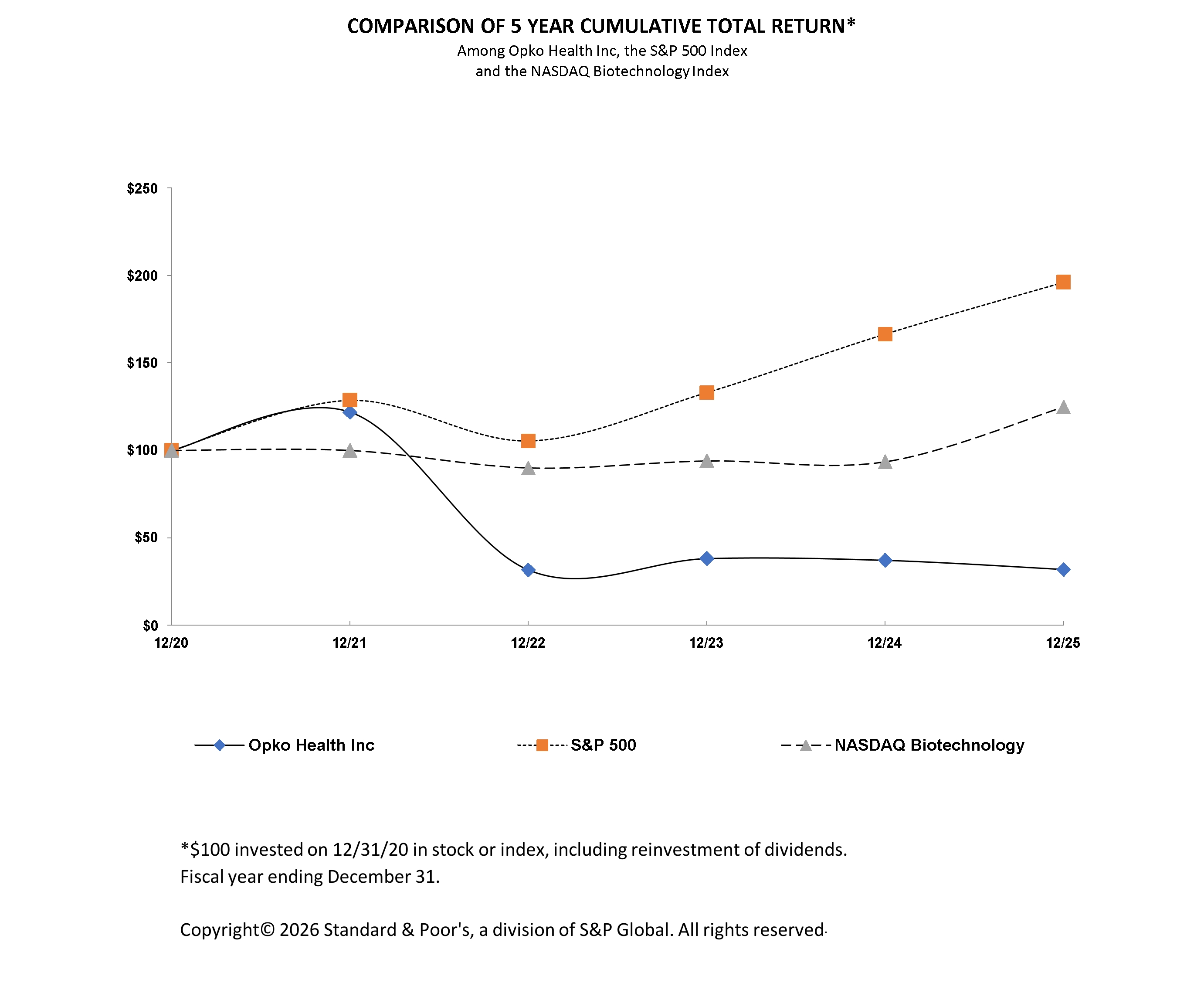
|
|
12/31/2020 |
|
|
12/31/2021 |
|
|
12/31/2022 |
|
|
12/31/2023 |
|
|
12/31/2024 |
|
|
12/31/2025 |
|
||||||
OPKO Health, Inc. |
|
$ |
100.00 |
|
|
$ |
121.77 |
|
|
$ |
31.65 |
|
|
$ |
38.23 |
|
|
$ |
37.22 |
|
|
$ |
31.90 |
|
S&P 500 |
|
|
100.00 |
|
|
|
128.71 |
|
|
|
105.40 |
|
|
|
133.10 |
|
|
|
166.40 |
|
|
|
196.16 |
|
NASDAQ Biotechnology |
|
|
100.00 |
|
|
|
100.02 |
|
|
|
89.90 |
|
|
|
94.03 |
|
|
|
93.49 |
|
|
|
124.75 |
|
ITEM 6. [Reserved].
56
ITEM 7. MANAGEMENT’S DISCUSSION AND ANALYSIS OF FINANCIAL CONDITION AND RESULTS OF OPERATIONS.
This Annual Report on Form 10-K contains forward-looking statements within the meaning of the Private Securities Litigation Reform Act of 1995 (“PSLRA”), Section 27A of the Securities Act of 1933, as amended, (the “Securities Act”), and Section 21E of the Securities Exchange Act of 1934, as amended, (the “Exchange Act”), about our expectations, beliefs, or intentions regarding our product development efforts, business, financial condition, results of operations, strategies and prospects. You can identify forward-looking statements by the fact that these statements do not relate to historical or current matters. Rather, forward-looking statements relate to anticipated or expected events, activities, trends or results and otherwise reflect our views related thereto only as of the date they are made. Because forward-looking statements relate to matters that have not yet occurred, these statements are inherently subject to risks and uncertainties that could cause our actual results to differ materially from any future results expressed or implied by the forward-looking statements. Many factors could cause our actual activities or results to differ materially from the activities and results anticipated in forward-looking statements. These factors include those contained in “Item 1A — Risk Factors” of this Annual Report on Form 10-K. We do not undertake any obligation to update forward-looking statements except as required by applicable law. We intend that all forward-looking statements be subject to the safe harbor provisions of PSLRA.
OVERVIEW
We are a diversified healthcare company that seeks to establish industry-leading positions in large and rapidly growing medical markets. Our pharmaceutical business features Somatrogon (hGH-CTP), a once-weekly human growth hormone injection. We have partnered with Pfizer Inc. (“Pfizer”) for further development and commercialization of Somatrogon (hGH-CTP). Regulatory approvals for Somatrogon (hGH-CTP) for the treatment of children and adolescents, as young as three years of age, with growth disturbance due to insufficient secretion of growth hormone, have been secured in more than 50 markets worldwide, including in the United States, European Union Member States, Japan, Canada, and Australia under the brand name NGENLA®. Also, through our pharmaceutical business, we manufacture and sell Rayaldee, an FDA approved treatment for secondary hyperparathyroidism (“SHPT”) in adults with stage 3 or 4 chronic kidney disease (“CKD”) and vitamin D insufficiency.
Our subsidiary, ModeX Therapeutics, Inc. (“ModeX”), is a biotechnology company focused on developing innovative multi-specific immune therapies for cancer and infectious disease candidates. ModeX has a robust early-stage pipeline with assets in key areas of immuno-oncology and infectious diseases, and we intend to further expand our pharmaceutical product pipeline through ModeX’s portfolio of development candidates.
Our diagnostics business, BioReference Health, LLC (“BioReference”), is a highly specialized laboratory in the United States, with a sales and marketing team focused on growth and new product integration, including the 4Kscore® test which is designed to assesses a patient's probability for prostate cancer. BioReference® offers a broad spectrum of diagnostic testing services for urology (4Kscore), and corrections nationwide, setting new standards with its industry-leading turnaround times. BioReference also provides comprehensive clinical and women’s health testing in New York and New Jersey. Our test offerings are backed by a team of board-certified medical professionals and driven by the latest healthcare guidelines and standards. We market our laboratory testing services directly to physicians, geneticists, hospitals, clinics, correctional and other health facilities. As described below, we sold certain BioReference assets to Laboratory Corporation of America Holdings (“Labcorp”) in 2024 and 2025.
We operate several established, revenue-generating pharmaceutical platforms internationally, with our principal operations located in Spain, Ireland, Chile, and Mexico. These key platforms contribute to positive cash flow and facilitate future market entry for our products currently in development. Beyond these platforms, our operations include a development and commercial supply pharmaceutical company, as well as a global supply chain operation.
Our management team possesses extensive industry experience in development, regulatory affairs, and commercialization. Their industry relationships support the identification and pursuit of commercial opportunities. Research and development activities are primarily conducted in facilities located in Weston, Massachusetts, Waterford, Ireland, Kiryat Gat, Israel, and Barcelona, Spain.
On September 15, 2025, we consummated the sale of certain assets of BioReference to Labcorp (the “Oncology Transaction”), pursuant to an agreement entered into on March 10, 2025 (the “Labcorp Oncology Purchase Agreement”). Labcorp acquired BioReference's oncology diagnostics business and related clinical testing services assets, which were part of our diagnostics segment. Upon closing, Labcorp paid an aggregate of $192.5 million in cash consideration, of which $19.2 million was deposited in escrow. The escrow is to be released to us on the 12-month anniversary of the closing date, net of any outstanding or liquidated indemnity claims. The Company may also receive up to $32.5 million in performance-based cash contingent consideration in accordance with the terms of a post-closing earnout based upon revenue generated by certain customer accounts. We recognized a gain of $101.6 million from the Oncology Transaction for the year ended December 31,
57
2025.
On September 16, 2024, we consummated the sale of certain assets of BioReference to Labcorp pursuant to an agreement entered into on March 27, 2024 (the “Labcorp Asset Purchase Agreement”). Labcorp acquired select assets of BioReference (the “BioReference Transaction”), which were part of our diagnostics segment and included BioReference's laboratory testing businesses focused on clinical diagnostics, reproductive health, and women's health across the United States, excluding BioReference's New York and New Jersey operations. Upon closing, Labcorp paid us aggregate consideration of $237.5 million, in cash, net of $23.75 million deposited in escrow. We received $24.6 million of escrow funds, including accrued interest. We recognized a gain of $121.5 million from the BioReference Transaction for the year ended December 31, 2024.
RECENT DEVELOPMENTS
Entera Collaboration Agreements
On February 4, 2026, we and our wholly owned subsidiary, OPKO Biologics, entered into an amendment to our 2025 collaboration and license agreement with Entera Bio Ltd. (“Entera”) to expand the partnership to include the development of a first-in-class oral long-acting parathyroid hormone (LA-PTH) analog for the treatment of hypoparathyroidism. This program combines the Company's proprietary long-acting PTH variants with Entera's proprietary N-Tab® oral peptide delivery technology to create a once-daily tablet intended to replace daily or weekly injections.
Under the terms of the expanded agreement, the Company and Entera will each hold a 50% pro-rata ownership interest in the LA-PTH hypoparathyroidism program and will each be responsible for 50% of the associated development costs. The companies expect to file an investigational new drug (IND) application with the FDA for the LA-PTH program in late 2026.
This expansion builds upon the existing collaboration between the parties, which includes the development of an oral oxyntomodulin (OXM) dual GLP-1/glucagon analog for metabolic and fibrotic disorders and an oral GLP-2 tablet for the treatment of short bowel syndrome. For the oral OXM program, the Company and Entera maintain a 60% and 40% ownership structure, respectively, with development costs shared on a pro-rata basis. Initial Phase 1 clinical data for the injectable formulation of OXM is expected in late 2026, with an IND filing for the oral tablet formulation to follow thereafter.
RESULTS OF OPERATIONS
Foreign Currency Exchange Rates
For the years ended December 31, 2025, 2024, and 2023, approximately 28.0%, 23.1%, and 29.6% of revenue, respectively, was denominated in currencies other than the U.S. Dollar (USD). Our financial statements are reported in USD and, accordingly, fluctuations in exchange rates affect the translation of revenues and expenses denominated in foreign currencies into USD for purposes of reporting our consolidated financial results. During the years ended December 31, 2025, 2024 and 2023, the most significant currency exchange rate exposures were to the Chilean Peso and Euro. Gross accumulated currency translation adjustments recorded as a separate component of shareholders’ equity were $17.6 million and $52.7 million at December 31, 2025 and 2024, respectively.
We are subject to foreign currency translation risk for fluctuations in exchange rates during the period of time between the consummation and cash settlement of transactions. We limit foreign currency transaction risk through hedge transactions with foreign currency forward contracts. Under these forward contracts, for any rate above or below the fixed rate, we receive or pay the difference between the spot rate and the fixed rate for the given amount at the settlement date. As of December 31, 2025, we held $13.6 million in open foreign exchange forward contracts related to inventory purchases on letters of credit, compared to zero open contracts as of December 31, 2024.
58
For The Years Ended December 31, 2025 and 2024
Our consolidated loss from operations for the years ended December 31, 2025 and 2024 was as follows:
|
|
For the years ended |
|
|
|
|
|
|
|
|||||||
(In thousands) |
|
2025 |
|
|
2024 |
|
|
Change |
|
|
% Change |
|
||||
Revenues: |
|
|
|
|
|
|
|
|
|
|
|
|
||||
Revenue from services |
|
$ |
370,275 |
|
|
$ |
480,667 |
|
|
$ |
(110,392 |
) |
|
|
(23 |
)% |
Revenue from products |
|
|
156,924 |
|
|
|
155,111 |
|
|
|
1,813 |
|
|
|
1 |
% |
Revenue from transfer of intellectual property and other |
|
|
79,680 |
|
|
|
77,364 |
|
|
|
2,316 |
|
|
|
3 |
% |
Total revenues |
|
|
606,879 |
|
|
|
713,142 |
|
|
|
(106,263 |
) |
|
|
(15 |
)% |
Costs and expenses: |
|
|
|
|
|
|
|
|
|
|
|
|
||||
Cost of revenue |
|
|
400,939 |
|
|
|
494,632 |
|
|
|
(93,693 |
) |
|
|
(19 |
)% |
Selling, general and administrative |
|
|
223,002 |
|
|
|
304,220 |
|
|
|
(81,218 |
) |
|
|
(27 |
)% |
Research and development |
|
|
124,033 |
|
|
|
105,214 |
|
|
|
18,819 |
|
|
|
18 |
% |
Amortization of intangible assets |
|
|
77,890 |
|
|
|
82,634 |
|
|
|
(4,744 |
) |
|
|
(6 |
)% |
Gain on sale of assets |
|
|
(101,576 |
) |
|
|
(121,493 |
) |
|
|
19,917 |
|
|
|
(16 |
)% |
Total costs and expenses |
|
|
724,288 |
|
|
|
865,207 |
|
|
|
(140,919 |
) |
|
|
(16 |
)% |
Loss from operations |
|
|
(117,409 |
) |
|
|
(152,065 |
) |
|
|
34,656 |
|
|
|
23 |
% |
Diagnostics
|
|
For the years ended |
|
|
|
|
|
|
|
|||||||
(In thousands) |
|
2025 |
|
|
2024 |
|
|
Change |
|
|
% Change |
|
||||
Revenues |
|
|
|
|
|
|
|
|
|
|
|
|
||||
Revenue from services |
|
$ |
370,275 |
|
|
$ |
480,667 |
|
|
$ |
(110,392 |
) |
|
|
(23 |
)% |
Total revenues |
|
|
370,275 |
|
|
|
480,667 |
|
|
|
(110,392 |
) |
|
|
(23 |
)% |
Costs and expenses: |
|
|
|
|
|
|
|
|
|
|
|
|
||||
Cost of revenue |
|
|
307,350 |
|
|
|
402,109 |
|
|
|
(94,759 |
) |
|
|
(24 |
)% |
Selling, general and administrative |
|
|
129,301 |
|
|
|
205,185 |
|
|
|
(75,884 |
) |
|
|
(37 |
)% |
Research and development |
|
|
1,637 |
|
|
|
2,075 |
|
|
|
(438 |
) |
|
|
(21 |
)% |
Amortization of intangible assets |
|
|
12,304 |
|
|
|
16,916 |
|
|
|
(4,612 |
) |
|
|
(27 |
)% |
Gain on sale of assets |
|
|
(101,576 |
) |
|
|
(121,493 |
) |
|
|
19,917 |
|
|
|
(16 |
)% |
Total costs and expenses |
|
|
349,016 |
|
|
|
504,792 |
|
|
|
(155,776 |
) |
|
|
(31 |
)% |
Income (loss) from operations |
|
|
21,259 |
|
|
|
(24,125 |
) |
|
|
45,384 |
|
|
|
188 |
% |
Revenue. Revenue from services for the year ended December 31, 2025 decreased by approximately $110.4 million, or 23.0%, compared to the year ended December 31, 2024. The decrease was driven by total reductions of $119.8 million, composed of $109.6 million reflecting the sale of BioReference's lab and oncology operations, and $10.2 million from lower clinical test volume in continuing operations, which were partially offset by a $9.4 million increase from higher clinical test reimbursement rates. In addition, revenue benefited from increased demand for the 4Kscore test, with test revenue rising approximately 13%, or $3.2 million, year over year.
Estimated collection amounts are subject to the complexities and ambiguities of billing, reimbursement regulations and claims processing, as well as considerations unique to Medicare and Medicaid programs, and require us to consider the potential for retroactive adjustments when estimating variable consideration in the recognition of revenue for the period in which the related services are rendered. For the years ended December 31, 2025 and 2024, we recorded $1.3 million and $1.5 million, respectively, of negative revenue adjustments due to changes in estimates of implicit price concessions for performance obligations satisfied in prior periods mainly due to the composition of patient payer mix.
The composition of revenue from services by payor for the years ended December 31, 2025 and 2024 was as follows:
59
|
|
For the years ended December 31, |
|
|||||
(In thousands) |
|
2025 |
|
|
2024 |
|
||
Healthcare insurers |
|
$ |
213,603 |
|
|
$ |
289,158 |
|
Government payers |
|
|
59,925 |
|
|
|
82,421 |
|
Client payers |
|
|
87,608 |
|
|
|
93,310 |
|
Patients |
|
|
9,139 |
|
|
|
15,778 |
|
Total |
|
$ |
370,275 |
|
|
$ |
480,667 |
|
Cost of revenue. Cost of revenue for the year ended December 31, 2025 decreased $94.8 million, or 23.6% compared to the year ended December 31, 2024. This decrease was predominantly driven by the absence of costs associated with divested operations following the sale of BioReference assets to Labcorp. The reduction in expenses was characterized by a significant decrease in personnel costs due to headcount reductions, as well as lower clinical activity expenses resulting from decreased consumption of materials and lower testing volumes. Furthermore, the decrease was supported by ongoing cost-reduction initiatives at BioReference and lower expenditures for freight, raw materials, and reference lab testing.
Selling, general and administrative expenses. Selling, general and administrative expenses for the years ended December 31, 2025 and 2024 were $129.3 million and $205.2 million, respectively, representing a decrease of 37.0% from the prior year. The decrease was primarily driven by lower employee-related expenses resulting from headcount reductions, as well as decreases in professional fees, technology and communication costs, and facility rental expenses. These reductions were largely attributable to costs associated with divested operations, as well as the successful execution of continued cost-reduction initiatives across the remaining ongoing operations.
Research and development expenses. The following table summarizes the components of our research and development expenses:
Research and Development Expenses |
|
For the years ended December 31, |
|
|||||
|
|
2025 |
|
|
2024 |
|
||
External expenses: |
|
|
|
|
|
|
||
Research and development employee-related expenses |
|
$ |
1,059 |
|
|
$ |
1,333 |
|
Other internal research and development expenses |
|
|
578 |
|
|
|
742 |
|
Total research and development expenses |
|
$ |
1,637 |
|
|
$ |
2,075 |
|
Research and development expenses for the years ended December 31, 2025 and 2024 were $1.6 million and $2.1 million, respectively, representing a decrease of 21.1% from the prior year. The decrease in research and development expenses was primarily due to lower employee-related expenses reflecting continued cost-reduction initiatives implemented at BioReference.
Amortization of intangible assets. Amortization of intangible assets was $12.3 million and $16.9 million for the years ended December 31, 2025 and 2024, respectively. The decrease is primarily attributable to divested operations.
Gain on sale of assets. Gain on sale of assets for the year ended December 31, 2025 and 2024 was $101.6 million and $121.5 million, respectively. These gains were due to the Oncology Transaction, which closed during the third quarter of 2025, and the BioReference Transaction, which closed during the third quarter of 2024.
Pharmaceuticals
60
|
|
For the years ended |
|
|
|
|
|
|
|
|||||||
(In thousands) |
|
2025 |
|
|
2024 |
|
|
Change |
|
|
% Change |
|
||||
Revenues: |
|
|
|
|
|
|
|
|
|
|
|
|
||||
Revenue from products |
|
$ |
156,924 |
|
|
$ |
155,111 |
|
|
$ |
1,813 |
|
|
|
1 |
% |
Revenue from transfer of intellectual property and other |
|
|
79,680 |
|
|
|
77,364 |
|
|
|
2,316 |
|
|
|
3 |
% |
Total revenues |
|
|
236,604 |
|
|
|
232,475 |
|
|
|
4,129 |
|
|
|
2 |
% |
Costs and expenses: |
|
|
|
|
|
|
|
|
|
|
|
|
||||
Cost of revenue |
|
|
93,589 |
|
|
|
92,523 |
|
|
|
1,066 |
|
|
|
1 |
% |
Selling, general and administrative |
|
|
53,866 |
|
|
|
58,007 |
|
|
|
(4,141 |
) |
|
|
(7 |
)% |
Research and development |
|
|
121,905 |
|
|
|
103,022 |
|
|
|
18,883 |
|
|
|
18 |
% |
Amortization of intangible assets |
|
|
65,586 |
|
|
|
65,718 |
|
|
|
(132 |
) |
|
|
(0 |
)% |
Total costs and expenses |
|
|
334,946 |
|
|
|
319,270 |
|
|
|
15,676 |
|
|
|
5 |
% |
Loss from operations |
|
|
(98,342 |
) |
|
|
(86,795 |
) |
|
|
(11,547 |
) |
|
|
(13 |
)% |
Revenue from products. Revenue from products for the year ended December 31, 2025 increased $1.8 million, or 1%, compared to the year ended December 31, 2024. This increase was primarily driven by a positive net foreign exchange impact of $2.9 million, resulting from a $5.0 million favorable movement in the Euro that was partially offset by a combined $2.1 million negative impact from the Mexican Peso and Chilean Peso. These gains were moderated by lower sales volumes in our international operations, specifically within our Chilean and Ireland operating companies, which were impacted by the timing of customer orders and product mix. This overall increase was also supported by a $0.8 million increase in revenue from Rayaldee, which grew to $29.8 million compared to $29.0 million in the 2024 period.
Revenue from transfer of intellectual property and other. Revenue from intellectual property and other increased by $2.3 million to $79.7 million for the year ended December 31, 2025, from $77.4 million in the same period last year. The increase was primarily driven by a $4.8 million increase from the BARDA Contract, with revenue recognized under the contract totaling $28.5 million for the year ended December 31, 2025, compared to $23.8 million for the 2024 period. Performance was further bolstered by $4.3 million in royalty revenue from Eli Lilly following the commercial launch of Mazdutide in China and a $7.2 million upfront payment from Regeneron during the 2025 period. Additionally, we saw an increase of $3.5 million in gross profit share and royalty payments from NGENLA® and Pfizer’s Genotropin® (Somatropin). These positive factors were partially offset by the absence of $12.5 million milestone payment from Merck in the 2024 period and a $2.8 million decrease in contract manufacturers’ commercial milestones.
Cost of revenue. Cost of revenue for the year ended December 31, 2025 increased by 1% to $93.6 million compared to $92.5 million for the year ended December 31, 2024. This was primarily driven by shifts in product mix due to the timing of customer orders from our international operating companies, which included an inventory reserve expense of $4.1 million for 2025 compared to $2.1 million for 2024. These factors were partially offset by a decrease in product costs resulting from lower sales volumes across our international operations, specifically within our Chilean and Ireland operations.
Selling, general and administrative expenses. Selling, general and administrative expenses for the years ended December 31, 2025 and 2024 were $53.9 million and $58.0 million, respectively, representing a decrease of 7% from the prior year. The decrease in selling, general and administrative expenses was primarily driven by lower employee-related expenses resulting from operational efficiencies, particularly impacting the Rayaldee commercial operations. This was further aided by a reduction in costs from international operations, which reflected lower professional fees, primarily related to tax litigation.
Research and development expenses. Research and development expenses for the years ended December 31, 2025 and 2024 were $121.9 million and $103.0 million, respectively, representing an increase of 18% from the prior year. Research and development expenses include external and internal expenses, partially offset by third-party grants and funding arising from collaboration agreements. External expenses include clinical and non-clinical activities performed by contract research organizations, lab services, purchases of drug and diagnostic product materials and manufacturing development costs. We track external research and development expenses by individual program for phase 3 clinical trials for drug approval and premarket approval for diagnostics tests, if any. Internal expenses include employee-related expenses such as salaries, benefits and equity-based compensation expense. Other internal research and development expenses are incurred to support overall research and development activities and include expenses related to general overhead and facilities.
The following table summarizes the components of our research and development expenses:
61
Research and Development Expenses |
|
For the years ended December 31, |
|
|||||
|
|
2025 |
|
|
2024 |
|
||
External expenses: |
|
|
|
|
|
|
||
Manufacturing expense for biological products |
|
$ |
46,439 |
|
|
$ |
37,394 |
|
Phase 3 studies |
|
|
13 |
|
|
|
1,239 |
|
Post-marketing studies |
|
|
95 |
|
|
|
713 |
|
Earlier-stage programs |
|
|
29,528 |
|
|
|
29,882 |
|
Research and development employee-related expenses |
|
|
40,784 |
|
|
|
37,650 |
|
Other internal research and development expenses |
|
|
8,133 |
|
|
|
8,036 |
|
Third-party grants and funding from collaboration agreements |
|
|
(3,087 |
) |
|
|
(11,892 |
) |
Total research and development expenses |
|
$ |
121,905 |
|
|
$ |
103,022 |
|
Research and development expenses for the year ended December 31, 2025 increased primarily due to higher manufacturing expenses for biological products, including costs incurred under the BARDA Contract, and higher employee‑related expenses due to an increase in headcount, primarily at ModeX. Additionally, the increase reflected lower third-party grants and funding from collaboration agreements compared to the prior year. These funds consist primarily of reimbursements from Merck for development costs related to the Epstein-Barr Virus (EBV) program. Much of the Phase 1 work for this program was done in 2024 and successfully completed in 2025. These increases were partially offset by a modest decrease in spending on earlier-stage programs as resources were prioritized toward advancing these key clinical initiatives.
Amortization of intangible assets. Amortization of intangible assets was $65.6 million and $65.7 million, respectively, for the years ended December 31, 2025 and 2024. Amortization expense reflects the amortization of acquired intangible assets with defined useful lives. Our indefinite lived IPR&D assets will not be amortized until the underlying development programs are completed. Upon obtaining regulatory approval, IPR&D assets will be accounted for as a finite-lived intangible asset and amortized on a straight-line basis over its estimated useful life of approximately 12 years.
Corporate
|
|
For the years ended |
|
|
|
|
|
|
|
|||||||
(In thousands) |
|
2025 |
|
|
2024 |
|
|
Change |
|
|
% Change |
|
||||
Costs and expenses: |
|
|
|
|
|
|
|
|
|
|
|
|
||||
Selling, general and administrative |
|
$ |
39,835 |
|
|
$ |
41,028 |
|
|
$ |
(1,193 |
) |
|
|
(3 |
)% |
Research and development |
|
|
491 |
|
|
|
117 |
|
|
|
374 |
|
|
|
320 |
% |
Total costs and expenses |
|
|
40,326 |
|
|
|
41,145 |
|
|
|
(819 |
) |
|
|
(2 |
)% |
Loss from operations |
|
$ |
(40,326 |
) |
|
$ |
(41,145 |
) |
|
$ |
819 |
|
|
|
2 |
% |
Operating loss for our unallocated corporate operations for the years ended December 31, 2025 and 2024 was $40.3 million and $41.1 million, respectively, and principally reflects general and administrative expenses incurred in connection with our corporate operations. The decrease in operating loss was primarily due to lower employee-related expenses.
Other
Interest income. Interest income for the years ended December 31, 2025 and 2024 was $14.8 million and $8.4 million, respectively. The increase in interest income is driven by interest earned on our larger cash investment.
Interest expense. Interest expense for the years ended December 31, 2025 and 2024 was $108.5 million and $47.5 million, respectively. The increase was primarily attributable to $59.1 million from the amortization of $54.7 million in unamortized debt discount and $4.4 million in debt issuance costs related to the Note Exchange Transactions (as defined in Note 7 of the Consolidated Financial Statements). In addition, interest expense was impacted by interest incurred on the 2029 Convertible Notes and the 2044 Notes (both as defined in Note 7 of the Consolidated Financial Statements), including amortization of deferred financing and debt issuance costs.
Fair value changes of derivative instruments, net. Fair value changes of derivative instruments, net for the years ended December 31, 2025 and 2024 were $0.4 million of expense and $26.2 million reversal of expense, respectively. Derivative
62
expense was principally related to the change in fair value of the 2029 Convertible Notes and of foreign currency forward exchange contracts at OPKO Chile.
Other income (expense), net. Other income (expense), net for the years ended December 31, 2025 and 2024, was ($29.9) million of expense and $206.9 million of income, respectively. The decrease was primarily related to our GeneDx (as defined in Note 5 to the Consolidated Financial Statements) investment; we recognized $204.5 million of income for the year ended December 31, 2024, which included $140.0 million reflecting an increase in the fair value of our investment (primarily unrealized gains) and $64.5 million from the sale of GeneDx shares. The decrease was also caused by the inclusion of $32.6 million in inducement expense related to the Note Exchange Transactions for the year ended December 31, 2025. Furthermore, a foreign currency loss of $2.0 million was recorded in the 2025, compared with a loss of $3.8 million recorded in 2024 and were further impacted by a net increase from other non-operating income and expense items.
Income tax benefit (provision). Our income tax benefit (provision) for the years ended December 31, 2025 and 2024 was $15.7 million and ($42.8 million), respectively. The $58.6 million increase in income tax benefit was primarily a result of the discrete, non-recurring tax expenses related to the BioReference Transaction and the Oncology Transaction. While the U.S. federal statutory income tax rate is 21%, our consolidated effective tax rate for both periods differed from this rate primarily due to the relative mix of earnings and losses generated in the U.S. versus foreign tax jurisdictions, as well as the operating results in tax jurisdictions which do not result in a tax benefit.
Loss from investments in investees. We have invested in certain early stage companies that we believe have valuable proprietary technology and significant potential to create value for us as an equity holder. We account for these investments under the equity method of accounting, resulting in the recording of our proportionate share of their losses until our share of their loss exceeds our investment. Until the investees’ technologies are commercialized, if ever, we anticipate they will report net losses. Loss from investments in investees was $29.0 thousand and $18.0 thousand for the years ended December 31, 2025 and 2024, respectively.
For The Years Ended December 31, 2024 and 2023
Our consolidated income (loss) from operations for the years ended December 31, 2024 and 2023 is as follows:
|
|
For the years ended |
|
|
|
|
|
|
|
|||||||
(In thousands) |
|
2024 |
|
|
2023 |
|
|
Change |
|
|
% Change |
|
||||
Revenues: |
|
|
|
|
|
|
|
|
|
|
|
|
||||
Revenue from services |
|
$ |
480,667 |
|
|
$ |
515,275 |
|
|
$ |
(34,608 |
) |
|
|
(7 |
)% |
Revenue from products |
|
|
155,111 |
|
|
|
167,557 |
|
|
|
(12,446 |
) |
|
|
(7 |
)% |
Revenue from transfer of intellectual property and other |
|
|
77,364 |
|
|
|
180,663 |
|
|
|
(103,299 |
) |
|
|
(57 |
)% |
Total revenues |
|
|
713,142 |
|
|
|
863,495 |
|
|
|
(150,353 |
) |
|
|
(17 |
)% |
Costs and expenses: |
|
|
|
|
|
|
|
|
|
|
|
|
||||
Cost of revenue |
|
|
494,632 |
|
|
|
545,368 |
|
|
|
(50,736 |
) |
|
|
(9 |
)% |
Selling, general and administrative |
|
|
304,220 |
|
|
|
300,559 |
|
|
|
3,661 |
|
|
|
1 |
% |
Research and development |
|
|
105,214 |
|
|
|
89,593 |
|
|
|
15,621 |
|
|
|
17 |
% |
Contingent consideration |
|
|
— |
|
|
|
(1,036 |
) |
|
|
1,036 |
|
|
|
100 |
% |
Amortization of intangible assets |
|
|
82,634 |
|
|
|
86,032 |
|
|
|
(3,398 |
) |
|
|
(4 |
)% |
Gain on sale of assets |
|
|
(121,493 |
) |
|
|
— |
|
|
|
(121,493 |
) |
|
|
(100 |
)% |
Total costs and expenses |
|
|
865,207 |
|
|
|
1,020,516 |
|
|
|
(155,309 |
) |
|
|
(15 |
)% |
Loss from operations |
|
|
(152,065 |
) |
|
|
(157,021 |
) |
|
|
4,956 |
|
|
|
(3 |
)% |
Diagnostics
63
|
|
For the years ended |
|
|
|
|
|
|
|
|||||||
(In thousands) |
|
2024 |
|
|
2023 |
|
|
Change |
|
|
% Change |
|
||||
Revenues |
|
|
|
|
|
|
|
|
|
|
|
|
||||
Revenue from services |
|
$ |
480,667 |
|
|
$ |
515,275 |
|
|
|
(34,608 |
) |
|
|
(7 |
)% |
Total revenues |
|
|
480,667 |
|
|
|
515,275 |
|
|
|
(34,608 |
) |
|
|
(7 |
)% |
Costs and expenses: |
|
|
|
|
|
|
|
|
|
|
|
|
||||
Cost of revenue |
|
|
402,109 |
|
|
|
445,827 |
|
|
|
(43,718 |
) |
|
|
(10 |
)% |
Selling, general and administrative |
|
|
205,185 |
|
|
|
202,341 |
|
|
|
2,844 |
|
|
|
1 |
% |
Research and development |
|
|
2,075 |
|
|
|
2,508 |
|
|
|
(433 |
) |
|
|
(17 |
)% |
Amortization of intangible assets |
|
|
16,916 |
|
|
|
20,195 |
|
|
|
(3,279 |
) |
|
|
(16 |
)% |
Gain on sale of assets |
|
|
(121,493 |
) |
|
|
— |
|
|
|
(121,493 |
) |
|
|
(100 |
)% |
Total costs and expenses |
|
|
504,792 |
|
|
|
670,871 |
|
|
|
(166,079 |
) |
|
|
(25 |
)% |
Loss from operations |
|
|
(24,125 |
) |
|
|
(155,596 |
) |
|
|
131,471 |
|
|
|
84 |
% |
Revenue. Revenue from services for the year ended December 31, 2024 decreased by approximately $34.6 million, or 7%, compared to the year ended December 31, 2023. This decrease was primarily due to a $42.5 million decrease in clinical test volume, largely attributable to the BioReference Transaction, offset by a $7.9 million increase in clinical test reimbursement rates.
Estimated collection amounts are subject to the complexities and ambiguities of billing, reimbursement regulations and claims processing, as well as considerations unique to Medicare and Medicaid programs, and require us to consider the potential for retroactive adjustments when estimating variable consideration in the recognition of revenue for the period in which the related services are rendered. For the years ended December 31, 2024 and 2023, we recorded $1.5 million and $19.2 million, respectively, of negative revenue adjustments due to changes in estimates of implicit price concessions for performance obligations satisfied in prior periods mainly due to the composition of patient payer mix.
The composition of revenue from services by payor for the years ended December 31, 2024 and 2023 was as follows:
|
|
For the years ended December 31, |
|
|||||
(In thousands) |
|
2024 |
|
|
2023 |
|
||
Healthcare insurers |
|
$ |
289,158 |
|
|
$ |
315,560 |
|
Government payers |
|
|
82,421 |
|
|
|
82,502 |
|
Client payers |
|
|
93,310 |
|
|
|
100,171 |
|
Patients |
|
|
15,778 |
|
|
|
17,042 |
|
Total |
|
$ |
480,667 |
|
|
$ |
515,275 |
|
Cost of revenue. Cost of revenue for the year ended December 31, 2024 decreased $43.7 million, a decrease of 10% compared to the year ended December 31, 2023. Cost of revenue decreased primarily due to lower employee headcount, reflecting our continued cost-reduction initiatives implemented at BioReference, changes in the mix of testing ordered during the period, and by a decrease in consumption reflecting the timing of the BioReference Transaction.
Selling, general and administrative expenses. Selling, general and administrative expenses for the years ended December 31, 2024 and 2023 were $205.2 million and $202.3 million, respectively, representing an increase of 1% from the prior period. The increase in expense is primarily related to $26.3 million in severance charges associated with cost reduction initiatives and $9.7 million in adjustments to the life of certain leases. This was partially offset by continued cost-reduction initiatives at BioReference, which included a reduction in employee headcount and the streamlining of certain smaller operations, resulting in an overall decrease in employee-related expenses and other operating efficiencies. The divestiture of certain laboratory operations also contributed to the reduction in employee-related expenses.
Research and development expenses. The following table summarizes the components of our research and development expenses:
64
Research and Development Expenses |
|
For the years ended December 31, |
|
|||||
|
|
2024 |
|
|
2023 |
|
||
External expenses: |
|
|
|
|
|
|
||
Research and development employee-related expenses |
|
$ |
1,333 |
|
|
$ |
1,729 |
|
Other internal research and development expenses |
|
|
742 |
|
|
|
779 |
|
Total research and development expenses |
|
$ |
2,075 |
|
|
$ |
2,508 |
|
The decrease in research and development expenses for the year ended December 31, 2024 was primarily due to a decrease in employee-related expenses as a result of the continued cost-reduction initiatives implemented at BioReference and the BioReference Transaction.
Amortization of intangible assets. Amortization of intangible assets was $16.9 million and $20.2 million for the years ended December 31, 2024 and 2023, respectively. The decrease is primarily attributable to the BioReference Transaction, which impacted the amount of amortizable intangible assets.
Gain on sale of assets. Gain on sale of assets for the year ended December 31, 2024 was $121.5 million due to the BioReference Transaction which closed during the third quarter of 2024.
Pharmaceuticals
|
|
For the years ended |
|
|
|
|
|
|
|
|||||||
(In thousands) |
|
2024 |
|
|
2023 |
|
|
Change |
|
|
% Change |
|
||||
Revenues: |
|
|
|
|
|
|
|
|
|
|
|
|
||||
Revenue from products |
|
$ |
155,111 |
|
|
$ |
167,557 |
|
|
$ |
(12,446 |
) |
|
|
(7 |
)% |
Revenue from transfer of intellectual property and other |
|
|
77,364 |
|
|
|
180,663 |
|
|
|
(103,299 |
) |
|
|
(57 |
)% |
Total revenues |
|
|
232,475 |
|
|
|
348,220 |
|
|
|
(115,745 |
) |
|
|
(33 |
)% |
Costs and expenses: |
|
|
|
|
|
|
|
|
|
|
|
|
||||
Cost of revenue |
|
|
92,523 |
|
|
|
99,541 |
|
|
|
(7,018 |
) |
|
|
(7 |
)% |
Selling, general and administrative |
|
|
58,007 |
|
|
|
55,687 |
|
|
|
2,320 |
|
|
|
4 |
% |
Research and development |
|
|
103,022 |
|
|
|
87,007 |
|
|
|
16,015 |
|
|
|
18 |
% |
Contingent consideration |
|
|
— |
|
|
|
(1,036 |
) |
|
|
1,036 |
|
|
|
100 |
% |
Amortization of intangible assets |
|
|
65,718 |
|
|
|
65,837 |
|
|
|
(119 |
) |
|
|
(0 |
)% |
Total costs and expenses |
|
|
319,270 |
|
|
|
307,036 |
|
|
|
12,234 |
|
|
|
4 |
% |
(Loss) income from operations |
|
|
(86,795 |
) |
|
|
41,184 |
|
|
|
(127,979 |
) |
|
|
311 |
% |
Revenue from products. Revenue from products for the year ended December 31, 2024 decreased $12.5 million, or 7%, compared to the year ended December 31, 2023. The decrease in product revenue was primarily driven by unfavorable foreign exchange fluctuations of approximately $8.9 million from our international operations and a $2.0 million decrease in Rayaldee sales. While we experienced higher sales volumes in 2024 compared to 2023, this increase was more than offset by unfavorable foreign exchange fluctuations. Revenue from sales of Rayaldee for the year ended December 31, 2024, was $29.0 million compared to $31.0 million for the year ended December 31, 2023.
Revenue from transfer of intellectual property and other. For the year ended December 31, 2024, we recorded $77.4 million in revenue from the transfer of intellectual property and other. Revenue for the year ended December 31, 2024 principally reflects $30.0 million from Pfizer, which includes $28.3 million from gross profit share and royalty payments for both NGENLA® and Pfizer's Genotropin®. Revenue in 2024 also included $23.8 million from the BARDA Contract, a $12.5 million milestone payment from Merck, and $10.2 million from contract manufacturers' commercial milestones. In comparison, for the year ended December 31, 2023, we recorded $180.7 million in revenue from the transfer of intellectual property and other. This was primarily driven by a $90.0 million milestone payment, triggered by the FDA approval of NGENLA®, and $26.7 million in revenue that included $22.6 million from gross profit share and royalty payments for both NGENLA® and Pfizer's Genotropin®. In 2023, revenue also included $50.0 million from Merck in consideration for the rights granted to Merck under the Merck Agreement, $7.0 million from VFMCRP triggered by the German price approval for Rayaldee, $2.5 million from Nicoya due to Nicoya's submission of the investigational new drug application to China's Center for Drug Evaluation, $2.4 million from contract manufacturers' commercial milestones and $1.2 million from the BARDA Contract.
65
Cost of revenue. Cost of revenue for the year ended December 31, 2024 decreased by 7% to $92.5 million compared to $99.5 million for the year ended December 31, 2023, which was primarily driven by favorable foreign exchange fluctuations. Despite increased sales volumes during 2024, which typically increases cost of revenue, we were able to limit this increase due to a combination of factors, including favorable foreign currency fluctuations and a reduction in Rayaldee's cost of revenue. Favorable foreign currency fluctuations positively impacted cost of revenue by approximately $6.1 million. The reduction in Rayaldee's cost of revenue resulted from a lower standard cost per bottle, achieved through ongoing process improvements and favorable raw material pricing.
Selling, general and administrative expenses. Selling, general and administrative expenses for the years ended December 31, 2024 and 2023 were $58.0 million and $55.7 million, respectively, representing an increase of 4% from the prior year period. The increase in selling, general and administrative expenses was due to higher employee-related, professional, and legal expenses related to our international operations.
Research and development expenses. Research and development expenses for the years ended December 31, 2024 and 2023 were $103.0 million and $87.0 million, respectively, representing an increase of 18% from the prior year. Research and development expenses include external and internal expenses, partially offset by third-party grants and funding arising from collaboration agreements. External expenses include clinical and non-clinical activities performed by contract research organizations, lab services, purchases of drug and diagnostic product materials and manufacturing development costs. We track external research and development expenses by individual program for phase 3 clinical trials for drug approval and premarket approval for diagnostics tests, if any. Internal expenses include employee-related expenses such as salaries, benefits and equity-based compensation expense. Other internal research and development expenses are incurred to support overall research and development activities and include expenses related to general overhead and facilities.
The following table summarizes the components of our research and development expenses:
Research and Development Expenses |
|
For the years ended December 31, |
|
|||||
|
|
2024 |
|
|
2023 |
|
||
External expenses: |
|
|
|
|
|
|
||
Manufacturing expense for biological products |
|
$ |
37,394 |
|
|
$ |
14,687 |
|
Phase 3 studies |
|
|
1,239 |
|
|
|
4,414 |
|
Post-marketing studies |
|
|
713 |
|
|
|
591 |
|
Earlier-stage programs |
|
|
29,882 |
|
|
|
45,476 |
|
Research and development employee-related expenses |
|
|
37,650 |
|
|
|
33,719 |
|
Other internal research and development expenses |
|
|
8,036 |
|
|
|
4,894 |
|
Third-party grants and funding from collaboration agreements |
|
|
(11,892 |
) |
|
|
(16,774 |
) |
Total research and development expenses |
|
$ |
103,022 |
|
|
$ |
87,007 |
|
Research and development expenses for the year ended December 31, 2024, increased primarily due to growth in our BARDA collaboration and higher employee-related expenses. These increases were partially offset by a one-time payment to Sanofi of $12.5 million made in 2023 pursuant to the Sanofi In-License Agreement, which was triggered as a result of the Merck Agreement, and lower costs related to Somatrogon (hGH-CTP) following the closure of open-label extension studies in countries where it has received marketing authorization.
Contingent consideration. Contingent consideration for the year ended December 31, 2023 reflected a reversal of expense of $1.0 million. This was primarily attributable to changes in assumptions regarding the timing of achievement of future milestones for OPKO Renal, and potential amounts payable to former stockholders of OPKO Renal in connection therewith, pursuant to our acquisition agreement in March 2013. We recorded no contingent consideration for the year ended December 31, 2024.
Amortization of intangible assets. Amortization of intangible assets was $65.7 million and $65.8 million, respectively, for the years ended December 31, 2024 and 2023. Amortization expense reflects the amortization of acquired intangible assets with defined useful lives. Our indefinite lived IPR&D assets will not be amortized until the underlying development programs are completed. Upon obtaining regulatory approval, IPR&D assets will be accounted for as a finite-lived intangible asset and amortized on a straight-line basis over its estimated useful life of approximately 12 years.
66
Corporate
|
|
For the years ended |
|
|
|
|
|
|
|
|||||||
(In thousands) |
|
2024 |
|
|
2023 |
|
|
Change |
|
|
% Change |
|
||||
Costs and expenses: |
|
|
|
|
|
|
|
|
|
|
|
|
||||
Selling, general and administrative |
|
$ |
41,028 |
|
|
$ |
42,531 |
|
|
$ |
(1,503 |
) |
|
|
(4 |
)% |
Research and development |
|
|
117 |
|
|
|
78 |
|
|
|
39 |
|
|
|
50 |
% |
Total costs and expenses |
|
|
41,145 |
|
|
|
42,609 |
|
|
|
(1,464 |
) |
|
|
(3 |
)% |
Loss from operations |
|
$ |
(41,145 |
) |
|
$ |
(42,609 |
) |
|
$ |
1,464 |
|
|
|
3 |
% |
Operating loss for our unallocated corporate operations for the years ended December 31, 2024 and 2023 was $41.4 million and $42.6 million, respectively, and principally reflect general and administrative expenses incurred in connection with our corporate operations.
Other
Interest income. Interest income for the years ended December 31, 2024 and 2023 was $8.4 million and $4.0 million, respectively. The increase reflects higher average cash and investment balances as a result of the cash received from the BioReference Transaction, the issuance of the 2044 Notes, and the sale of common stock of GeneDx Holdings Corp. (formerly, Sema4 Holdings Corp., (“GeneDx Holdings”). We originally acquired shares of GeneDx Holdings in the 2022 disposition of our former subsidiary, GeneDx LLC (“GeneDx”) and subsequently acquired additional shares in an underwritten offering by GeneDx Holdings.
Interest expense. Interest expense for the years ended December 31, 2024 and 2023 was $47.5 million and $13.5 million, respectively. The increase was primarily driven by interest incurred on the 2029 Convertible Notes (as defined below) and the 2044 Notes, including amortization of deferred financing and debt issuance costs. This increase was partially offset by the extinguishment of our outstanding 2023 Convertible Notes (as defined below) in connection with their exchange for 2029 Convertible Notes and the repurchase of a significant portion of the outstanding 2025 Notes (as defined in Note 7 of the Consolidated Financial Statements) using a portion of the net proceeds from the issuance of 2029 Convertible Notes.
Fair value changes of derivative instruments, net. Fair value changes of derivative instruments, net for the years ended December 31, 2024 and 2023 were $26.2 million of expense and $0.8 million reversal of expense, respectively. Derivative expense for the years ended December 31, 2024 and 2023 was principally related to the change in fair value of the 2029 Convertible Notes and of foreign currency forward exchange contracts at OPKO Chile.
Other income (expense), net. Other income (expense), net for the years ended December 31, 2024 and 2023, was $206.9 million and ($17.0 million), respectively. The increase in 2024 was primarily driven by a $140.0 million gain related to the change in fair value of our investment in GeneDx Holdings and a $64.5 million gain from the sale of 2,937,762 shares of GeneDx Holdings. In 2023, the expense was primarily due to a $23.0 million loss related to the change in fair value of our investment in GeneDx Holdings, partially offset by a $6.7 million gain resulting from GeneDx Holdings achieving specific revenue target milestones. Foreign currency fluctuations resulted in a $3.8 million loss in 2024 and a $1.2 million gain in 2023.
Income tax benefit (provision). Our income tax benefit (provision) for the years ended December 31, 2024 and 2023 was ($42.8 million) and ($4.4 million), respectively. For the year ended December 31, 2024, the tax rate differed from the U.S. federal statutory rate of 21% primarily due to the relative mix in earnings and losses in the U.S. versus foreign tax jurisdictions, impact related to the BioReference Transaction, the impact of the payments under Merck Agreement, the impact of sales of the GeneDx investment, and operating results in tax jurisdictions which do not result in a tax benefit.
Loss from investments in investees. We have invested in certain early stage companies that we believe have valuable proprietary technology and significant potential to create value for us as an equity holder. We account for these investments under the equity method of accounting, resulting in the recording of our proportionate share of their losses until our share of their loss exceeds our investment. Until the investees’ technologies are commercialized, if ever, we anticipate they will report net losses. Loss from investments in investees was $18.0 thousand and $107.0 thousand for the years ended December 31, 2024 and 2023, respectively.
67
LIQUIDITY AND CAPITAL RESOURCES
At December 31, 2025, we had cash, cash equivalents and restricted cash of approximately $382.7 million. Cash used in operations of $178.5 million for year ended December 31, 2025 principally reflected general and administrative expenses related to our corporate operations, research and development activities and sales and marketing activities related to our pharmaceutical and diagnostic business. Cash provided by investing activities was $230.3 million for the year ended December 31, 2025, primarily reflecting $197.8 million in total proceeds from the BioReference Transaction and Oncology Transaction, inclusive of escrow released, and $52.2 million from the sale of equity securities, offset by a $7.7 million investment in Entera and $13.0 million in capital expenditures. Cash used in financing activities of $118.1 million primarily reflected both the repurchase of Common Stock for $47.0 million and the 2029 Convertible 144A Notes for $62.2 million, as well as net repayments on our lines of credit of $7.9 million. We have historically not generated sustained positive cash flow sufficient to offset our operating and other expenses, and our primary sources of cash have been from the public and private placement of equity and debt, as well as credit facilities available to us.
On September 15, 2025, the Company consummated the Oncology Transaction, pursuant to which Labcorp acquired BioReference's oncology diagnostics and related clinical testing services assets. Labcorp paid to the Company aggregate consideration of $192.5 million, consisting of $173.3 million in cash and an escrow of $19.2 million, subject to certain adjustments as set forth in the Labcorp Oncology Purchase Agreement.
On April 4, 2025, the Company announced that its Board of Directors has authorized an increase of $100.0 million to the Company’s existing Common Stock repurchase program, bringing the aggregate capacity of the program to $200.0 million. As of December 31, 2025, approximately $50.6 million shares of Common Stock had been repurchased under the program since its authorization in July 2024. Under this program, the Company may repurchase shares from time to time through various methods, including open market purchases, block trades, privately negotiated transactions, accelerated share repurchases, as well as pursuant to pre-set trading plans meeting the requirements of Rule 10b5-1(c) of the Exchange Act, and otherwise in compliance with applicable laws. The timing and amount of any repurchases is subject to general market conditions, the Company's capital management, investment opportunities, and other factors. The repurchase program does not obligate the Company to repurchase any specific number of shares, has no time limit, and may be modified, suspended, or discontinued at any time at the Company's discretion.
On April 1, 2025, the Company consummated the Note Exchange Transactions related to its 2029 Convertible 144A Notes. In total, the Company exchanged $159,221,000 aggregate principal amount of the 2029 Convertible 144A Notes for 121,437,998 shares of Common Stock and cash payments totaling approximately $63.5 million, inclusive of accrued and unpaid interest. The exchanged 2029 Convertible 144A Notes were subsequently retired. As of December 31,2025, approximately $85.0 million aggregate principal amount of our 2029 Convertible Notes, which bear interest at 3.75% per annum, remained outstanding. See Note 7 to our Consolidated Financial Statements.
During the first quarter of 2025, the Company sold its entire holding of 620 thousand shares of GeneDx common stock at various prices per share for approximately $51.7 million in aggregate proceeds. As a result of these sales, the Company no longer holds shares in GeneDx.
In September 2024, ModeX entered into two amendments to modify the scope and funding of the BARDA Contract. The BARDA Amendments structured the funding thereunder as cost-plus-fixed-fee, which included a $26.9 million supplement to further advance the development of COVID-19 multispecific antibodies and provided $24.1 million for the development of a multispecific protein antibody for influenza or another pathogen. In December 2025, the Company entered into a further bilateral modification to de-scope all mRNA development-related efforts using SARS-CoV-2 as an antigen model, as these activities were no longer a priority for the U.S. Department of Health and Human Services. As a result, the total value of the BARDA Contract decreased from $110.0 million to $103.5 million, and the total potential value of the overall contract, inclusive of all options, decreased from $205.0 million to $198.5 million. As of December 31, 2025, the aggregate amount of transaction price allocated to remaining performance obligations, excluding unexercised contract options, was $49.9 million.
On July 17, 2024, we completed a private offering of $250 million aggregate principal amount of the 2044 Notes in accordance with the terms of the 2044 Note Purchase Agreement. The 2044 Notes are secured by the Company’s profit share payments from Pfizer under the Restated Pfizer Agreement. The 2044 Notes bear interest at the 3-month SOFR plus 7.5%, subject to a minimum interest rate of 4.0% per annum. The 2044 Notes mature in July 2044, with interest-only payments required for the first four years.
As of December 31, 2025, the total commitments under our lines of credit with financial institutions in Chile and Spain were $30.4 million, of which $8.5 million was drawn as of December 31, 2025. On December 31, 2025, the weighted
68
average interest rate on these lines of credit was approximately 5.5%. These lines of credit are short-term and are used primarily as a source of working capital. The highest aggregate principal balance at any time outstanding during the year ended December 31, 2025 was $14.3 million. We intend to continue to draw under these lines of credit as needed. There is no assurance that these lines of credit or other funding sources will be available to us on acceptable terms, or at all, in the future.
Our liquidity would be impacted by the successful achievement of various milestones and the generation of royalty revenues under our existing collaboration and licensing agreements. We can provide no assurance that any of the following milestones or royalties will be achieved or earned. As of December 31, 2025, the historical and potential payments from these agreements were as follows:
Merck Agreement:
Restated Pfizer Agreement:
VFMCRP Agreement:
Nicoya Agreement:
Eli Lilly Agreement:
69
The timing and ultimate receipt of these milestone and royalty payments are subject to the achievement of the specified events and certain risks and uncertainties inherent in drug development and commercialization. For further discussion of these risks, please refer to “Item 1A – Risk Factors”.
We believe that the cash, cash equivalents and restricted cash on hand on December 31, 2025 are sufficient to meet our anticipated cash requirements for operations and debt service beyond the next 12 months. We based this estimate on assumptions that may prove to be wrong or are subject to change, and we may be required to use our available cash resources sooner than we currently expect. If we acquire additional assets or companies, accelerate our product development programs or initiate additional clinical trials, we will need additional funds. Our future cash requirements, and the timing of those requirements, will depend on a number of factors, including the approval and success of our products and products in development, particularly our long acting Somatrogon (hGH-CTP) for which we have received approval in over 50 markets, including the United States, Europe, Japan, Australia and Canada, the commercial success of Rayaldee, the commercial launch of Mazdutide by our partners, BioReference’s financial performance, possible acquisitions and dispositions, the continued progress of research and development of our product candidates, the timing and outcome of clinical trials and regulatory approvals, the costs involved in preparing, filing, prosecuting, maintaining, defending, and enforcing patent claims and other intellectual property rights, the status of competitive products, the availability of financing, our success in developing markets for our product candidates and results of government investigations, payor claims, existing legal proceedings (including the ITA litigation) and those that may arise in the future. We have historically not generated sustained positive cash flow and if we are not able to secure additional funding when needed, we may have to delay, reduce the scope of, or eliminate one or more of our clinical trials or research and development programs or possible acquisitions or reduce our marketing or sales efforts or cease operations.
The following table provides information as of December 31, 2025, with respect to the amounts and timing of our known contractual obligation payments due by period.
Contractual obligations |
|
|
|
|
|
|
|
|
|
|
|
|
|
|
|
|
|
|
|
|
|
|||||||
(In thousands) |
|
2026 |
|
|
2027 |
|
|
2028 |
|
|
2029 |
|
|
2030 |
|
|
Thereafter |
|
|
Total |
|
|||||||
Open purchase orders |
|
$ |
32,953 |
|
|
$ |
108 |
|
|
$ |
— |
|
|
$ |
— |
|
|
$ |
— |
|
|
$ |
— |
|
|
$ |
33,061 |
|
Operating leases |
|
|
10,917 |
|
|
|
9,075 |
|
|
|
7,593 |
|
|
|
6,099 |
|
|
|
4,832 |
|
|
|
9,216 |
|
|
|
47,732 |
|
Finance leases |
|
|
1,690 |
|
|
|
1,172 |
|
|
|
214 |
|
|
|
211 |
|
|
|
211 |
|
|
|
1,585 |
|
|
|
5,083 |
|
2029 and 2033 Convertible Notes |
|
|
— |
|
|
|
— |
|
|
|
— |
|
|
|
84,970 |
|
|
|
— |
|
|
|
50 |
|
|
|
85,020 |
|
2044 Notes |
|
|
— |
|
|
|
— |
|
|
|
— |
|
|
|
— |
|
|
|
— |
|
|
|
246,433 |
|
|
|
246,433 |
|
Mortgages and other debts payable |
|
|
1,736 |
|
|
|
862 |
|
|
|
879 |
|
|
|
521 |
|
|
|
— |
|
|
|
— |
|
|
|
3,998 |
|
Lines of credit |
|
|
10,251 |
|
|
|
— |
|
|
|
— |
|
|
|
— |
|
|
|
— |
|
|
|
— |
|
|
|
10,251 |
|
Interest commitments |
|
|
4,670 |
|
|
|
4,652 |
|
|
|
4,647 |
|
|
|
193 |
|
|
|
— |
|
|
|
— |
|
|
|
14,162 |
|
Total |
|
$ |
62,217 |
|
|
$ |
15,869 |
|
|
$ |
13,333 |
|
|
$ |
91,994 |
|
|
$ |
5,043 |
|
|
$ |
257,284 |
|
|
$ |
445,740 |
|
The preceding table does not include information where the amounts of the obligations are not currently determinable, including the following:
CRITICAL ACCOUNTING POLICIES AND ESTIMATES
Use of estimates. The preparation of financial statements in conformity with accounting principles generally accepted in the U.S. requires management to make estimates and assumptions that affect the reported amounts of assets and liabilities and disclosure of contingent assets and liabilities at the date of the financial statements and the reported amounts of revenues and expenses during the reporting period. Actual results could differ significantly from these estimates.
70
Goodwill and intangible assets. Goodwill, in-process research and development (“IPR&D”) and other intangible assets acquired in business combinations, licensing and other transactions was $1.2 billion and $1.3 billion at December 31, 2025 and 2024, respectively.
Assets acquired and liabilities assumed in business combinations, licensing and other transactions are generally recognized at the date of acquisition at their respective fair values. Any excess of the purchase price over the estimated fair values of the net assets acquired is recognized as goodwill. At acquisition, we generally determine the fair value of intangible assets, including IPR&D, using the “income method.”
Subsequent to acquisition, goodwill and indefinite lived intangible assets are tested at least annually as of October 1 for impairment, or when events or changes in circumstances indicate it is more likely than not that the carrying amount of such assets may not be recoverable. Our annual assessment may consist of a qualitative or quantitative analysis to determine whether it is more likely than not that its fair value exceeds the carrying value. When performing qualitative analysis, the factors we consider include our share price, our financial performance compared to budgets, long-term financial plans, the timing and cost of development plans, macroeconomic, industry and market conditions as well as the excess of fair value over the carrying value of net assets from the annual impairment test previously performed.
When performing quantitative analysis, we use a combination of income and market valuation methods and may weigh the outcomes of valuation approaches when estimating fair value. Inputs and assumptions used to determine fair value are determined from a market participant view, which might be different than our specific views. The valuation process is complex and requires significant input and judgment using internal and external sources. Market approaches depend on the availability of guideline companies and representative transactions. When using the income approach, complex and judgmental matters applicable to the valuation process may include the following:
Goodwill was $484.3 million and $529.3 million at December 31, 2025 and 2024, respectively. Estimating the fair value of a reporting unit for goodwill impairment is highly sensitive to changes in projections and assumptions and changes in assumptions could potentially lead to impairment. We perform sensitivity analyses around our assumptions in order to assess the reasonableness of the assumptions and the results of our testing. Ultimately, potential changes in these assumptions may impact the estimated fair value of a reporting unit and result in an impairment if the fair value of such reporting unit is less than its carrying value.
Net intangible assets other than goodwill were $711.3 million and $811.6 million at December 31, 2025 and 2024, respectively, including IPR&D of $195.0 million at December 31, 2025 and 2024. For the year ended December 31, 2025, $30.5 million of intangible assets were de-recognized as part of the consummation of the Oncology Transaction, which was included in the sale of assets for the year ended December 31, 2025. Considering the high risk nature of research and development and the industry’s success rate of bringing developmental compounds to market, IPR&D impairment charges
71
may occur in future periods. Estimating the fair value of IPR&D for potential impairment is highly sensitive to changes in projections and assumptions and changes in assumptions could potentially lead to impairment.
Upon regulatory approval, IPR&D assets are classified as finite-lived intangible assets. These assets are then amortized on a straight-line basis over their estimated useful lives. If a project is abandoned, the associated IPR&D costs are immediately expensed. We also regularly assess finite-lived intangible assets for impairment. This assessment involves comparing the carrying amount of an asset, which is its cost minus accumulated amortization, to its estimated future undiscounted cash flows. If an asset's carrying amount exceeds its estimated future cash flows, then an impairment charge is recognized to reflect the difference between the asset's carrying amount and its fair value.
While we believe our estimates and assumptions used in impairment testing (including for goodwill and IPR&D) are reasonable and reflect those used by market participants, there is a potential risk of material impairment charges. Our future performance, particularly for our Ireland reporting unit, which includes EirGen and Rayaldee, could be impacted by changing global trade policies and the imposition of new tariffs. Based on the current financial performance of our diagnostics segment and our Ireland reporting unit, we could be subject to such charges if their future performance deviates from our current estimates and assumptions. For reference, the goodwill of our diagnostics segment totaled $163.4 million and $219.7 million at December 31, 2025 and 2024, respectively. The decrease reflects the derecognition of $56.3 million of goodwill as part of the Oncology Transaction, which was included in the sale of assets. Separately, the goodwill of our Ireland reporting unit totaled $89.5 million and $79.4 million at December 31, 2025 and 2024, respectively. The $10.1 million increase was entirely attributable to the impact of foreign currency exchange rate fluctuations. No impairment charges were recognized for the years ended December 31, 2025, 2024, or 2023.
We amortize intangible assets with definite lives on a straight-line basis over their estimated useful lives, ranging from 3 to 20 years. We use the straight-line method of amortization as there is no reliably determinable pattern in which the economic benefits of our intangible assets are consumed or otherwise used up. Amortization expense was $77.9 million, $82.6 million and $86.0 million for the years ended December 31, 2025, 2024 and 2023, respectively.
Revenue recognition. We generate revenues from services, products and intellectual property as follows:
Revenue from services. Revenue for laboratory services is recognized at the time test results are reported, which approximates when services are provided and the performance obligations are satisfied. Services are provided to patients covered by various third-party payor programs including various managed care organizations, as well as the Medicare and Medicaid programs. Billings for services are included in revenue net of allowances for contractual discounts, allowances for differences between the amounts billed and estimated program payment amounts, and implicit price concessions provided to uninsured patients which are all elements of variable consideration.
The following are descriptions of our payors for laboratory services:
Healthcare Insurers. Reimbursements from healthcare insurers are based on negotiated fee-for-service schedules. Revenues consist of amounts billed, net of contractual allowances for differences between amounts billed and the estimated consideration we expect to receive from such payors, which considers historical denial and collection experience and the terms of our contractual arrangements. Adjustments to the allowances, based on actual receipts from the third-party payors, are recorded upon settlement.
Government Payors. Reimbursements from government payors are based on fee-for-service schedules set by governmental authorities, including traditional Medicare and Medicaid. Revenues consist of amounts billed, net of contractual allowances for differences between amounts billed and the estimated consideration we expect to receive from such payors, which considers historical denial and collection experience and the terms of our contractual arrangements. Adjustments to the allowances, based on actual receipts from the government payors, are recorded upon settlement.
Client Payors. Client payors include physicians, hospitals, employers, and other institutions for which services are performed on a wholesale basis, and are billed and recognized as revenue based on negotiated fee schedules.
Patients. Uninsured patients are billed based on established patient fee schedules or fees negotiated with physicians on behalf of their patients. Insured patients (including amounts for coinsurance and deductible responsibilities) are billed based on fees negotiated with healthcare insurers. Collection of billings from patients is subject to credit risk and ability of the patients to pay. Revenues consist of amounts billed net of discounts provided to uninsured patients in accordance with our policies and implicit price concessions. Implicit price concessions represent differences between amounts billed and the estimated consideration that we expect to receive from patients, which considers historical collection experience and other
72
factors including current market conditions. Adjustments to the estimated allowances, based on actual receipts from the patients, are recorded upon settlement.
The complexities and ambiguities of billing, reimbursement regulations and claims processing, as well as considerations unique to Medicare and Medicaid programs, require us to estimate the potential for retroactive adjustments as an element of variable consideration in the recognition of revenue in the period the related services are rendered. Actual amounts are adjusted in the period those adjustments become known. For the years ended December 31, 2025 and 2024, we recorded $1.3 million and $1.5 million, respectively, of negative revenue adjustments due to changes in estimates of implicit price concessions for performance obligations satisfied in prior periods mainly due to the composition of patient payer mix.
Third-party payors, including government programs, may decide to deny payment or recoup payments for testing they contend were improperly billed or not medically necessary, against their coverage determinations, or for which they believe they have otherwise overpaid (including as a result of their own error), and we may be required to refund payments already received. Our revenues may be subject to retroactive adjustment as a result of these factors among others, including without limitation, differing interpretations of billing and coding guidance and changes by government agencies and payors in interpretations, requirements, and “conditions of participation” in various programs. We have processed requests for recoupment from third-party payors in the ordinary course of our business, and it is likely that we will continue to do so in the future. If a third-party payor denies payment for testing or recoups money from us in a later period, reimbursement for our testing could decline.
As an integral part of our billing compliance program, we periodically assess our billing and coding practices, respond to payor audits on a routine basis, and investigate reported failures or suspected failures to comply with federal and state healthcare reimbursement requirements, as well as overpayment claims which may arise from time to time without fault on the part of the Company. We may have an obligation to reimburse Medicare, Medicaid, and third-party payors for overpayments regardless of fault. We have periodically identified and reported overpayments, reimbursed payors for overpayments and taken appropriate corrective action.
Settlements with third-party payors for retroactive adjustments due to audits, reviews or investigations are also considered variable consideration and are included in the determination of the estimated transaction price for providing services. These settlements are estimated based on the terms of the payment agreement with the payor, correspondence from the payor and our historical settlement activity, including an assessment of the probability a significant reversal of cumulative revenue recognized will occur when the uncertainty is subsequently resolved. Estimated settlements are adjusted in future periods as adjustments become known (that is, new information becomes available), or as years are settled or are no longer subject to such audits, reviews, and investigations. As of December 31, 2025 and 2024, we have liabilities of approximately $2.1 million and $2.0 million, respectively, within Accrued expenses and Other long-term liabilities related to reimbursements for payor overpayments.
Revenue from products. We recognize revenue from product sales when a customer obtains control of promised goods or services. The amount of revenue that is recorded reflects the consideration that we expect to receive in exchange for those goods or services. Our estimates for sales returns and allowances are based upon the historical patterns of product returns and allowances taken, matched against the sales from which they originated, and our evaluation of specific factors that may increase or decrease the risk of product returns. Product revenues are recorded net of estimated rebates, chargebacks, discounts, co-pay assistance and other deductions (collectively, “Sales Deductions”) as well as estimated product returns which are all elements of variable consideration. Allowances are recorded as a reduction of revenue at the time product revenues are recognized. The actual amounts of consideration ultimately received may differ from our estimates. If actual results in the future vary from our estimates, we will adjust these estimates, which would affect Revenue from products in the period such variances become known.
Rayaldee is distributed in the U.S. principally through the retail pharmacy channel, which initiates with the largest wholesalers in the U.S. (collectively, “Rayaldee Customers”). In addition to distribution agreements with Rayaldee Customers, we have entered into arrangements with many healthcare providers and payors that provide for government-mandated and/or privately-negotiated rebates, chargebacks and discounts with respect to the purchase of Rayaldee.
We recognize revenue for shipments of Rayaldee at the time of delivery to customers after estimating Sales Deductions and product returns as elements of variable consideration utilizing historical information and market research projections. For the years ended December 31, 2025, 2024 and 2023, we recognized $29.8 million, $29.0 million and $31.0 million, respectively, in net product revenue from sales of Rayaldee.
Taxes collected from customers related to revenues from services and revenues from products are excluded from revenues.
73
Revenue from intellectual property. We recognize revenues from the transfer of intellectual property generated through license, development, collaboration and/or commercialization agreements. The terms of these agreements typically include payment to us for one or more of the following: non-refundable, up-front license fees; development and commercialization milestone payments; funding of research and/or development activities; and royalties on sales of licensed products. Revenue is recognized upon satisfaction of a performance obligation by transferring control of a good or service to the customer.
For research, development and/or commercialization agreements that result in revenues, we identify all material performance obligations, which may include a license to intellectual property and know-how, and research and development activities. In order to determine the transaction price, in addition to any upfront payment, we estimate the amount of variable consideration at the outset of the contract either utilizing the expected value or most likely amount method, depending on the facts and circumstances relative to the contract. We constrain (reduce) our estimates of variable consideration such that it is probable that a significant reversal of previously recognized revenue will not occur throughout the life of the contract. When determining if variable consideration should be constrained, we consider whether there are factors outside of our control that could result in a significant reversal of revenue. In making these assessments, we consider the likelihood and magnitude of a potential reversal of revenue. These estimates are re-assessed each reporting period as required.
Upfront License Fees: If a license to our intellectual property is determined to be functional intellectual property distinct from the other performance obligations identified in the arrangement, we recognize revenue from nonrefundable, upfront license fees based on the relative value prescribed to the license compared to the total value of the arrangement. The revenue is recognized when the license is transferred to the customer and the customer is able to use and benefit from the license. For licenses that are not distinct from other obligations identified in the arrangement, we utilize judgment to assess the nature of the combined performance obligation to determine whether the combined performance obligation is satisfied over time or at a point in time. If the combined performance obligation is satisfied over time, we apply an appropriate method of measuring progress for purposes of recognizing revenue from nonrefundable, upfront license fees. We evaluate the measure of progress each reporting period and, if necessary, adjust the measure of performance and related revenue recognition.
Development and Regulatory Milestone Payments: Depending on facts and circumstances, we may conclude that it is appropriate to include the milestone in the estimated transaction price or that it is appropriate to fully constrain the milestone. A milestone payment is included in the transaction price in the reporting period that we conclude that it is probable that recording revenue in the period will not result in a significant reversal in amounts recognized in future periods. We may record revenues from certain milestones in a reporting period before the milestone is achieved if we conclude that achievement of the milestone is probable and that recognition of revenue related to the milestone will not result in a significant reversal in amounts recognized in future periods. We record a corresponding contract asset when this conclusion is reached. Milestone payments that have been fully constrained are not included in the transaction price to date. These milestones remain fully constrained until we conclude that achievement of the milestone is probable and that recognition of revenue related to the milestone will not result in a significant reversal in amounts recognized in future periods. We re-evaluate the probability of achievement of such development milestones and any related constraint each reporting period. We adjust our estimate of the overall transaction price, including the amount of revenue recorded, if necessary.
Research and Development Activities: If we are entitled to reimbursement from our collaborators for specified research and development expenses, we account for them as separate performance obligations if distinct. We also determine whether the research and development funding would result in revenues or an offset to research and development expenses in accordance with provisions of gross or net revenue presentation. The corresponding revenues or offset to research and development expenses are recognized as the related performance obligations are satisfied.
BARDA Contract (as defined in Note 16 of the Consolidated Financial Statements): Revenue from the BARDA Contract is generated under terms that are cost plus fee. We recognize revenue using the incurred costs output method to measure progress. Revenue will only be recognized when research and development services are performed to the extent of actual costs incurred.
Sales-based Milestone and Royalty Payments: Our collaborators may be required to pay us sales-based milestone payments or royalties on future sales of commercial products. We recognize revenues related to sales-based milestone and royalty payments upon the later to occur of (i) achievement of the customer’s underlying sales or (ii) satisfaction of any performance obligation(s) related to these sales, in each case assuming the license to our intellectual property is deemed to be the predominant item to which the sales-based milestones and/or royalties relate.
Other Potential Products and Services: Arrangements may include an option for license rights, future supply of drug substance or drug product for either clinical development or commercial supply at the licensee’s election. We assess if these options provide a material right to the licensee and if so, they are accounted for as separate performance obligations at the
74
inception of the contract and revenue is recognized only if the option is exercised and products or services are subsequently delivered or when the rights expire. If the promise is based on market terms and not considered a material right, the option is accounted for if and when exercised. If we are entitled to additional payments when the licensee exercises these options, any additional payments are generally recorded in license or other revenues when the licensee obtains control of the goods, which is upon delivery.
The following summarize the components of revenue from the transfer of intellectual property and other for the periods presented, highlighting the impact of significant milestones, royalties, and upfront payments on our results of operations:
Year Ended December 31, 2025
Year Ended December 31, 2024
Year Ended December 31, 2023
Concentration of credit risk and allowance for doubtful accounts. Financial instruments that potentially subject us to concentrations of credit risk consist primarily of accounts receivable. Substantially all of our accounts receivable are with either companies in the health care industry or patients. However, credit risk is limited due to the number of our clients as well as their dispersion across many different geographic regions.
While we have receivables due from federal and state governmental agencies, such receivables are not a credit risk because federal and state governments fund the related healthcare programs. Payment is primarily dependent upon submitting appropriate documentation. At December 31, 2025 and 2024, receivable balances (net of explicit and implicit price concessions) from Medicare and Medicaid were 5.2% and 4.8%, respectively, of our consolidated Accounts receivable, net.
The portion of our accounts receivable due from individual patients comprises the largest portion of credit risk. At December 31, 2025 and 2024, receivables due from patients represented approximately 1.5% and 1.7%, respectively, of our consolidated accounts receivable, net.
75
We assess the collectability of accounts receivable balances by considering factors such as historical collection experience, customer credit worthiness, the age of accounts receivable balances, regulatory changes and current economic conditions and trends that may affect a customer’s ability to pay. Actual results could differ from those estimates. The allowance for credit losses was $2.1 million and $1.3 million at December 31, 2025 and 2024, respectively. The credit loss expense for the years ended December 31, 2025, 2024 and 2023 was $0.8 million, $0.1 million and $0.3 million, respectively.
Accounts receivable as of December 31, 2025 and 2024 included $2.3 million and $3.6 million, respectively, of government contract revenue earned under the BARDA Contract.
Income taxes. Income taxes are accounted for under the asset-and-liability method. Deferred tax assets and liabilities are recognized for the future tax consequences attributable to differences between the financial statement carrying amounts of existing assets and liabilities and the respective tax bases and for operating loss and tax credit carryforwards. Deferred tax assets and liabilities are measured using enacted tax rates expected to apply to taxable income in the years in which those temporary differences are expected to be recovered or settled. The effect on deferred tax assets and liabilities of a change in tax rates is recognized in operations in the period that includes the enactment date. We periodically evaluate the realizability of our net deferred tax assets. Our tax accruals are analyzed periodically and adjustments are made as events occur to warrant such adjustment. Valuation allowances on certain U.S. deferred tax assets and non-U.S. deferred tax assets are established, because realization of these tax benefits through future taxable income does not meet the more-likely-than-not threshold.
Equity-based compensation. We measure the cost of services received in exchange for an award of equity instruments based on the grant-date fair value of the award. That cost is recognized in the Consolidated Statements of Operations over the period during which an employee is required to provide service in exchange for the award. We record excess tax benefits, realized from the exercise of stock options, as cash flows from operations. We estimate the grant-date fair value of our stock option grants using a valuation model known as the Black-Scholes-Merton formula or the “Black-Scholes Model.” The Black-Scholes Model requires the use of several variables to estimate the grant-date fair value of stock options including expected term, expected volatility, expected dividends and risk-free interest rate. We perform analyses to calculate and select the appropriate variable assumptions used in the Black-Scholes Model. The selection of assumptions is subject to significant judgment and future changes to our assumptions and estimates which may have a material impact on our Consolidated Financial Statements.
Inventories. Inventories are valued at the lower of cost and net realizable value. Cost is determined by the first-in, first-out method. We consider such factors as the amount of inventory on hand, estimated time required to sell such inventories, remaining shelf-life, and current market conditions to determine whether inventories are stated at the lower of cost and net realizable value. Inventories at our diagnostics segment consist primarily of purchased laboratory supplies, which are used in our testing laboratories. Inventory obsolescence expense for the years ended December 31, 2025, 2024 and 2023 was $4.1 million, $2.1 million and $8.1 million, respectively.
RECENT ACCOUNTING PRONOUNCEMENTS
Accounting standards yet to be adopted.
In November 2024, the FASB issued ASU 2024-03, Income Statement (Subtopic 220-40): Disaggregation of Income Statement Expenses is effective prospectively to financial statements issued for reporting period after the effective date or retrospectively to any or all prior periods presented in the financial statements, for annual periods beginning after December 15, 2026 and interim reporting periods beginning after December 15, 2027. Early adoption is permitted. We are currently evaluating the potential impact of adopting this new guidance on our consolidated financial statements and related disclosures.
Recently adopted accounting standards.
In December 2023, the FASB issued ASU No. 2023-09, “Income Taxes (Topic 740): Improvements to Income Tax Disclosures” (“ASU 2023-09”), which modifies the rules on income tax disclosures to require entities to disclose (i) specific categories in the rate reconciliation, (ii) the income or loss from continuing operations before income tax expense or benefit (separated between domestic and foreign) and (iii) income tax expense or benefit from continuing operations (separated by federal, state and foreign). ASU 2023-09 also requires entities to disclose their income tax payments to international, federal, state, and local jurisdictions, among other changes. The guidance is effective for annual periods beginning after December 15, 2024. Early adoption is permitted for annual financial statements that have not yet been issued or made available for issuance. ASU 2023-09 should be applied on a prospective basis, but retrospective application is permitted. We are currently evaluating the potential impact of adopting this new guidance on our consolidated financial statements and related disclosures.
76
In November 2024, the FASB issued ASU 2024-04, Debt (Subtopic 470-20): Debt with Conversion and Other Options. (“ASU 2024-04”) clarifies the assessment of whether a transaction should be accounted for as an induced conversion or extinguishment of convertible debt when changes are made to conversion features as part of an offer to settle the instrument. ASU 2024-04 is effective for reporting periods beginning after December 15, 2025, and interim periods within those annual reporting periods. Early adoption is permitted for entities that have adopted ASU 2020-06. We adopted ASU 2024-04 prospectively effective January 1, 2025. The adoption of ASU 2024-04 did not have a material impact on our Condensed Consolidated Financial Statements.
In November 2023, the FASB issued ASU No 2023-07, Segment Reporting (Topic 280): Improvements to Reportable Segment Disclosures (“ASU 2023-07”). ASU 2023-07 enhances disclosures for significant segment expenses for all public entities required to report segment information in accordance with ASC 280. ASC 280 requires a public entity to report for each reportable segment a measure of segment profit or loss that its CODM uses to assess segment performance and to make decisions about resource allocations. The Company adopted ASU 2023-07 in the fourth quarter of fiscal year 2024. This guidance was applied prospectively.
In 2021, the Organization for Economic Co-operation and Development (“OECD”) established an inclusive framework on base erosion and profit shifting and agreed on a two-pillar solution (“Pillar Two”) to global taxation, focusing on global profit allocation and a 15% global minimum effective tax rate. On December 15, 2022, the EU member states agreed to implement the OECD’s global minimum tax rate of 15%. The OECD issued Pillar Two model rules and continues to release guidance on these rules. Various participating countries have enacted or have announced plans to enact new tax laws to implement the global minimum tax, some effective beginning in 2024. We considered the applicable tax law changes on Pillar Two implementation in the relevant countries, and there is no material impact to our tax results for the period. We anticipate further legislative activity and administrative guidance, and will continue to evaluate the impacts of enacted legislation and pending legislation to enact Pillar Two Model Rules in the non-US tax jurisdictions we operate in.
77
ITEM 7A. QUANTITATIVE AND QUALITATIVE DISCLOSURES ABOUT MARKET RISK
In the normal course of doing business, we are exposed to the risks associated with foreign currency exchange rates and changes in interest rates.
Foreign Currency Exchange Rate Risk – We operate globally, and, we are subject to foreign exchange risk in our commercial operations as portions of our revenues are exposed to changes in foreign currency exchange rates, primarily those for the Chilean Peso, the Mexican Peso, and the Euro.
From time to time, we manage our exposure to fluctuations in foreign currency exchange rates by entering into offsetting positions through the use of foreign exchange forward contracts. Certain firmly committed transactions may be hedged with foreign exchange forward contracts. As exchange rates change, gains and losses on the exposed transactions are partially offset by gains and losses related to the hedging contracts. Both the exposed transactions and the hedging contracts are translated and fair valued, respectively, at current spot rates, with gains and losses included in earnings. We do not enter into foreign exchange or other derivative contracts for trading or speculative purposes.
Our derivative activities, which consist of foreign exchange forward contracts, are intended to economically hedge forecasted cash flows that are exposed to foreign currency risk. The foreign exchange forward contracts generally require us to exchange local currencies for foreign currencies based on pre-established exchange rates at the contracts’ respective maturity dates. As exchange rates change, gains and losses on these contracts are generated based on the changes in the exchange rates that are recognized in the Consolidated Statements of Operations and offset the impact of the change in exchange rates on the foreign currency cash flows that are hedged. If the counterparties to the exchange contracts do not fulfill their obligations to deliver the contracted currencies, our results could be negatively impacted due to effectively unhedged currency related fluctuations. Our foreign exchange forward contracts primarily hedge exchange rates on the Chilean Peso to the U.S. dollar. If Chilean Pesos were to strengthen or weaken in relation to the U.S. dollar, our loss or gain on hedged foreign currency cash-flows would be offset by the derivative contracts, with a net effect of zero.
For the years ended December 31, 2025, 2024, and 2023, approximately 28.0%, 23.1%, and 29.6% of revenue was denominated in currencies other than the USD. Our financial statements are reported in USD and, accordingly, fluctuations in exchange rates will affect the translation of revenues and expenses denominated in foreign currencies into USD for purposes of reporting our consolidated financial results. During the years ended December 31, 2025 and 2024, the most significant currency exchange rate exposures were to the Chilean Peso and Euro. Gross accumulated currency translation adjustments recorded as a separate component of shareholders’ equity were $17.6 million and $52.7 million at December 31, 2025 and 2024, respectively. For information on such open foreign exchange forward contracts for the years ended December 31, 2025 and 2024 see “Management’s Discussion and Analysis—Results of Operations— Foreign Currency Exchange Rates.”
We do not engage in trading market risk sensitive instruments or purchasing hedging instruments or “other than trading” instruments that are likely to expose us to significant market risk, whether interest rate, foreign currency exchange, commodity price, or equity price risk.
Interest Rate Risk – Our exposure to interest rate risk relates to our cash and investments and to our borrowings. We generally maintain an investment portfolio of money market funds and marketable securities. The securities in our investment portfolio are not leveraged, and are, due to their very short-term nature, subject to minimal interest rate risk. We currently do not hedge interest rate exposure. Because of the short-term maturities of our investments, we do not believe that a change in market interest rates would have a significant negative impact on the value of our investment portfolio except for reduced interest income.
At December 31, 2025, we had cash, cash equivalents and restricted cash of $382.7 million. The weighted average interest rate related to our cash, cash equivalents and restricted cash for the year ended December 31, 2025 was approximately 3.8%. As of December 31, 2025, the principal outstanding balances under our Chilean and Spanish lines of credit was $8.5 million in the aggregate at a weighted average interest rate of approximately 5.5%.
As of December 31, 2025, the principal outstanding balance under our 2044 Notes, which accrue interest at the 3-month SOFR, was $250.0 million at a weighted average interest rate of approximately 12.11%. Based on our outstanding balances at December 31, 2025, if our applicable interest rates on our variable rate debt increase by 1%, then our debt service on an annual basis would increase by approximately $2.5 million. Our other outstanding convertible senior notes have fixed rates of interest; therefore, we are not exposed to interest rate risk on those instruments. See Note 7 to the Consolidated Financial Statements.
The primary objective of our investment activities is to preserve the principal while at the same time maximizing yield without significantly increasing risk. To achieve this objective, we may invest our excess cash in debt instruments of the U.S. Government and its agencies, bank obligations, repurchase agreements and high-quality corporate issuers, and money market funds that invest in such debt instruments, and, by policy, restrict our exposure to any single corporate issuer by imposing
78
concentration limits. To minimize the exposure due to adverse shifts in interest rates, we maintain investments at an average maturity of generally less than three months.
79
ITEM 8. FINANCIAL STATEMENTS AND SUPPLEMENTARY DATA
|
Page |
Reports of Independent Registered Certified Public Accounting Firm (PCAOB ID No. |
81 |
84 |
|
85 |
|
86 |
|
87 |
|
88 |
|
89 |
80
Report of Independent Registered Public Accounting Firm
To the Shareholders and the Board of Directors of OPKO Health, Inc.
Opinion on the Financial Statements
We have audited the accompanying consolidated balance sheets of OPKO Health, Inc. and subsidiaries (the Company) as of December 31, 2025 and 2024, the related consolidated statements of operations, comprehensive income (loss), equity and cash flows for each of the three years in the period ended December 31, 2025, and the related notes (collectively referred to as the “consolidated financial statements”). In our opinion, the consolidated financial statements present fairly, in all material respects, the financial position of the Company at December 31, 2025 and 2024, and the results of its operations and its cash flows for each of the three years in the period ended December 31, 2025, in conformity with U.S. generally accepted accounting principles.
We also have audited, in accordance with the standards of the Public Company Accounting Oversight Board (United States) (PCAOB), the Company's internal control over financial reporting as of December 31, 2025, based on criteria established in Internal Control—Integrated Framework issued by the Committee of Sponsoring Organizations of the Treadway Commission (2013 framework), and our report dated February 26, 2026 expressed an unqualified opinion thereon.
Basis for Opinion
These financial statements are the responsibility of the Company's management. Our responsibility is to express an opinion on the Company’s financial statements based on our audits. We are a public accounting firm registered with the PCAOB and are required to be independent with respect to the Company in accordance with the U.S. federal securities laws and the applicable rules and regulations of the Securities and Exchange Commission and the PCAOB.
We conducted our audits in accordance with the standards of the PCAOB. Those standards require that we plan and perform the audit to obtain reasonable assurance about whether the financial statements are free of material misstatement, whether due to error or fraud. Our audits included performing procedures to assess the risks of material misstatement of the financial statements, whether due to error or fraud, and performing procedures that respond to those risks. Such procedures included examining, on a test basis, evidence regarding the amounts and disclosures in the financial statements. Our audits also included evaluating the accounting principles used and significant estimates made by management, as well as evaluating the overall presentation of the financial statements. We believe that our audits provide a reasonable basis for our opinion.
Critical Audit Matter
The critical audit matter communicated below is a matter arising from the current period audit of the financial statements that was communicated or required to be communicated to the audit committee and that: (1) relates to accounts or disclosures that are material to the financial statements and (2) involved our especially challenging, subjective or complex judgments. The communication of the critical audit matter does not alter in any way our opinion on the consolidated financial statements, taken as a whole, and we are not, by communicating the critical audit matter below, providing a separate opinion on the critical audit matter or on the accounts or disclosures to which it relates.
|
|
Variable Consideration in Determining Revenue from Services |
|
|
|
Description of the Matter |
|
For the year ended December 31, 2025, the Company recorded revenue from services of $370.3 million. As discussed in Note 15 to the consolidated financial statements, revenue from services includes amounts due under third-party and government payer programs, net of estimates for explicit and implicit price concessions and other elements of variable consideration. The Company estimates variable consideration by evaluating, among other factors, recent collections experience as well as changes in reimbursement regulations, claims processing and coverage determinations. |
81
|
|
Auditing revenue from services is complex and highly judgmental due to the estimation required to measure the variable consideration. In particular, management applies judgment in evaluating whether changes in reimbursement regulations, claims processing and coverage determinations affect the estimate of the revenue management expects to be entitled to collect. This resulted in significant auditor judgment in the performance of our procedures. |
|
|
|
How We Addressed the Matter in Our Audit |
|
We obtained an understanding, evaluated the design, and tested the operating effectiveness of controls over the Company’s variable consideration estimation process, including management’s review of collections experience and the evaluation of factors that would affect the amount of variable consideration described above.
To test the variable consideration estimate, we performed audit procedures that included, among others, assessing the methodology used and testing the underlying data used by the Company in its analysis. We assessed the historical accuracy of management’s estimate and reviewed management’s sensitivity analyses to evaluate the changes in variable consideration that would result from changes in the expected collection rates used and the corresponding effect on revenue from services. |
/s/
We have served as the Company’s auditor since 2007.
Miami, Florida
February 26, 2026
82
Report of Independent Registered Public Accounting Firm
To the Shareholders and the Board of Directors of OPKO Health, Inc.
Opinion on Internal Control over Financial Reporting
We have audited OPKO Health, Inc. and subsidiaries’ internal control over financial reporting as of December 31, 2025, based on criteria established in Internal Control—Integrated Framework issued by the Committee of Sponsoring Organizations of the Treadway Commission (2013 framework) (the COSO criteria). In our opinion, OPKO Health, Inc. and subsidiaries (the Company) maintained, in all material respects, effective internal control over financial reporting as of December 31, 2025, based on the COSO criteria.
We also have audited, in accordance with the standards of the Public Company Accounting Oversight Board (United States) (PCAOB), the 2025 consolidated financial statements of the Company and our report dated February 26, 2026 expressed an unqualified opinion thereon.
Basis for Opinion
The Company’s management is responsible for maintaining effective internal control over financial reporting and for its assessment of the effectiveness of internal control over financial reporting included in the accompanying Management’s Annual Report on Internal Control Over Financial Reporting. Our responsibility is to express an opinion on the Company’s internal control over financial reporting based on our audit. We are a public accounting firm registered with the PCAOB and are required to be independent with respect to the Company in accordance with the U.S. federal securities laws and the applicable rules and regulations of the Securities and Exchange Commission and the PCAOB.
We conducted our audit in accordance with the standards of the PCAOB. Those standards require that we plan and perform the audit to obtain reasonable assurance about whether effective internal control over financial reporting was maintained in all material respects.
Our audit included obtaining an understanding of internal control over financial reporting, assessing the risk that a material weakness exists, testing and evaluating the design and operating effectiveness of internal control based on the assessed risk, and performing such other procedures as we considered necessary in the circumstances. We believe that our audit provides a reasonable basis for our opinion.
Definition and Limitations of Internal Control Over Financial Reporting
A company’s internal control over financial reporting is a process designed to provide reasonable assurance regarding the reliability of financial reporting and the preparation of financial statements for external purposes in accordance with generally accepted accounting principles. A company’s internal control over financial reporting includes those policies and procedures that (1) pertain to the maintenance of records that, in reasonable detail, accurately and fairly reflect the transactions and dispositions of the assets of the company; (2) provide reasonable assurance that transactions are recorded as necessary to permit preparation of financial statements in accordance with generally accepted accounting principles, and that receipts and expenditures of the company are being made only in accordance with authorizations of management and directors of the company; and (3) provide reasonable assurance regarding prevention or timely detection of unauthorized acquisition, use, or disposition of the company’s assets that could have a material effect on the financial statements.
Because of its inherent limitations, internal control over financial reporting may not prevent or detect misstatements. Also, projections of any evaluation of effectiveness to future periods are subject to the risk that controls may become inadequate because of changes in conditions, or that the degree of compliance with the policies or procedures may deteriorate.
/s/ Ernst & Young LLP
February 26, 2026
83
OPKO Health, Inc. and Subsidiaries
CONSOLIDATED BALANCE SHEETS
(In thousands, except share and per share data)
|
|
December 31, |
|
|||||
|
|
2025 |
|
|
2024 |
|
||
ASSETS |
|
|
|
|
|
|
||
Current assets: |
|
|
|
|
|
|
||
Cash, cash equivalents and current restricted cash |
|
$ |
|
|
$ |
|
||
Accounts receivable, net |
|
|
|
|
|
|
||
Inventory, net |
|
|
|
|
|
|
||
Other current assets and prepaid expenses |
|
|
|
|
|
|
||
Total current assets |
|
|
|
|
|
|
||
Property, plant and equipment, net |
|
|
|
|
|
|
||
Intangible assets, net |
|
|
|
|
|
|
||
In-process research and development |
|
|
|
|
|
|
||
Goodwill |
|
|
|
|
|
|
||
Investments |
|
|
|
|
|
|
||
Operating lease right-of-use assets |
|
|
|
|
|
|
||
Other assets |
|
|
|
|
|
|
||
Total assets |
|
$ |
|
|
$ |
|
||
LIABILITIES AND EQUITY |
|
|
|
|
|
|
||
Current liabilities: |
|
|
|
|
|
|
||
Accounts payable |
|
$ |
|
|
$ |
|
||
Accrued expenses |
|
|
|
|
|
|
||
Current maturities of operating leases |
|
|
|
|
|
|
||
Current portion of convertible notes |
|
|
|
|
|
|
||
Current portion of lines of credit and notes payable |
|
|
|
|
|
|
||
Total current liabilities |
|
|
|
|
|
|
||
Operating lease liabilities |
|
|
|
|
|
|
||
Long term portion of convertible notes |
|
|
|
|
|
|
||
Senior secured notes |
|
|
|
|
|
|
||
Deferred tax liabilities |
|
|
|
|
|
|
||
Other long-term liabilities, principally contingent consideration and lines of credit |
|
|
|
|
|
|
||
Total long-term liabilities |
|
|
|
|
|
|
||
Total liabilities |
|
|
|
|
|
|
||
Equity: |
|
|
|
|
|
|
||
Common Stock - $ |
|
|
|
|
|
|
||
Treasury Stock - |
|
|
( |
) |
|
|
( |
) |
Additional paid-in capital |
|
|
|
|
|
|
||
Accumulated other comprehensive loss |
|
|
( |
) |
|
|
( |
) |
Accumulated deficit |
|
|
( |
) |
|
|
( |
) |
Total shareholders’ equity |
|
|
|
|
|
|
||
Total liabilities and equity |
|
$ |
|
|
$ |
|
||
The accompanying Notes to Consolidated Financial Statements are an integral part of these statements.
84
OPKO Health, Inc. and Subsidiaries
CONSOLIDATED STATEMENTS OF OPERATIONS
(In thousands, except share and per share data)
|
|
For the years ended December 31, |
|
|||||||||
|
|
2025 |
|
|
2024 |
|
|
2023 |
|
|||
Revenues: |
|
|
|
|
|
|
|
|
|
|||
Revenue from services |
|
$ |
|
|
$ |
|
|
$ |
|
|||
Revenue from products |
|
|
|
|
|
|
|
|
|
|||
Revenue from transfer of intellectual property and other |
|
|
|
|
|
|
|
|
|
|||
Total revenues |
|
|
|
|
|
|
|
|
|
|||
Costs and expenses: |
|
|
|
|
|
|
|
|
|
|||
Cost of service revenue |
|
|
|
|
|
|
|
|
|
|||
Cost of product revenue |
|
|
|
|
|
|
|
|
|
|||
Selling, general and administrative |
|
|
|
|
|
|
|
|
|
|||
Research and development |
|
|
|
|
|
|
|
|
|
|||
Contingent consideration |
|
|
|
|
|
|
|
|
( |
) |
||
Amortization of intangible assets |
|
|
|
|
|
|
|
|
|
|||
Gain on sale of assets |
|
|
( |
) |
|
|
( |
) |
|
|
|
|
Total costs and expenses |
|
|
|
|
|
|
|
|
|
|||
Operating loss |
|
|
( |
) |
|
|
( |
) |
|
|
( |
) |
Other income and (expense), net: |
|
|
|
|
|
|
|
|
|
|||
Interest income |
|
|
|
|
|
|
|
|
|
|||
Interest expense |
|
|
( |
) |
|
|
( |
) |
|
|
( |
) |
Fair value changes of derivative instruments, net |
|
|
( |
) |
|
|
( |
) |
|
|
( |
) |
Other income (expense), net |
|
|
( |
) |
|
|
|
|
|
( |
) |
|
Other income (expense), net |
|
|
( |
) |
|
|
|
|
|
( |
) |
|
Loss before income taxes and investment losses |
|
|
( |
) |
|
|
( |
) |
|
|
( |
) |
Income tax benefit (provision) |
|
|
|
|
|
( |
) |
|
|
( |
) |
|
Net loss before investment losses |
|
|
( |
) |
|
|
( |
) |
|
|
( |
) |
Loss from investments in investees |
|
|
( |
) |
|
|
( |
) |
|
|
( |
) |
Net loss |
|
$ |
( |
) |
|
$ |
( |
) |
|
$ |
( |
) |
Loss per share basic and diluted: |
|
|
|
|
|
|
|
|
|
|||
Loss per share |
|
$ |
( |
) |
|
$ |
( |
) |
|
$ |
( |
) |
Weighted average number of common shares outstanding, basic and diluted |
|
|
|
|
|
|
|
|
|
|||
The accompanying Notes to Consolidated Financial Statements are an integral part of these statements.
85
OPKO Health, Inc. and Subsidiaries
CONSOLIDATED STATEMENTS OF COMPREHENSIVE INCOME (LOSS)
(In thousands)
|
|
For the years ended December 31, |
|
|||||||||
|
|
2025 |
|
|
2024 |
|
|
2023 |
|
|||
Net loss |
|
$ |
( |
) |
|
$ |
( |
) |
|
$ |
( |
) |
Other comprehensive income (loss), net of tax: |
|
|
|
|
|
|
|
|
|
|||
Change in foreign currency translation and other comprehensive income (loss) |
|
|
|
|
|
( |
) |
|
|
|
||
Comprehensive loss |
|
$ |
( |
) |
|
$ |
( |
) |
|
$ |
( |
) |
The accompanying Notes to Consolidated Financial Statements are an integral part of these statements.
86
OPKO Health, Inc. and Subsidiaries
CONSOLIDATED STATEMENTS OF EQUITY
(In thousands, except share and per share data)
For the years ended December 31, 2025, 2024, 2023
|
|
|
|
|
|
|
|
|
|
|
|
|
|
Additional |
|
|
Accumulated Other |
|
|
|
|
|
|
|
||||||||
|
|
Common Stock |
|
|
Treasury |
|
|
Paid-In |
|
|
Comprehensive |
|
|
Accumulated |
|
|
|
|
||||||||||||||
|
|
Shares |
|
|
Dollars |
|
|
Shares |
|
|
Dollars |
|
|
Capital |
|
|
Loss |
|
|
Deficit |
|
|
Total |
|
||||||||
Balance at December 31, 2022 |
|
|
|
|
$ |
|
|
|
( |
) |
|
|
( |
) |
|
$ |
|
|
$ |
( |
) |
|
$ |
( |
) |
|
$ |
|
||||
Equity-based compensation expense |
|
|
— |
|
|
|
— |
|
|
|
— |
|
|
|
— |
|
|
|
|
|
|
— |
|
|
|
— |
|
|
|
|
||
Exercise of common stock options/vesting of restricted stock units |
|
|
|
|
|
|
|
|
— |
|
|
|
— |
|
|
|
( |
) |
|
|
— |
|
|
|
— |
|
|
|
( |
) |
||
Net loss |
|
|
— |
|
|
|
— |
|
|
|
— |
|
|
|
— |
|
|
|
— |
|
|
|
— |
|
|
|
( |
) |
|
|
( |
) |
Other comprehensive income |
|
|
— |
|
|
|
— |
|
|
|
— |
|
|
|
— |
|
|
|
— |
|
|
|
|
|
|
— |
|
|
|
|
||
Balance at December 31, 2023 |
|
|
|
|
$ |
|
|
|
( |
) |
|
|
( |
) |
|
$ |
|
|
$ |
( |
) |
|
$ |
( |
) |
|
$ |
|
||||
|
|
|
|
|
|
|
|
|
|
|
|
|
|
Additional |
|
|
Accumulated Other |
|
|
|
|
|
|
|
||||||||
|
|
Common Stock |
|
|
Treasury |
|
|
Paid-In |
|
|
Comprehensive |
|
|
Accumulated |
|
|
|
|
||||||||||||||
|
|
Shares |
|
|
Dollars |
|
|
Shares |
|
|
Dollars |
|
|
Capital |
|
|
Loss |
|
|
Deficit |
|
|
Total |
|
||||||||
Balance at December 31, 2023 |
|
|
|
|
$ |
|
|
|
( |
) |
|
$ |
( |
) |
|
$ |
|
|
$ |
( |
) |
|
$ |
( |
) |
|
$ |
|
||||
Equity-based compensation expense |
|
|
— |
|
|
|
— |
|
|
|
— |
|
|
|
— |
|
|
|
|
|
|
— |
|
|
|
— |
|
|
|
|
||
Exercise of common stock options/vesting of restricted stock units |
|
|
|
|
|
|
|
|
— |
|
|
|
— |
|
|
|
( |
) |
|
|
— |
|
|
|
— |
|
|
|
( |
) |
||
2025 Notes |
|
|
— |
|
|
|
— |
|
|
|
( |
) |
|
|
— |
|
|
|
— |
|
|
|
— |
|
|
|
— |
|
|
|
— |
|
2029 Convertible Notes |
|
|
— |
|
|
|
— |
|
|
|
— |
|
|
|
— |
|
|
|
|
|
|
— |
|
|
|
— |
|
|
|
|
||
Repurchase of 2029 Convertible Notes |
|
|
— |
|
|
|
— |
|
|
|
— |
|
|
|
— |
|
|
|
( |
) |
|
|
— |
|
|
|
— |
|
|
|
( |
) |
Shares repurchase |
|
|
( |
) |
|
|
( |
) |
|
|
— |
|
|
|
— |
|
|
|
( |
) |
|
|
— |
|
|
|
— |
|
|
|
( |
) |
Net loss |
|
|
— |
|
|
|
— |
|
|
|
— |
|
|
|
— |
|
|
|
— |
|
|
|
— |
|
|
|
( |
) |
|
|
( |
) |
Other comprehensive loss |
|
|
— |
|
|
|
— |
|
|
|
— |
|
|
|
— |
|
|
|
— |
|
|
|
( |
) |
|
|
— |
|
|
|
( |
) |
Balance at December 31, 2024 |
|
|
|
|
$ |
|
|
|
( |
) |
|
$ |
( |
) |
|
$ |
|
|
$ |
( |
) |
|
$ |
( |
) |
|
$ |
|
||||
|
|
|
|
|
|
|
|
|
|
|
|
|
|
Additional |
|
|
Accumulated Other |
|
|
|
|
|
|
|
||||||||
|
|
Common Stock |
|
|
Treasury |
|
|
Paid-In |
|
|
Comprehensive |
|
|
Accumulated |
|
|
|
|
||||||||||||||
|
|
Shares |
|
|
Dollars |
|
|
Shares |
|
|
Dollars |
|
|
Capital |
|
|
Loss |
|
|
Deficit |
|
|
Total |
|
||||||||
Balance at December 31, 2024 |
|
|
|
|
$ |
|
|
|
( |
) |
|
|
( |
) |
|
$ |
|
|
$ |
( |
) |
|
$ |
( |
) |
|
$ |
|
||||
Equity-based compensation expense |
|
|
— |
|
|
|
— |
|
|
|
— |
|
|
|
— |
|
|
|
|
|
|
— |
|
|
|
— |
|
|
|
|
||
Exercise of common stock options/vesting of restricted stock units |
|
|
|
|
|
|
|
|
— |
|
|
|
— |
|
|
|
( |
) |
|
|
— |
|
|
|
— |
|
|
|
( |
) |
||
Repurchase of 2029 Convertible Notes |
|
|
|
|
|
|
|
|
— |
|
|
|
— |
|
|
|
|
|
|
— |
|
|
|
— |
|
|
|
|
||||
Shares repurchase |
|
|
( |
) |
|
|
( |
) |
|
|
( |
) |
|
|
( |
) |
|
|
( |
) |
|
|
— |
|
|
|
— |
|
|
|
( |
) |
Net loss |
|
|
— |
|
|
|
— |
|
|
|
— |
|
|
|
— |
|
|
|
— |
|
|
|
— |
|
|
|
( |
) |
|
|
( |
) |
Other comprehensive income |
|
|
— |
|
|
|
— |
|
|
|
— |
|
|
|
— |
|
|
|
— |
|
|
|
|
|
|
— |
|
|
|
|
||
Balance at December 31, 2025 |
|
|
|
|
$ |
|
|
|
( |
) |
|
|
( |
) |
|
$ |
|
|
$ |
( |
) |
|
$ |
( |
) |
|
$ |
|
||||
The accompanying Notes to Consolidated Financial Statements are an integral part of these statements.
87
OPKO Health, Inc. and Subsidiaries
CONSOLIDATED STATEMENTS OF CASH FLOWS
(In thousands)
|
|
For the years ended December 31, |
|
|||||||||
|
|
2025 |
|
|
2024 |
|
|
2023 |
|
|||
Cash flows from operating activities: |
|
|
|
|
|
|
|
|
|
|||
Net loss |
|
$ |
( |
) |
|
$ |
( |
) |
|
$ |
( |
) |
Adjustments to reconcile net loss to net cash provided by (used in) operating activities: |
|
|
|
|
|
|
|
|
|
|||
Depreciation and amortization |
|
|
|
|
|
|
|
|
|
|||
Non-cash interest |
|
|
|
|
|
|
|
|
|
|||
Amortization of deferred financing costs |
|
|
|
|
|
|
|
|
|
|||
Losses from investments in investees |
|
|
|
|
|
|
|
|
|
|||
Equity-based compensation – employees and non-employees |
|
|
|
|
|
|
|
|
|
|||
Impairment of Intangible Assets |
|
|
|
|
|
|
|
|
|
|||
Realized loss (gain) on disposal of fixed assets and sales of equity securities |
|
|
( |
) |
|
|
( |
) |
|
|
|
|
Change in fair value of equity securities and derivative instruments |
|
|
|
|
|
( |
) |
|
|
|
||
Loss on conversion convertible senior notes |
|
|
|
|
|
( |
) |
|
|
|
||
Inducement expense and loss on debt conversion |
|
|
|
|
|
|
|
|
|
|||
Change in fair value of contingent consideration |
|
|
|
|
|
|
|
|
( |
) |
||
Deferred income tax provision |
|
|
( |
) |
|
|
|
|
|
|
||
Gain on sale of assets |
|
|
( |
) |
|
|
( |
) |
|
|
|
|
Changes in assets and liabilities, net of the effects of acquisitions: |
|
|
|
|
|
|
|
|
|
|||
Accounts receivable, net |
|
|
|
|
|
( |
) |
|
|
|
||
Inventory, net |
|
|
( |
) |
|
|
|
|
|
|
||
Other current assets and prepaid expenses |
|
|
( |
) |
|
|
( |
) |
|
|
|
|
Other assets |
|
|
|
|
|
|
|
|
( |
) |
||
Accounts payable |
|
|
( |
) |
|
|
( |
) |
|
|
|
|
Foreign currency measurement |
|
|
|
|
|
|
|
|
( |
) |
||
Accrued expenses and other liabilities |
|
|
( |
) |
|
|
|
|
|
( |
) |
|
Net cash used in operating activities |
|
|
( |
) |
|
|
( |
) |
|
|
( |
) |
Cash flows from investing activities: |
|
|
|
|
|
|
|
|
|
|||
Investments in investees |
|
|
( |
) |
|
|
|
|
|
( |
) |
|
Proceeds from sale of investments |
|
|
|
|
|
|
|
|
|
|||
Proceeds from the sale of property, plant and equipment |
|
|
|
|
|
|
|
|
|
|||
Capital expenditures |
|
|
( |
) |
|
|
( |
) |
|
|
( |
) |
Proceeds from Labcorp Sale |
|
|
|
|
|
|
|
|
|
|||
Net cash provided by (used in) investing activities |
|
|
|
|
|
|
|
|
( |
) |
||
Cash flows from financing activities: |
|
|
|
|
|
|
|
|
|
|||
Issuance of 3.00% convertible senior notes, net (including related parties) |
|
|
|
|
|
|
|
|
|
|||
Issuance of 2044 Notes |
|
|
|
|
|
|
|
|
|
|||
Debt issuance costs |
|
|
|
|
|
( |
) |
|
|
|
||
Share repurchase |
|
|
( |
) |
|
|
( |
) |
|
|
|
|
Net activity from the exercise of common stock options and warrants |
|
|
( |
) |
|
|
( |
) |
|
|
( |
) |
Repurchase of 2029 Convertible Notes |
|
|
( |
) |
|
|
( |
) |
|
|
|
|
Borrowings on lines of credit |
|
|
|
|
|
|
|
|
|
|||
Repayments of lines of credit |
|
|
( |
) |
|
|
( |
) |
|
|
( |
) |
Settlement of convertible notes |
|
|
( |
) |
|
|
( |
) |
|
|
( |
) |
Net cash (used in) provided by financing activities |
|
|
( |
) |
|
|
|
|
|
( |
) |
|
Effect of exchange rate changes on cash, cash equivalents and restricted cash |
|
|
|
|
|
( |
) |
|
|
|
||
Net (decrease) increase in cash, cash equivalents and restricted cash |
|
|
( |
) |
|
|
|
|
|
( |
) |
|
Cash, cash equivalents and restricted cash at beginning of period |
|
|
|
|
|
|
|
|
|
|||
Cash, cash equivalents and restricted cash at end of period |
|
$ |
|
|
$ |
|
|
$ |
|
|||
SUPPLEMENTAL INFORMATION: |
|
|
|
|
|
|
|
|
|
|||
Interest paid |
|
$ |
|
|
$ |
|
|
$ |
|
|||
Income taxes paid, net of refunds |
|
$ |
|
|
$ |
|
|
$ |
|
|||
Operating lease right-of-use assets obtained in exchange for lease obligations |
|
$ |
|
|
$ |
|
|
$ |
|
|||
Assets acquired by finance leases |
|
$ |
|
|
$ |
|
|
$ |
|
|||
Non-cash financing: |
|
|
|
|
|
|
|
|
|
|||
Shares issued upon the conversion of: |
|
|
|
|
|
|
|
|
|
|||
Common Stock options and warrants, surrendered in net exercise |
|
$ |
|
|
$ |
|
|
$ |
|
|||
Fair value of shares included in consideration from GeneDx Holdings |
|
$ |
|
|
$ |
|
|
$ |
|
|||
The accompanying Notes to Consolidated Financial Statements are an integral part of these statements.
88
OPKO Health, Inc. and Subsidiaries
NOTES TO CONSOLIDATED FINANCIAL STATEMENTS
Note 1 Business and Organization
We are a diversified healthcare company that seeks to establish industry-leading positions in large and rapidly growing medical markets. Our pharmaceutical business features NGENLA® (somatrogon-ghla), also referred to as Somatrogon (hGH-CTP), a once-weekly human growth hormone injection. We have partnered with Pfizer Inc. (“Pfizer”) for further development and commercialization of Somatrogon (hGH-CTP). Regulatory approvals for Somatrogon (hGH-CTP) for the treatment of children and adolescents, as young as three years of age, with growth disturbance due to insufficient secretion of growth hormone, have been secured in more than 50 markets worldwide, including in the United States, European Union Member States, Japan, Canada, and Australia under the brand name NGENLA®. Also, through our pharmaceutical business, we manufacture and sell Rayaldee, a U.S. Food and Drug Administration (“FDA”) approved treatment for secondary hyperparathyroidism (“SHPT”) in adults with stage 3 or 4 chronic kidney disease (“CKD”) and vitamin D insufficiency. Rayaldee has secured marketing authorizations in 11 European countries, and we are advancing the development in mainland China through our strategic partner, Nicoya Macau Limited.
Our subsidiary, ModeX Therapeutics, Inc. (“ModeX”), is a biotechnology company focused on developing innovative multi-specific immune therapies for cancer and infectious disease candidates. ModeX has a robust early-stage pipeline with assets in key areas of immuno-oncology and infectious diseases, and we intend to further expand our pharmaceutical product pipeline through ModeX’s portfolio of development candidates.
We operate established, revenue-generating pharmaceutical platforms internationally, with our principal operations located in Spain, Ireland, Chile, and Mexico. These key platforms contribute to positive cash flow and may facilitate future market entry for our products currently in development. Our Irish subsidiary, EirGen Pharma Ltd. (“EirGen”), specializes in the development and commercial supply of high-potency oral solid dose pharmaceutical products and exports to more than 60 countries. Research and development activities are primarily conducted in facilities located in Weston, Massachusetts; Waterford, Ireland; Kiryat Gat, Israel; and Barcelona, Spain.
Our diagnostics business, BioReference Health, LLC (“BioReference”), is a highly specialized laboratory in the United States. Following the strategic divestitures described below, BioReference focuses on its core clinical and women’s health testing operations in the New York and New Jersey regions and its national specialty urology franchise, including its proprietary 4Kscore® prostate cancer test. We market our laboratory testing services directly to physicians, geneticists, hospitals, clinics, correctional and other health facilities.
Divestitures to Labcorp
On September 15, 2025, we consummated the sale of certain assets of BioReference to Labcorp (the “Oncology Transaction”), pursuant to an agreement entered into on March 10, 2025 (the “Labcorp Oncology Purchase Agreement”). Labcorp acquired BioReference's oncology diagnostics business and related clinical testing services assets. These assets were part of our diagnostics segment. Upon closing, Labcorp paid an aggregate of $
On September 16, 2024, we consummated the sale of certain assets of BioReference to Labcorp pursuant to an agreement entered into on March 27, 2024 (the “Labcorp Asset Purchase Agreement”). Labcorp acquired select assets of BioReference (the “BioReference Transaction”), which were part of our diagnostics segment and included BioReference's laboratory testing businesses focused on clinical diagnostics, reproductive health, and women's health across the United States, excluding BioReference's New York and New Jersey operations. Upon closing, Labcorp paid the Company aggregate consideration of $
Note 2 Foreign exchange rates
For the years ended December 31, 2025, 2024, and 2023, approximately
89
fluctuations in exchange rates affect the translation of revenues and expenses denominated in foreign currencies into USD for purposes of reporting our consolidated financial results. During the years ended December 31, 2025, 2024 and 2023, the most significant currency exchange rate exposures were to the Chilean Peso and Euro. Gross accumulated currency translation adjustments recorded as a separate component of shareholders’ equity were $
We are subject to foreign currency translation risk for fluctuations in exchange rates during the period of time between the consummation and cash settlement of transactions. We limit foreign currency transaction risk through hedge transactions with foreign currency forward contracts. Under these forward contracts, for any rate above or below the fixed rate, we receive or pay the difference between the spot rate and the fixed rate for the given amount at the settlement date. As of December 31, 2025, we held $
Note 3 Summary of Significant Accounting Policies
Basis of presentation. The accompanying Consolidated Financial Statements have been prepared in accordance with accounting principles generally accepted in the U.S. and with the instructions to Form 10-K and of Regulation S-X.
Principles of consolidation. The accompanying Consolidated Financial Statements include the accounts of OPKO Health, Inc. and of our wholly-owned subsidiaries. All intercompany accounts and transactions are eliminated in consolidation.
Use of estimates. The preparation of financial statements in conformity with GAAP requires management to make estimates and assumptions that affect the reported amounts of assets and liabilities and disclosure of contingent assets and liabilities at the date of the financial statements and the reported amounts of revenues and expenses during the reporting period. Actual results could differ significantly from these estimates.
Cash, cash equivalents and restricted cash. Cash, cash equivalents and restricted cash include short-term, interest-bearing instruments with original maturities of 90 days or less at the date of purchase. We also consider all highly liquid investments with original maturities at the date of purchase of 90 days or less as cash equivalents. These investments include money markets, bank deposits, certificates of deposit and U.S. treasury securities.
The following table provides a reconciliation of cash, cash equivalents and restricted cash reported within the Condensed Consolidated Balance Sheet to the sum of such amounts in the Condensed Consolidated Statements of Cash Flows:
|
|
December 31, 2025 |
|
|
December 31, 2024 |
|
||
Cash and cash equivalents |
|
$ |
|
|
$ |
|
||
Restricted cash, current |
|
|
|
|
|
|
||
Restricted cash, long-term |
|
|
|
|
|
|
||
Total cash, cash equivalents, and restricted cash shown in the Condensed Consolidated Statements of Cash Flows |
|
$ |
|
|
$ |
|
||
The Company classifies cash deposits related to letters of credit securing insurance and lease obligations as restricted cash, which is included in other assets, non-current, within the Consolidated Balance Sheet.
Inventories. Inventories are valued at the lower of cost and net realizable value. Cost is determined by the first-in, first-out method. We consider such factors as the amount of inventory on hand, estimated time required to sell such inventories, remaining shelf-life, and current market conditions to determine whether inventories are stated at the lower of cost and net realizable value. Inventories at our diagnostics segment consist primarily of purchased laboratory supplies, which are used in our testing laboratories. Inventory obsolescence expense for the years ended December 31, 2025, 2024 and 2023 was $
Goodwill and intangible assets. Goodwill represents the difference between the purchase price and the estimated fair value of the net assets acquired accounted for by the acquisition method of accounting. Refer to Note 6. Goodwill, in-process research and development (“IPR&D”) and other intangible assets acquired in business combinations, licensing and other transactions was $
90
Assets acquired and liabilities assumed in business combinations, licensing and other transactions are generally recognized at the date of acquisition at their respective fair values. Any excess of the purchase price over the estimated fair values of the net assets acquired is recognized as goodwill. At acquisition, we generally determine the fair value of intangible assets, including IPR&D, using the “income method.”
Subsequent to acquisition, goodwill and indefinite lived intangible assets are tested at least annually as of October 1 for impairment, or when events or changes in circumstances indicate it is more likely than not that the carrying amount of such assets may not be recoverable.
Estimating the fair value of a reporting unit for goodwill impairment is highly sensitive to changes in projections and assumptions and changes in assumptions could potentially lead to impairment. We perform sensitivity analyses around our assumptions in order to assess the reasonableness of the assumptions and the results of our testing. Ultimately, potential changes in these assumptions may impact the estimated fair value of a reporting unit and result in an impairment if the fair value of such reporting unit is less than its carrying value. Goodwill was $
Net intangible assets other than goodwill were $
Upon regulatory approval, IPR&D assets are classified as finite-lived intangible assets. These assets are then amortized on a straight-line basis over their estimated useful lives. If a project is abandoned, the associated IPR&D costs are immediately expensed. We also regularly assess finite-lived intangible assets for impairment. This assessment involves comparing the carrying amount of an asset, which is its cost minus accumulated amortization, to its estimated future undiscounted cash flows. If an asset's carrying amount exceeds its estimated future cash flows, then an impairment charge is recognized to reflect the difference between the asset's carrying amount and its fair value.
While we believe our estimates and assumptions used in impairment testing (including for goodwill and IPR&D) are reasonable and reflect those used by market participants, there is a potential risk of material impairment charges. Our future performance, particularly for our Ireland reporting unit, which includes EirGen and Rayaldee, could be impacted by changing global trade policies and the imposition of new tariffs. Based on the current financial performance of our diagnostics segment and our Ireland reporting unit, we could be subject to such charges if their future performance deviates from our current estimates and assumptions. For reference, the goodwill of our diagnostics segment totaled $
We amortize intangible assets with definite lives on a straight-line basis over their estimated useful lives, ranging from
Fair value measurements. The carrying amounts of our cash, cash equivalents, restricted cash, accounts receivable, accounts payable and short-term debt approximate their fair value due to the short-term maturities of these instruments. Investments that are considered equity securities as of December 31, 2025 and 2024 are predominately carried at fair value.
In evaluating the fair value information, considerable judgment is required to interpret the market data used to develop the estimates. The use of different market assumptions and/or different valuation techniques may have a material effect on the estimated fair value amounts. Accordingly, the estimates of fair value presented herein may not be indicative of the amounts that could be realized in a current market exchange. Refer to Note 19.
91
Contingent consideration. Each period, we revalued contingent consideration obligations associated with certain prior acquisitions to their fair value and recorded changes in fair value as contingent consideration expense or a reduction thereof. Changes in fair value resulted from changes in the assumptions regarding probabilities of successful achievement of related milestones, the estimated timing in which the milestones were achieved, and the discount rate used to estimate the respective liabilities fair values. Contingent consideration expense for the year ended December 31, 2023 was $
Derivative financial instruments. We record derivative financial instruments on our Consolidated Balance Sheet at their fair value and recognize the changes in the fair value in our Consolidated Statement of Operations when they occur, the only exception being derivatives that qualify as hedges. For a derivative instrument to qualify as a hedge, we are required to meet strict hedge effectiveness and contemporaneous documentation requirements at the initiation of the hedge and assess the hedge effectiveness on an ongoing basis over the life of the hedge. At December 31, 2025 and 2024, our foreign currency forward contracts held to economically hedge inventory purchases did not meet the documentation requirements to be designated as hedges. Accordingly, we recognize all changes in the fair values of our derivatives instruments, net, in our Consolidated Statement of Operations. Refer to Note 20.
Property, plant and equipment. Property, plant and equipment are recorded at cost or fair value if acquired in a business combination. Depreciation is provided using the straight-line method over the estimated useful lives of the assets and includes amortization expense for assets capitalized under finance leases. The estimated useful lives by asset class are as follows: software -
Impairment of long-lived assets. Long-lived assets, such as property and equipment and assets held for sale, are reviewed for impairment whenever events or changes in circumstances indicate that the carrying amount of an asset may not be recoverable. Recoverability of assets to be held and used is measured by a comparison of the carrying amount of an asset to estimated undiscounted future cash flows expected to be generated by the asset. If the carrying amount of an asset exceeds its estimated future cash flows, then an impairment charge is recognized for the amount by which the carrying amount of the asset exceeds the fair value of the asset. During the year ended December 31, 2024, the Company determined the carrying amount of certain long-lived assets within our Finetech subsidiary was not recoverable. As a result, we recognized an of $
Income taxes. Income taxes are accounted for under the asset-and-liability method. Deferred tax assets and liabilities are recognized for the future tax consequences attributable to differences between the financial statement carrying amounts of existing assets and liabilities and the respective tax bases and for operating loss and tax credit carryforwards. Deferred tax assets and liabilities are measured using enacted tax rates expected to apply to taxable income in the years in which those temporary differences are expected to be recovered or settled. The effect on deferred tax assets and liabilities of a change in tax rates is recognized in operations in the period that includes the enactment date. We periodically evaluate the realizability of our net deferred tax assets. Our tax accruals are analyzed periodically and adjustments are made as events occur to warrant such adjustment. Valuation allowances on certain U.S. deferred tax assets and non-U.S. deferred tax assets are established, because realization of these tax benefits through future taxable income does not meet the more-likely-than-not threshold.
We operate in various countries and tax jurisdictions globally. For the year ended December 31, 2025, the tax rate differed from the U.S. federal statutory rate of
Included in Other long-term liabilities is an accrual of $
92
Revenue recognition. We recognize revenue when a customer obtains control of promised goods or services in accordance with Accounting Standards Codification Topic 606, Revenue from Contracts with Customers (“Topic 606”). The amount of revenue that is recorded reflects the consideration that we expect to receive in exchange for those goods or services. We apply the following five-step model in order to determine this amount: (i) identify the contract(s) with a customer; (ii) identify the performance obligations in the contract; (iii) determine the transaction price; (iv) allocate the transaction price to the performance obligations in the contract; and (v) recognize revenue when (or as) we satisfy a performance obligation.
We apply the five-step model to contracts when it is probable that we will collect the consideration we are entitled to in exchange for the goods or services we transfer to the customer. At contract inception, once the contract is determined to be within the scope of Topic 606, we review the contract to determine which performance obligations we must deliver and which of these performance obligations are distinct. We recognize as revenue the amount of the transaction price that is allocated to the respective performance obligation when the performance obligation is satisfied or as it is satisfied. For a complete discussion of accounting for Revenues from services, Revenues from products and Revenue from transfer of intellectual property and other, refer to Note 15.
Concentration of credit risk and allowance for credit losses. Financial instruments that potentially subject us to concentrations of credit risk consist primarily of accounts receivable. Substantially all of our accounts receivable are with either companies in the healthcare industry or patients. However, credit risk is limited due to the number of our clients as well as their dispersion across many different geographic regions.
While we have receivables due from federal and state governmental agencies, such receivables are not a credit risk because federal and state governments fund the related healthcare programs. Payment is primarily dependent upon submitting appropriate documentation. At December 31, 2025 and 2024, receivable balances (net of explicit and implicit price concessions) from Medicare and Medicaid were
We assess the collectability of accounts receivable balances by considering factors such as historical collection experience, customer credit worthiness, the age of accounts receivable balances, regulatory changes and current economic conditions and trends that may affect a customer’s ability to pay. Actual results could differ from those estimates. The allowance for credit losses was $
Accounts receivable as of December 31, 2025 and 2024 included $
Equity-based compensation. We measure the cost of services received in exchange for an award of equity instruments based on the grant-date fair value of the award. That cost is recognized in the Consolidated Statement of Operations over the period during which an employee is required to provide service in exchange for the award. We record excess tax benefits realized from the exercise of stock options as cash flows from operations. For the years ended December 31, 2025, 2024 and 2023, we recorded $
Research and development expenses. Research and development expenses include external and internal expenses. External expenses include clinical and non-clinical activities performed by contract research organizations, lab services, purchases of drug and diagnostic product materials and manufacturing development costs. Research and development employee-related expenses include salaries, benefits and equity-based compensation expense. Other internal research and development expenses are incurred to support overall research and development activities and include expenses related to general overhead and facilities. We expense these costs in the period in which they are incurred. We estimate our liabilities for research and development expenses in order to match the recognition of expenses to the period in which the actual services are received. As such, accrued liabilities related to third party research and development activities are recognized based upon our estimate of services received and degree of completion of the services in accordance with the specific third party contract.
93
Research and development expense includes costs for in-process research and development projects acquired in asset acquisitions which have not reached technological feasibility, and which have no alternative future use. For in-process research and development projects acquired in business combinations, the in-process research and development project is capitalized and evaluated for impairment until the development process has been completed. Once the development process has been completed the asset will be amortized over its remaining estimated useful life.
Segment reporting. Our chief operating decision-maker (“CODM”) is Phillip Frost, M.D., our Chairman and Chief Executive Officer. Dr. Frost reviews our operating results and operating plans and makes resource allocation decisions on a Company-wide or aggregate basis. We manage our operations in
Shipping and handling costs. We do not charge customers for shipping and handling costs. Shipping and handling costs are classified as Cost of revenues in the Consolidated Statement of Operations.
Foreign currency translation. The financial statements of certain of our foreign operations are measured using the local currency as the functional currency. The local currency assets and liabilities are generally translated at the rate of exchange to the U.S. dollar on the balance sheet date, and the local currency revenues and expenses are translated at average rates of exchange to the U.S. dollar during the reporting periods. Foreign currency transaction gains (losses) have been reflected as a component of Other income (expense), net within the Consolidated Statement of Operations and foreign currency translation gains (losses) have been included as a component of the Consolidated Statement of Comprehensive Income (Loss). We recorded foreign currency transaction (losses) and gain of ($
Variable interest entities. The consolidation of a variable interest entity (“VIE”) is required when an enterprise has a controlling financial interest. A controlling financial interest in a VIE will have both of the following characteristics: (a) the power to direct the activities of a VIE that most significantly impact the VIE’s economic performance and (b) the obligation to absorb losses of the VIE that could potentially be significant to the VIE. Refer to Note 5.
Investments. We have made strategic investments in development stage and emerging companies. We record these investments as equity method investments or as equity securities based on our percentage of ownership and whether we have significant influence over the operations of the investees. For investments classified under the equity method of accounting, we record our proportionate share of their losses in Losses from investments in investees in our Consolidated Statement of Operations. Refer to Note 5. For investments classified as equity securities, we record changes in their fair value as Other income (expense) in our Consolidated Statement of Operations based on their closing price per share at the end of each reporting period, unless the equity security does not have a readily determinable fair value. Refer to Note 5.
Accounting standards yet to be adopted.
In November 2024, the FASB issued ASU 2024-03, Income Statement (Subtopic 220-40): Disaggregation of Income Statement Expenses is effective prospectively to financial statements issued for reporting period after the effective date or retrospectively to any or all prior periods presented in the financial statements, for annual periods beginning after December 15, 2026 and interim reporting periods beginning after December 15, 2027. Early adoption is permitted. We are currently evaluating the potential impact of adopting this new guidance on our consolidated financial statements and related disclosures.
Recently adopted accounting standards.
In November 2024, the FASB issued ASU 2024-04, Debt (Subtopic 470-20): Debt with Conversion and Other Options. (“ASU 2024-04”) clarifies the assessment of whether a transaction should be accounted for as an induced conversion or extinguishment of convertible debt when changes are made to conversion features as part of an offer to settle the instrument. ASU 2024-04 is effective for reporting periods beginning after December 15, 2025, and interim periods within those annual reporting periods. Early adoption is permitted for entities that have adopted ASU 2020-06. We adopted ASU 2024-04 prospectively effective January 1, 2025. The adoption of ASU 2024-04 did not have a material impact on our Condensed Consolidated Financial Statements.
In December 2023, the FASB issued ASU No. 2023-09, “Income Taxes (Topic 740): Improvements to Income Tax Disclosures” (“ASU 2023-09”), which modifies the rules on income tax disclosures to require entities to disclose (i) specific categories in the rate reconciliation, (ii) the income or loss from continuing operations before income tax expense or benefit
94
(separated between domestic and foreign) and (iii) income tax expense or benefit from continuing operations (separated by federal, state and foreign). ASU 2023-09 also requires entities to disclose their income tax payments to international, federal, state, and local jurisdictions, among other changes. The guidance is effective for annual periods beginning after December 15, 2024. Early adoption is permitted for annual financial statements that have not yet been issued or made available for issuance. ASU 2023-09 should be applied on a prospective basis, but retrospective application is permitted. The Company adopted ASU 2023-09 in the fourth quarter of fiscal year 2025. This guidance was applied prospectively.
In November 2023, the FASB issued ASU No 2023-07, Segment Reporting (Topic 280): Improvements to Reportable Segment Disclosures (“ASU 2023-07”). ASU 2023-07 enhances disclosures for significant segment expenses for all public entities required to report segment information in accordance with ASC 280. ASC 280 requires a public entity to report for each reportable segment a measure of segment profit or loss that its CODM uses to assess segment performance and to make decisions about resource allocations. The Company adopted ASU 2023-07 in the fourth quarter of fiscal year 2024. This guidance was applied prospectively. The adoption of ASU 2023-07 did not have a material impact on our Condensed Consolidated Financial Statements.
In 2021, the Organization for Economic Co-operation and Development (“OECD”) established an inclusive framework on base erosion and profit shifting and agreed on a two-pillar solution (“Pillar Two”) to global taxation, focusing on global profit allocation and a 15% global minimum effective tax rate. On December 15, 2022, the EU member states agreed to implement the OECD’s global minimum tax rate of 15%. The OECD issued Pillar Two model rules and continues to release guidance on these rules. Various participating countries have enacted or have announced plans to enact new tax laws to implement the global minimum tax, some effective beginning in 2024. We considered the applicable tax law changes on Pillar Two implementation in the relevant countries, and there is no material impact to our tax results for the period. We anticipate further legislative activity and administrative guidance, and will continue to evaluate the impacts of enacted legislation and pending legislation to enact Pillar Two Model Rules in the non-US tax jurisdictions we operate in.
Note 4 Loss Per Share
Basic loss per share is computed by dividing our net loss by the weighted average number of shares of our Common Stock outstanding during the period. Shares of Common Stock that had been outstanding under the share lending arrangement entered into in conjunction with the 2025 Notes (as defined in Note 7) were excluded from the calculation of basic and diluted earnings per share because the borrower of the shares was required under the share lending arrangement to refund any dividends paid on the shares lent. We terminated the share lending agreement on January 22, 2024. For diluted earnings per share, the dilutive impact of stock options and warrants is determined by applying the “treasury stock” method. The dilutive impact of the 2029 Convertible Notes, 2033 Senior Notes, the 2023 Convertible Notes and the 2025 Notes (each, as defined and discussed in Note 7) has been considered using the “if converted” method. For periods in which their effect would have been antidilutive, no effect is given in the dilutive computation to Common Stock issuable under outstanding options or warrants or the potentially dilutive shares issuable pursuant to the 2029 Convertible Notes, 2033 Senior Notes, the 2023 Convertible Notes and the 2025 Notes.
A total of
During the year ended December 31, 2025,
During the year ended December 31, 2024,
During the year ended December 31, 2023,
95
Note 5 Investments
Investments
The following table reflects the accounting method, carrying value and underlying equity in net assets of our unconsolidated investments as of December 31, 2025 and 2024:
(in thousands) |
|
As of December 31, 2025 |
|
|
As of December 31, 2024 |
|
||||||||||
Investment type |
|
Investment |
|
|
Underlying |
|
|
Investment |
|
|
Underlying |
|
||||
Equity securities |
|
$ |
|
|
|
|
|
$ |
|
|
|
|
||||
Equity securities with no readily determinable fair value |
|
|
|
|
|
|
|
|
|
|
|
|
||||
Variable interest entity, equity method |
|
|
|
|
|
|
|
|
|
|
|
|
||||
Warrants and options |
|
|
|
|
|
|
|
|
|
|
|
|
||||
Total carrying value of investments |
|
$ |
|
|
|
|
|
$ |
|
|
|
|
||||
Investments in Equity securities
We hold investments in various equity securities, which are accounted for based on the Company's level of influence over the particular investee and whether the particular equity security has a readily determinable fair value. We have determined that our ownership in these entities, along with that of related parties, does not provide the Company with significant influence over their operations, except as noted below. Accordingly, we account for our investments in these entities as equity securities and records changes in their fair values in other income (expense) each reporting period. Equity securities with readily determinable fair values are measured at fair value, while those without are adjusted to fair value when there is an observable price change.
GeneDx Holdings
During the year ended December 31, 2025, the Company sold its remaining
Other Equity Securities
We hold equity securities in Entera Bio Ltd. (“Entera”) (
Net gains and losses on our equity securities for the year ended December 31, 2025, 2024 and 2023 were as follows:
|
|
For the year ended December 31 |
|
|||||||||
(in thousands) |
|
2025 |
|
|
2024 |
|
|
2023 |
|
|||
Equity Securities: |
|
|
|
|
|
|
|
|
|
|||
Net gains and (losses) recognized during the period on equity securities |
|
$ |
|
|
$ |
|
|
$ |
( |
) |
||
Less: Net gains realized during the period on equity securities |
|
|
( |
) |
|
|
( |
) |
|
|
|
|
Unrealized net gains and losses recognized during the period on equity securities still held at the reporting date |
|
$ |
( |
) |
|
$ |
|
|
$ |
( |
) |
|
Investments in variable interest entities
We have determined that we hold variable interests in LeaderMed Health Group Limited ("LeaderMed") and Zebra Biologics, Inc. ("Zebra") based on our assessment that they do not have sufficient resources to carry out their principal activities without additional financial support.
96
LeaderMed
In September 2021, we and LeaderMed, a pharmaceutical development company with operations based in Asia, formed a joint venture to develop, manufacture and commercialize two of OPKO’s clinical stage, long-acting drug products in Greater China and eight other Asian territories. Under the terms of the agreements, we granted the joint venture exclusive rights to develop, manufacture and commercialize (a) OPK88003, an oxyntomodulin analog being developed for the treatment of obesity and diabetes, and (b) Factor VIIa-CTP, a novel long acting coagulation factor for treating hemophilia, in exchange for
In order to determine the primary beneficiary of the joint venture, we evaluated our investment and our related parties’ investment, as well as our investment combined with the related parties’ investment to identify if we had the power to direct the activities that most significantly impact the economic performance of the joint venture. Based on the capital structure, governing documents and overall business operations of the joint venture, we determined that, while a VIE, we do not have the power to direct the activities that most significantly impact the joint venture’s economic performance and do not have an obligation to fund expected losses. We did determine that we can significantly influence control of the joint venture through our board representation and voting power. Therefore, we have the ability to exercise significant influence over the joint venture’s operations and account for our investment in the joint venture under the equity method.
Zebra
We owned
In order to determine the primary beneficiary of Zebra, we evaluated our investment and our related parties’ investment, as well as our investment combined with the related parties’ investment to identify if we had the power to direct the activities that most significantly impact the economic performance of Zebra. Based on the capital structure, governing documents and overall business operations of Zebra, we determined that, while a VIE, we do not have the power to direct the activities that most significantly impact Zebra’s economic performance and have no obligation to fund expected losses. We determined, however, that we can significantly influence control of Zebra through our board representation and voting power. Therefore, we have the ability to exercise significant influence over Zebra’s operations and account for our investment in Zebra under the equity method.
Sales of investments
Gains (losses) included in earnings from sales of our investments are recorded in Other income (expense), net in our Consolidated Statement of Operations. The cost of securities sold is based on the specific identification method.
Warrants and options
In addition to our equity method investments and equity securities, we held options to purchase
Equity method investments
The Company accounts for certain investments under the equity method when it has the ability to exercise significant influence over the investee's operating and financial policies. This influence may be indicated by factors such as board representation or voting power. Under the equity method, we recognized our proportionate share of the investee's net income or loss in the Consolidated Statement of Operations.
Our equity method investments, as described below, consist of investments in Pharmsynthez (ownership
The aggregate amount of assets, liabilities, and net losses of these equity method investees as of and for the year ended December 31, 2025 was $
97
liabilities, and net losses of these equity method investees as of and for the year ended December 31, 2024 was $
98
Note 6 Composition of Certain Financial Statement Captions
|
|
For the years ended December 31, |
|
|||||
(In thousands) |
|
2025 |
|
|
2024 |
|
||
Accounts receivable, net |
|
|
|
|
|
|
||
Accounts receivable |
|
$ |
|
|
$ |
|
||
Less: allowance for doubtful accounts |
|
|
( |
) |
|
|
( |
) |
|
|
$ |
|
|
$ |
|
||
Inventories, net |
|
|
|
|
|
|
||
Finished products |
|
$ |
|
|
$ |
|
||
Consumable supplies |
|
|
|
|
|
|
||
Work in-process |
|
|
|
|
|
|
||
Raw materials |
|
|
|
|
|
|
||
Less: inventory reserve |
|
|
( |
) |
|
|
( |
) |
|
|
$ |
|
|
$ |
|
||
Other current assets and prepaid expenses |
|
|
|
|
|
|
||
Escrow receivable |
|
$ |
|
|
$ |
|
||
Prepaid supplies |
|
|
|
|
|
|
||
Prepaid insurance |
|
|
|
|
|
|
||
Taxes recoverable |
|
|
|
|
|
|
||
Other receivables |
|
|
|
|
|
|
||
Other |
|
|
|
|
|
|
||
|
|
$ |
|
|
$ |
|
||
Property, plant and equipment, net: |
|
|
|
|
|
|
||
Machinery, medical and other equipment |
|
$ |
|
|
$ |
|
||
Leasehold improvements |
|
|
|
|
|
|
||
Furniture and fixtures |
|
|
|
|
|
|
||
Building |
|
|
|
|
|
|
||
Software |
|
|
|
|
|
|
||
Automobiles |
|
|
|
|
|
|
||
Land |
|
|
|
|
|
|
||
Construction in process |
|
|
|
|
|
|
||
Less: accumulated depreciation |
|
|
( |
) |
|
|
( |
) |
|
|
$ |
|
|
$ |
|
||
Intangible assets, net: |
|
|
|
|
|
|
||
Technologies |
|
$ |
|
|
$ |
|
||
Customer relationships |
|
|
|
|
|
|
||
Trade names |
|
|
|
|
|
|
||
Covenants not to compete |
|
|
|
|
|
|
||
Licenses |
|
|
|
|
|
|
||
Product registrations |
|
|
|
|
|
|
||
Other |
|
|
|
|
|
|
||
Less: accumulated amortization |
|
|
( |
) |
|
|
( |
) |
|
|
$ |
|
|
$ |
|
||
99
|
|
For the years ended December 31, |
|
|||||
(In thousands) |
|
2025 |
|
|
2024 |
|
||
Accrued expenses: |
|
|
|
|
|
|
||
Employee benefits and severance |
|
$ |
|
|
$ |
|
||
Taxes payable |
|
|
|
|
|
|
||
Gross to net provision |
|
|
|
|
|
|
||
Accrued interest |
|
|
|
|
|
|
||
Inventory received but not invoiced |
|
|
|
|
|
|
||
Commitments and contingencies |
|
|
|
|
|
|
||
Clinical trials |
|
|
|
|
|
|
||
Finance leases short-term |
|
|
|
|
|
|
||
Royalties |
|
|
|
|
|
|
||
Professional fees |
|
|
|
|
|
|
||
Commissions |
|
|
|
|
|
|
||
Other |
|
|
|
|
|
|
||
|
|
$ |
|
|
$ |
|
||
Other long-term liabilities: |
|
|
|
|
|
|
||
Employee severance |
|
$ |
|
|
$ |
|
||
Mortgages and other debts payable |
|
|
|
|
|
|
||
Finance leases long-term |
|
|
|
|
|
|
||
Other |
|
|
|
|
|
|
||
|
|
$ |
|
|
$ |
|
||
Our intangible assets and goodwill relate principally to our completed acquisitions of OPKO Renal, OPKO Biologics, EirGen, BioReference and ModeX. We amortize intangible assets with definite lives on a straight-line basis over their estimated useful lives. The estimated useful lives by asset class are as follows: technologies -
Changes in value of the intangible assets and goodwill on December 31, 2025 and 2024, were primarily due to foreign currency fluctuations between the Chilean Peso, and the Euro against the U.S. dollar.
The following table reflects the changes in the allowance for doubtful accounts, provision for inventory reserve and tax valuation allowance accounts:
(In thousands) |
|
Beginning |
|
|
Charged to |
|
|
Written-off |
|
|
Charged to |
|
|
Ending |
|
|||||
2025 |
|
|
|
|
|
|
|
|
|
|
|
|
|
|
|
|||||
Allowance for doubtful accounts |
|
$ |
( |
) |
|
|
( |
) |
|
|
( |
) |
|
|
|
|
$ |
( |
) |
|
Inventory reserve |
|
$ |
( |
) |
|
|
( |
) |
|
|
|
|
|
|
|
$ |
( |
) |
||
Tax valuation allowance |
|
$ |
( |
) |
|
|
( |
) |
|
|
|
|
|
( |
) |
|
$ |
( |
) |
|
2024 |
|
|
|
|
|
|
|
|
|
|
|
— |
|
|
|
|
||||
Allowance for doubtful accounts |
|
$ |
( |
) |
|
|
( |
) |
|
|
|
|
|
|
|
$ |
( |
) |
||
Inventory reserve |
|
$ |
( |
) |
|
|
( |
) |
|
|
|
|
|
|
|
$ |
( |
) |
||
Tax valuation allowance |
|
$ |
( |
) |
|
|
|
|
|
|
|
|
|
|
$ |
( |
) |
|||
100
The following table summarizes the changes in Goodwill by reporting unit during the years ended December 31, 2025 and 2024.
|
|
2025 |
|
|
2024 |
|
||||||||||||||||||||||||||||||||||
(In thousands) |
|
Gross |
|
|
Cumulative |
|
|
Acquisitions, |
|
|
Foreign |
|
|
Balance at |
|
|
Gross |
|
|
Cumulative |
|
|
Acquisitions, |
|
|
Foreign |
|
|
Balance at |
|
||||||||||
Pharmaceuticals |
|
|
|
|
|
|
|
|
|
|
|
|
|
|
|
|
|
|
|
|
|
|
|
|
|
|
|
|
|
|
||||||||||
CURNA |
|
$ |
|
|
$ |
( |
) |
|
$ |
|
|
$ |
|
|
$ |
|
|
$ |
|
|
$ |
( |
) |
|
$ |
|
|
$ |
|
|
$ |
|
||||||||
Rayaldee |
|
|
|
|
|
|
|
|
|
|
|
|
|
|
|
|
|
|
|
|
|
|
|
|
|
|
( |
) |
|
|
|
|||||||||
FineTech |
|
|
|
|
|
( |
) |
|
|
|
|
|
|
|
|
|
|
|
|
|
|
( |
) |
|
|
|
|
|
|
|
|
|
||||||||
ModeX |
|
|
|
|
|
|
|
|
|
|
|
|
|
|
|
|
|
|
|
|
|
|
|
|
|
|
|
|
|
|
||||||||||
OPKO Biologics |
|
|
|
|
|
|
|
|
|
|
|
|
|
|
|
|
|
|
|
|
|
|
|
|
|
|
|
|
|
|
||||||||||
OPKO Chile |
|
|
|
|
|
|
|
|
|
|
|
|
|
|
|
|
|
|
|
|
|
|
|
|
|
|
( |
) |
|
|
|
|||||||||
OPKO Health Europe |
|
|
|
|
|
|
|
|
|
|
|
|
|
|
|
|
|
|
|
|
|
|
|
|
|
|
( |
) |
|
|
|
|||||||||
OPKO Mexico |
|
|
|
|
|
( |
) |
|
|
|
|
|
|
|
|
|
|
|
|
|
|
( |
) |
|
|
|
|
|
|
|
|
|
||||||||
Transition Therapeutics |
|
|
|
|
|
( |
) |
|
|
|
|
|
|
|
|
|
|
|
|
|
|
( |
) |
|
|
|
|
|
|
|
|
|
||||||||
Diagnostics |
|
|
|
|
|
|
|
|
|
|
|
|
|
|
|
|
|
|
|
|
|
|
|
|
|
|
|
|
|
|
||||||||||
BioReference |
|
|
|
|
|
|
|
|
( |
) |
|
|
|
|
|
|
|
|
|
|
|
|
|
|
( |
) |
|
|
|
|
|
|
||||||||
OPKO Diagnostics |
|
|
|
|
|
( |
) |
|
|
|
|
|
|
|
|
|
|
|
|
|
|
( |
) |
|
|
|
|
|
|
|
|
|
||||||||
|
|
$ |
|
|
$ |
( |
) |
|
$ |
( |
) |
|
$ |
|
|
$ |
|
|
$ |
|
|
$ |
( |
) |
|
$ |
( |
) |
|
$ |
( |
) |
|
$ |
|
|||||
Note 7 Debt
As of December 31, 2025 and 2024, our debt consisted of the following:
(In thousands) |
|
As of December 31, 2025 |
|
|
As of December 31, 2024 |
|
||
2044 Notes |
|
$ |
|
|
$ |
|
||
2029 Convertible Notes |
|
|
|
|
|
|
||
2025 Notes |
|
|
|
|
|
|
||
2033 Senior Notes |
|
|
|
|
|
|
||
Chilean lines of credit |
|
|
|
|
|
|
||
Spanish Current portion of notes payable |
|
|
|
|
|
|
||
Long term portion of notes payable |
|
|
|
|
|
|
||
Total |
|
$ |
|
|
$ |
|
||
|
|
|
|
|
|
|
||
Balance sheet captions |
|
|
|
|
|
|
||
Current portion of convertible notes |
|
$ |
|
|
$ |
|
||
Long term portion of convertible notes |
|
|
|
|
|
|
||
Current portion of lines of credit and notes payable |
|
|
|
|
|
|
||
Long Term notes payable included in long-term liabilities |
|
|
|
|
|
|
||
Total |
|
$ |
|
|
$ |
|
||
2044 Note Purchase Agreement
On July 17, 2024, the Company completed a private offering of $
The 2044 Notes mature on July 17, 2044 and bear interest at the 3-month SOFR subject to a
101
amount of the 2044 Notes. The Company will be required to pay the noteholders a
2029 Convertible 144A Notes
In January 2024, we completed a private offering of $
Net proceeds from the issuance of the 2029 Convertible 144A Notes totaled approximately $
Contemporaneously with the closing of the offering of the 2029 Convertible 144A Notes, we issued and sold approximately $
On January 9, 2024, we recorded $
From the date the 2029 Convertible Notes were issued through June 30, 2024, we observed an increase in the market price of our Common Stock which resulted in a $
On April 1, 2025, the Company completed privately negotiated exchange transactions (the “Note Exchange Transactions”), pursuant to which the Company exchanged an aggregate of $
102
As of December 31, 2025 the 2029 Convertible 144A Notes were not convertible. Holders may convert their 2029 Convertible Notes at their option prior to the close of business on the business day immediately preceding September 15, 2028 only under the following circumstances: (1) during any calendar quarter commencing after the calendar quarter ending on March 31, 2024 (and only during such calendar quarter), if the last reported sale price of our Common Stock for at least
The conversion rate is initially equal to
We may not redeem the notes prior to the maturity date, and no sinking fund is provided for the notes. If we undergo a fundamental change, holders may require us to purchase the notes in whole or in part for cash at a fundamental change purchase price equal to
The indenture governing the notes provides for customary events of default which include (subject in certain cases to customary grace and cure periods), among others, the following: nonpayment of principal or interest; breach of covenants or other agreements in the indenture; defaults in failure to pay certain other indebtedness; judgment defaults; and certain events of bankruptcy or insolvency. Generally, if an event of default occurs and is continuing under the indenture, the trustee thereunder or the holders of at least
The following table sets forth information related to the 2029 Convertible Notes which is included in our Condensed Consolidated Balance Sheet as of December 31, 2025:
(In thousands) |
|
2029 |
|
|
Discount |
|
|
Debt |
|
|
Total |
|
||||
Balance at December 31, 2024 |
|
$ |
|
|
$ |
( |
) |
|
$ |
( |
) |
|
$ |
|
||
Amortization of debt discount and debt issuance costs |
|
|
— |
|
|
|
|
|
|
|
|
|
|
|||
Repurchase |
|
|
( |
) |
|
|
|
|
|
|
|
|
( |
) |
||
Balance at December 31, 2025 |
|
$ |
|
|
$ |
( |
) |
|
$ |
( |
) |
|
$ |
|
||
2025 Convertible Notes
In February 2019, we issued $
103
ended December 31, 2025, the Company repurchased the remaining $
2033 Senior Notes
In January 2013, we issued an aggregate of $
International Line of Credit Agreements
The Company had line of credit agreements with 12 other financial institutions as of December 31, 2025 and December 31, 2024 in the U.S., Chile and Spain. These lines of credit are used primarily as a source of working capital for inventory purchases.
The following table summarizes the amounts outstanding under the BioReference, Chilean and Spanish lines of credit:
(Dollars in thousands) |
|
|
|
|
|
|
|
Balance Outstanding |
|
|||||||
|
|
Interest |
|
|
Credit line |
|
|
December 31, |
|
|
December 31, |
|
||||
Lender |
|
December 31, 2025 |
|
|
capacity |
|
|
2025 |
|
|
2024 |
|
||||
Itau Bank |
|
|
% |
|
$ |
|
|
$ |
|
|
$ |
|
||||
Bank of Chile |
|
|
% |
|
|
|
|
|
|
|
|
|
||||
BICE Bank |
|
|
% |
|
|
|
|
|
|
|
|
|
||||
Scotiabank |
|
|
% |
|
|
|
|
|
|
|
|
|
||||
Santander Bank |
|
|
% |
|
|
|
|
|
|
|
|
|
||||
Security Bank |
|
|
% |
|
|
|
|
|
|
|
|
|
||||
Estado Bank |
|
|
% |
|
|
|
|
|
|
|
|
|
||||
BCI Bank |
|
|
% |
|
|
|
|
|
|
|
|
|
||||
Internacional Bank |
|
|
% |
|
|
|
|
|
|
|
|
|
||||
Consorcio Bank |
|
|
% |
|
|
|
|
|
|
|
|
|
||||
Banco De Sabadell |
|
|
% |
|
|
|
|
|
|
|
|
|
||||
Santander Bank |
|
|
% |
|
|
|
|
|
|
|
|
|
||||
Total |
|
|
|
|
$ |
|
|
$ |
|
|
$ |
|
||||
At December 31, 2025 and 2024, the weighted average interest rate on our lines of credit was approximately
At December 31, 2025 and 2024, we had notes payable and other debt (excluding the 2033 Senior Notes, the 2023 Convertible Notes, the 2025 Notes, the BioReference Credit Agreement and amounts outstanding under lines of credit described above) as follows:
|
|
December 31, |
|
|
December 31, |
|
||
(In thousands) |
|
2025 |
|
|
2024 |
|
||
Current portion of notes payable |
|
$ |
|
|
$ |
|
||
Other long-term liabilities |
|
|
|
|
|
|
||
Total |
|
$ |
|
|
$ |
|
||
The notes and other debt mature at various dates ranging from 2025 through 2032 bearing variable interest rates from
104
Note 8 Shareholders’ Equity
Our authorized capital stock consists of
Common Stock
Subject to the rights of the holders of any shares of Preferred Stock currently outstanding or which may be issued in the future, the holders of the Common Stock are entitled to receive dividends from our funds legally available when, as and if declared by our Board of Directors, and are entitled to share ratably in all of our assets available for distribution to holders of Common Stock upon the liquidation, dissolution or winding-up of our affairs subject to the liquidation preference, if any, of any then outstanding shares of Preferred Stock. Holders of our Common Stock do not have any preemptive, subscription, redemption or conversion rights. Holders of our Common Stock are entitled to
Preferred Stock
Under our certificate of incorporation, our Board of Directors has the authority, without further action by stockholders, to designate up to
Of the authorized Preferred Stock,
Stock Repurchase Program
On July 18, 2024, the Company announced that its Board of Directors authorized the repurchase of $
Under the program, the Company may repurchase shares of Common Stock from time to time through various methods, including open market purchases, block trades, privately negotiated transactions, accelerated share repurchases, and pursuant to pre-set trading plans under Rule 10b5-1(c) of the Exchange Act and otherwise in compliance with applicable laws. The timing and volume of repurchases are subject to market conditions, capital management, investment opportunities, and other factors. The program does not obligate the Company to repurchase any specific number of shares, has no set expiration date, and may be modified, suspended, or discontinued at any time at the Company's discretion.
Common Stock Repurchase
In conjunction with the completion of the 2029 Convertible 144A Notes, we used approximately $
105
Note 9 Accumulated Other Comprehensive Income (Loss)
For the year ended December 31, 2025, changes in Accumulated other comprehensive income (loss), net of tax, were as follows:
|
|
Foreign |
|
|
(In thousands) |
|
currency |
|
|
Balance at December 31, 2024 |
|
$ |
( |
) |
Other comprehensive loss |
|
|
|
|
Balance at December 31, 2025 |
|
$ |
( |
) |
For the year ended December 31, 2024, changes in Accumulated other comprehensive income, net of tax, were as follows:
|
|
Foreign |
|
|
(In thousands) |
|
currency |
|
|
Balance at December 31, 2023 |
|
$ |
( |
) |
Other comprehensive income |
|
|
( |
) |
Balance at December 31, 2024 |
|
$ |
( |
) |
Note 10 Equity-Based Compensation
We maintain two equity-based incentive compensation plans, the 2016 Equity Incentive Plan and the 2007 Equity Incentive Plan that provide for grants of stock options and restricted stock to our directors, officers, key employees and certain outside consultants. Equity awards granted under our 2016 Equity Incentive Plan are exercisable for a period of up to
We classify the cash flows resulting from the tax benefit that arises when the tax deductions exceed the compensation cost recognized for those equity awards (excess tax benefits) as cash flows from operations. There were
Valuation and Expense Information
We recorded equity-based compensation expense of $
As of December 31, 2025, there was $
106
Stock Options
We estimate the fair value of each stock option on the date of grant using the Black-Scholes-Merton Model option-pricing formula and amortize the fair value to expense over the stock option’s vesting period using the straight-line attribution approach.
|
|
Year Ended |
|
|
Year Ended |
|
|
Year Ended |
|
|||
|
|
December 31, |
|
|
December 31, |
|
|
December 31, |
|
|||
|
|
2025 |
|
|
2024 |
|
|
2023 |
|
|||
Expected term (in years) |
|
|
|
|
|
|
||||||
Risk-free interest rate |
|
|
|
|
|
|
||||||
Expected volatility |
|
|
|
|
|
|
||||||
Expected dividend yield |
|
|
% |
|
|
% |
|
|
% |
|||
Expected Term: For the expected term of options grants, we used an estimate of the expected option life based on historical experience.
Risk-Free Interest Rate: The risk-free interest rate is based on the rates paid on securities issued by the U.S. Treasury with a term approximating the expected life of the option.
Expected Volatility: The expected volatility for stock options was based on the historical volatility of our Common Stock.
Expected Dividend Yield: We do not intend to pay dividends on Common Stock for the foreseeable future. Accordingly, we used a dividend yield of
We maintain incentive stock plans that provide for the grants of equity awards to our directors, officers, employees and non-employee consultants. As of December 31, 2025, there were
A summary of option activity under our stock option plans as of December 31, 2025, and the change during the year is presented below:
|
|
|
|
|
|
|
|
Weighted |
|
|
|
|
||||
|
|
|
|
|
Weighted |
|
|
average |
|
|
|
|
||||
|
|
|
|
|
average |
|
|
remaining |
|
|
Aggregate |
|
||||
|
|
Number of |
|
|
exercise |
|
|
contractual |
|
|
intrinsic value |
|
||||
Options |
|
options |
|
|
price |
|
|
term (years) |
|
|
(in thousands) |
|
||||
Outstanding at December 31, 2024 |
|
|
|
|
$ |
|
|
|
|
$ |
|
|||||
Granted |
|
|
|
|
$ |
|
|
|
|
|
|
|
||||
Exercised |
|
|
( |
) |
|
$ |
|
|
|
|
|
|
|
|||
Forfeited |
|
|
( |
) |
|
$ |
|
|
|
|
|
|
|
|||
Expired |
|
|
( |
) |
|
$ |
|
|
|
|
|
|
|
|||
Outstanding at December 31, 2025 |
|
|
|
|
$ |
|
|
|
|
$ |
|
|||||
Vested and expected to vest at December 31, 2025 |
|
|
|
|
$ |
|
|
|
|
$ |
|
|||||
Exercisable at December 31, 2025 |
|
|
|
|
$ |
|
|
|
|
|
$ |
|
||||
107
A summary of restricted stock unit activity as of December 31, 2025, and the change during the year is presented below:
|
|
|
|
|
|
|
|
Weighted |
|
|
|
|
||||
|
|
|
|
|
Weighted |
|
|
average |
|
|
|
|
||||
|
|
|
|
|
average |
|
|
remaining |
|
|
Aggregate |
|
||||
|
|
Number of |
|
|
fair |
|
|
contractual |
|
|
intrinsic value |
|
||||
Restricted stock units |
|
options |
|
|
value |
|
|
term (years) |
|
|
(in thousands) |
|
||||
Unvested at December 31, 2024 |
|
|
|
|
$ |
|
|
|
|
|
$ |
|
||||
Granted |
|
|
|
|
$ |
|
|
|
|
|
|
|
||||
Forfeited |
|
|
( |
) |
|
$ |
|
|
|
|
|
|
|
|||
Actual vested |
|
|
( |
) |
|
$ |
|
|
|
|
|
|
|
|||
Unvested and expected to vest at December 31, 2025 |
|
|
|
|
$ |
|
|
|
|
|
$ |
|
||||
The total intrinsic value of stock options exercised for each of the years ended December 31, 2025, 2024, and 2023 was $
The weighted average grant date fair value of stock options granted for the years ended December 31, 2025, 2024, and 2023 was $
The total fair value of stock options vested during the years ended December 31, 2025, 2024, and 2023 was $
Note 11 Income Taxes
We operate and are required to file tax returns in the U.S. and various foreign jurisdictions.
The benefit (provision) for incomes taxes consists of the following:
|
|
For the years ended December 31, |
|
|||||||||
(In thousands) |
|
2025 |
|
|
2024 |
|
|
2023 |
|
|||
Current |
|
|
|
|
|
|
|
|
|
|||
Federal |
|
$ |
|
|
$ |
( |
) |
|
$ |
( |
) |
|
State |
|
|
|
|
|
( |
) |
|
|
|
||
Foreign |
|
|
( |
) |
|
|
( |
) |
|
|
( |
) |
|
|
|
|
|
|
( |
) |
|
|
( |
) |
|
Deferred |
|
|
|
|
|
|
|
|
|
|||
Federal |
|
|
|
|
|
( |
) |
|
|
( |
) |
|
State |
|
|
( |
) |
|
|
( |
) |
|
|
|
|
Foreign |
|
|
|
|
|
|
|
|
( |
) |
||
|
|
|
|
|
|
( |
) |
|
|
( |
) |
|
Total, net |
|
$ |
|
|
$ |
( |
) |
|
$ |
( |
) |
|
108
Deferred income tax assets and liabilities as of December 31, 2025 and 2024 were comprised of the following:
(In thousands) |
|
December 31, 2025 |
|
|
December 31, 2024 |
|
||
Deferred income tax assets: |
|
|
|
|
|
|
||
Federal net operating loss |
|
$ |
|
|
$ |
|
||
State net operating loss |
|
|
|
|
|
|
||
Foreign net operating loss |
|
|
|
|
|
|
||
Research and development expense |
|
|
|
|
|
|
||
Tax credits |
|
|
|
|
|
|
||
Stock options |
|
|
|
|
|
|
||
Accruals |
|
|
|
|
|
|
||
Equity investments |
|
|
|
|
|
|
||
Bad debts |
|
|
|
|
|
|
||
Lease liability |
|
|
|
|
|
|
||
Foreign credits |
|
|
|
|
|
|
||
Available-for-sale securities |
|
|
|
|
|
|
||
Operating lease asset |
|
|
|
|
|
|
||
Fixed assets |
|
|
|
|
|
|
||
Other |
|
|
|
|
|
|
||
Deferred income tax assets |
|
|
|
|
|
|
||
Deferred income tax liabilities: |
|
|
|
|
|
|
||
Intangible assets |
|
|
( |
) |
|
|
( |
) |
Operating lease liability |
|
|
( |
) |
|
|
( |
) |
Other |
|
|
( |
) |
|
|
( |
) |
Deferred income tax liabilities |
|
|
( |
) |
|
|
( |
) |
Net deferred income tax assets |
|
|
|
|
|
|
||
Valuation allowance |
|
|
( |
) |
|
|
( |
) |
Net deferred income tax assets (liabilities) |
|
$ |
( |
) |
|
$ |
( |
) |
Note: Net deferred income tax liability balances at December 31, 2025 and 2024 include $
As of December 31, 2025, we had federal, state and foreign net operating loss carryforwards of approximately $
Under Section 382 of the Internal Revenue Code of 1986, as amended ("IRC" or the "Internal Revenue Code"), certain significant changes in ownership may restrict the future utilization of our income tax loss carryforwards and income tax credit carryforwards in the U.S. The annual limitation is equal to the value of our stock immediately before the ownership change, multiplied by the long-term tax-exempt rate (i.e., the highest of the adjusted federal long-term rates in effect for any month in the three-calendar-month period ending with the calendar month in which the change date occurs). This limitation may be increased under the IRC Section 338 Approach (IRS approved methodology for determining recognized Built-In Gain). As a result, federal net operating losses and tax credits may expire before we are able to fully utilize them.
During 2008, we conducted a study to determine the impact of the various ownership changes that occurred during 2007 and 2008. As a result, we have concluded that the annual utilization of our net operating loss carryforwards (“NOLs”) and tax credits is subject to a limitation pursuant to Internal Revenue Code Section 382. Under the tax law, such NOLs and tax credits are subject to expiration from
109
During 2020, we conducted a study to determine whether any ownership changes occurred from 2009 through 2020. In The study has since been updated annually, including through 2025, and we concluded that the annual utilization of our NOLs and tax credits is not subject to a limitation pursuant to Internal Revenue Code Section 382.
We file federal income tax returns in the U.S. and various foreign jurisdictions, as well as with various U.S. states and the Ontario and Nova Scotia provinces in Canada. We are subject to routine tax audits in all jurisdictions for which we file tax returns. Tax audits by their very nature are often complex and can require several years to complete. Other than the Israeli tax matter, we did not have any U.S. or foreign audits as of December 31, 2025.
U.S. Federal: Under the tax statute of limitations applicable to the Internal Revenue Code, we are no longer subject to U.S. federal income tax examinations by the Internal Revenue Service for years before 2021. However, because we are carrying forward income tax attributes, such as net operating losses and tax credits from those years, these attributes can still be audited when utilized on returns filed in the future.
State: Under the statute of limitations applicable to most state income tax laws, we are no longer subject to state income tax examinations by tax authorities for years before 2021 in states in which we have filed income tax returns. Certain states may take the position that we are subject to income tax in such states even though we have not filed income tax returns in such states and, depending on the varying state income tax statutes and administrative practices, the statute of limitations in such states may extend to years before 2021.
Foreign: Under the statute of limitations applicable to our foreign operations, we are generally no longer subject to tax examination for years before 2020 in jurisdictions where we have filed income tax returns.
One Big Beautiful Bill Act
On July 4, 2025, the One Big Beautiful Bill Act (“OBBBA”) was enacted in the United States. This comprehensive legislation includes several significant tax provisions, such as the permanent extension of certain expiring provisions of the 2017 Tax Cuts and Jobs Act (the “2017 Tax Act”), modifications to the international tax framework, and the restoration of key business provisions. The OBBBA has multiple effective dates, with certain provisions effective in 2025 and others implemented through 2027. Most notably for the Company, the legislation reverses the requirement to capitalize domestic research and experimental (R&E) costs under Section 174 of the Internal Revenue Code, allowing for immediate expense of these costs beginning with the tax year ended December 31, 2025. Management has evaluated the new legislation and determined that the enactment of the OBBBA did not have a material impact on the Company's annual effective tax rate.
Tax Cuts and Jobs Act
On December 22, 2017, the 2017 Tax Act was enacted into law, and the new legislation contained several key tax provisions, including a reduction of the corporate income tax rate from
The 2017 Tax Act provides for a Global Intangible Low Taxed Income provision (“GILTI”). Under the GILTI provision, certain foreign subsidiary earnings in excess of an allowable return on the foreign subsidiary’s tangible assets are included in U.S. taxable income. The Company has not recorded any deferred taxes for future GILTI inclusions as any future inclusions are expected to be treated as a period expense and offset by net operating loss carryforwards in the U.S, if available.
Unrecognized Tax Benefits
As of December 31, 2025, 2024, and 2023, the total amount of gross unrecognized tax benefits was approximately $
The following summarizes the changes in our gross unrecognized income tax benefits.
110
|
|
For the years ended December 31, |
|
|||||
(In thousands) |
|
2025 |
|
|
2024 |
|
||
Unrecognized tax benefits at beginning of period |
|
$ |
|
|
$ |
|
||
Gross increases – tax positions in current period |
|
|
|
|
|
|
||
Lapse of Statute of Limitations |
|
|
( |
) |
|
|
( |
) |
Unrecognized tax benefits at end of period |
|
$ |
|
|
$ |
|
||
Other Income Tax Disclosures
The significant elements contributing to the difference between the federal statutory tax rate and the Company's effective tax rate are as follows:
|
|
For the year ended December 31, 2025 |
|
|||||
(In thousands) |
|
Amount |
|
|
% |
|
||
Pre-tax book income/loss |
|
$ |
( |
) |
|
|
|
|
US federal statutory tax rate |
|
|
( |
) |
|
|
% |
|
State and local income taxes, net of federal income tax effect* |
|
|
( |
) |
|
|
% |
|
Foreign tax effects: |
|
|
|
|
|
|
||
Israel |
|
|
|
|
|
|
||
Changes in valuation allowances |
|
|
|
|
|
( |
)% |
|
Other |
|
|
( |
) |
|
|
% |
|
Mexico |
|
|
|
|
|
( |
)% |
|
Luxembourg |
|
|
|
|
|
|
||
Changes in valuation allowances |
|
|
|
|
|
( |
)% |
|
True-up adjustments |
|
|
( |
) |
|
|
% |
|
Other foreign jurisdiction |
|
|
( |
) |
|
|
% |
|
Effect of changes in tax laws or rates enacted in the current period: |
|
|
|
|
|
|
||
Tax Credits |
|
|
|
|
|
|
||
R&D tax credit |
|
|
( |
) |
|
|
% |
|
Changes in valuation allowance |
|
|
( |
) |
|
|
% |
|
Nontaxable or nondeductible items |
|
|
|
|
|
|
||
Convertible debt |
|
|
|
|
|
( |
)% |
|
Cancellation of stock options |
|
|
|
|
|
( |
)% |
|
BioReference Asset Sale |
|
|
|
|
|
( |
)% |
|
Imputed interest, net |
|
|
|
|
|
( |
)% |
|
Other |
|
|
|
|
|
( |
)% |
|
|
|
|
|
|
|
|
||
Changes in unrecognized tax benefits |
|
|
|
|
|
( |
)% |
|
|
|
|
|
|
|
|
||
Other adjustments |
|
|
( |
) |
|
|
% |
|
Total |
|
$ |
( |
) |
|
|
% |
|
*
111
|
|
For the years ended December 31, |
|
|||||
|
|
2024 |
|
|
2023 |
|
||
Federal statutory rate |
|
|
% |
|
|
% |
||
State income taxes, net of federal benefit |
|
|
( |
)% |
|
|
% |
|
Foreign income tax |
|
|
( |
)% |
|
|
( |
)% |
Income Tax Refunds |
|
|
% |
|
|
( |
)% |
|
Research and development tax credits |
|
|
% |
|
|
% |
||
Valuation allowance |
|
|
% |
|
|
( |
)% |
|
Rate change effect |
|
|
( |
)% |
|
|
% |
|
Non-deductible items |
|
|
( |
)% |
|
|
( |
)% |
Unrecognized tax benefits |
|
|
% |
|
|
% |
||
GILTI |
|
|
( |
)% |
|
|
( |
)% |
Convertible Debt |
|
|
( |
)% |
|
|
% |
|
Stock options excess tax benefit, cancellations & expirations |
|
|
( |
)% |
|
|
( |
)% |
Imputed interest |
|
|
( |
)% |
|
|
( |
)% |
True-Up to Adjustments |
|
|
( |
)% |
|
|
( |
)% |
BioReference Asset Sale |
|
|
( |
)% |
|
|
% |
|
Other |
|
|
% |
|
|
% |
||
Total |
|
|
( |
)% |
|
|
( |
)% |
The following table presents the disaggregation of income taxes paid, net of refunds received, for the year ended December 31, 2025. They are classified by federal, state, and local jurisdictions, with individual jurisdictions disclosed separately if they represent 5% or more of the total net income taxes paid.
|
|
For the year ended December 31, 2025 |
|
|||||
Jurisdiction |
|
Income Taxes Paid |
|
|
% of total income taxes paid |
|
||
(In thousands) |
|
|
|
|
|
|
||
U.S. Federal |
|
$ |
|
|
|
% |
||
|
|
|
|
|
|
|
||
U.S. State - New York |
|
|
|
|
|
% |
||
U.S. City - New York |
|
|
|
|
|
% |
||
|
|
|
|
|
|
|
||
Mexico |
|
|
|
|
|
% |
||
|
|
|
|
|
|
|
||
Other Jurisdictions |
|
|
|
|
|
% |
||
|
|
|
|
|
|
|
||
Total Net Income Taxes Paid/(Refunded) |
|
$ |
|
|
|
|
||
Certain operations in Israel have been granted “Beneficiary Enterprise” status by the Israeli Income Tax Authority, which makes us eligible for tax benefits under the Israeli Law for Encouragement of Capital Investments, 1959. Under the terms of the Beneficiary Enterprise program, beneficiary income that is attributable to our operations in Kiryat Gat, Israel will be exempt from income tax through 2023. For the years ended December 31, 2025, and 2024, the tax holiday had expired.
The following table reconciles our income (loss) before income taxes between U.S. and foreign jurisdictions:
|
|
For the years ended December 31, |
|
|||||||||
(In thousands) |
|
2025 |
|
|
2024 |
|
|
2023 |
|
|||
Pre-tax income (loss): |
|
|
|
|
|
|
|
|
|
|||
U.S. |
|
$ |
( |
) |
|
$ |
|
|
$ |
( |
) |
|
Foreign |
|
|
( |
) |
|
|
( |
) |
|
|
|
|
Total |
|
$ |
( |
) |
|
$ |
( |
) |
|
$ |
( |
) |
In 2021, we revised our position regarding unrepatriated foreign earnings to a partially reinvested assertion. We assert that all foreign earnings will be indefinitely reinvested, with the exception of certain foreign investments in which earnings
112
and cash generation are in excess of local needs, and if opportunities exist to repatriate funds in a tax efficient manner. With the passage of the Tax Act, dividends of earnings from non-U.S. operations are generally no longer subject to U.S. income tax. We continue to analyze and adjust the estimated impact of the non-U.S. income and withholding tax liabilities based on the source of these earnings, as well as the expected means through which those earnings may be taxed. As of December 31, 2025, we do not maintain any accrued withholding tax related to earnings that are not deemed to be permanently reinvested.
Note 12 Related Party Transactions
We lease office space from Frost Real Estate Holdings, LLC (“Frost Holdings”) in Miami, Florida, where our principal executive offices are located. Effective August 1, 2024, we entered into an amendment to our lease agreement with Frost Holdings to decrease the lease space from approximately
In January 2024, in connection with the closing of the offering of the 2029 Convertible Notes, we issued and sold approximately $
On October 12, 2023, the Company entered into an E-Commerce Distribution Agreement with NextPlat Corp (“NextPlat”), a global e-commerce provider, in which Dr. Frost owns more than a 20% interest. Under the terms of the agreement, NextPlat has agreed to launch an OPKO Health-branded online storefront on the Alibaba Group Holding Limited Tmall Global e-commerce platform in China, featuring an assortment of nutraceutical and veterinary products sold and distributed by OPKO Health Europe SLU, our wholly-owned subsidiary. The Company and NextPlat amended the agreement in October 2024 to extend the term of the agreement to 2026, and permit NextPlat to launch an online storefront on additional e-commerce platforms throughout Asia.
On May 4, 2023, the Company entered into an Assignment and Assumption Agreement (the “Assignment Agreement”) with Ruen-Hui Biopharmaceuticals, Inc., a Taiwanese entity (“Ruen-Hui”) in which Dr. Hsiao owns more than a
On April 29, 2022, upon consummation of our sale of GeneDx, the Company entered into a Transition Services Agreement (the “Transition Services Agreement”) with GeneDx, pursuant to which the Company agreed to provide, at cost, certain customary support services in respect of GeneDx’s business through August 31, 2023, including human resources, information technology support, and finance and accounting. As of December 31, 2023, the Company had incurred aggregate expenses of $
The Company owns approximately
We hold investments in Zebra (ownership
Dr. Elias Zerhouni, our Vice Chairman and President, sits on the board of directors of Danaher Corporation (“Danaher”). Our subsidiary, BioReference, routinely procures products and services from several subsidiaries of Danaher, including Beckman Coulter, Integrated DNA Technologies Inc., and Leica Microsystems Inc., to which BioReference has paid $
113
We reimburse Dr. Frost for Company-related use by Dr. Frost and our other executives of an airplane owned by a company that is beneficially owned by Dr. Frost. We do not reimburse Dr. Frost or any other executive for their personal use of the airplane. For the year ended December 31, 2025,
Note 13 Employee Benefit Plans
Effective January 1, 2007, the OPKO Health Savings and Retirement Plan (the “Plan”) permits employees to contribute up to
Note 14 Commitments and Contingencies
On December 29, 2022, the Israel Tax Authority (the “ITA”) issued an assessment against our subsidiary, OPKO Biologics in the amount of approximately $
The Company and BioReference entered into (i) a settlement agreement (the “Settlement Agreement”), effective July 14, 2022, with the United States of America, acting through the United States Department of Justice and on behalf of the Office of Inspector General of the Department of Health and Human Services (“OIG-HHS”), and the Defense Health Agency, acting on behalf of the TRICARE Program (collectively, the “United States”), the Commonwealth of Massachusetts , the State of Connecticut, and the relator identified therein (“Relator”), and (ii) a Corporate Integrity Agreement, effective July 14, 2022 (the “CIA”), with the OIG-HHS, to resolve the investigation and related civil action concerning alleged fee-for-service claims for payment to the Medicare Program, the Medicaid Program, and the TRICARE Program (collectively, the “Federal Health Care Programs”).
Under the Settlement Agreement, the Company and BioReference admitted only to having made payments to certain physicians and physicians’ groups for office space rentals for amounts that exceeded fair market value, and that it did
Under the CIA, which has a term of five years, BioReference is required to, among other things: (i) maintain a Compliance Officer, a Compliance Committee, board review and oversight of certain federal healthcare compliance matters, compliance programs, and disclosure programs; (ii) provide management certifications and compliance training and education; (iii) establish written compliance policies and procedures to meet federal health care program requirements; (iv) create procedures designed to ensure compliance with the Anti-Kickback Statute and/or Stark Law; (v) engage an independent review organization to conduct a thorough review of BioReference’s systems, policies, processes and procedures related to certain arrangements; (vi) implement a risk assessment and internal review process; (vii) establish a disclosure
114
program for whistleblowers; and (viii) report or disclose certain events and physician payments. The Company’s or BioReference’s failure to comply with its obligations under the CIA could result in monetary penalties and the exclusion from participation in Federal Health Care Programs. The CIA does not apply to any of the Company’s subsidiaries other than BioReference, and its scope is generally limited to “focus arrangements”, which are those “arrangements” (as defined in the CIA) (i) between BioReference and any actual source or recipient of health care business or referrals and involves, directly or indirectly, the offer, payment, or provision of anything of value, or (ii) is between BioReference and any physician (or a physician’s immediate family member). Most of these measures have already been implemented at BioReference. Following its acquisition of BioReference, the Company and BioReference implemented robust compliance measures that substantially align with those actions required under the CIA.
From time to time, we may receive inquiries, document requests, CIDs or subpoenas from the Department of Justice, OCR, CMS, various payors and fiscal intermediaries, and other state and federal regulators regarding investigations, audits and reviews. In addition to the matters discussed in this note, we are currently responding to CIDs, subpoenas, payor audits, and document requests for various matters relating to our laboratory operations. Some pending or threatened proceedings against us may involve potentially substantial amounts as well as the possibility of civil, criminal, or administrative fines, penalties, or other sanctions, which could be material. Settlements of suits involving the types of issues that we routinely confront may require monetary payments as well as corporate integrity agreements. Additionally, qui tam or “whistleblower” actions initiated under the civil False Claims Act may be pending but placed under seal by the court to comply with the False Claims Act’s requirements for filing such suits. Also, from time to time, we may detect issues of non-compliance with federal healthcare laws pertaining to claims submission and reimbursement practices and/or financial relationships with physicians, among other things. We may avail ourselves of various mechanisms to address these issues, including participation in voluntary disclosure protocols. Participating in voluntary disclosure protocols can have the potential for significant settlement obligations or even enforcement action. The Company generally has cooperated, and intends to continue to cooperate, with appropriate regulatory authorities as and when investigations, audits and inquiries arise. No accrual has been made for these matters we are currently responding to, as there is no basis to conclude that a loss has been incurred or to estimate a range of potential loss outcomes.
We are a party to other litigation in the ordinary course of business. While we cannot predict the ultimate outcome of legal matters, we accrue a liability for legal contingencies when we believe that it is both probable that a liability has been incurred and that we can reasonably estimate the amount of the loss. It’s reasonably possible the ultimate liability could exceed amounts currently estimated and we review established accruals and adjust them to reflect ongoing negotiations, settlements, rulings, advice of legal counsel and other relevant information. To the extent new information is obtained and our views on the probable outcomes of claims, suits, assessments, investigations or legal proceedings change, changes in our accrued liabilities would be recorded in the period in which such determination is made. Because of the high degree of judgment involved in establishing loss estimates, the ultimate outcome of such matters will differ from our estimates and such differences may be material to our business, financial condition, results of operations, and cash flows.
At December 31, 2025, we were committed to make future purchases for inventory and other items in 2026 that occur in the ordinary course of business under various purchase arrangements with fixed purchase provisions aggregating approximately $
Note 15 Revenue Recognition
We generate revenues from services, products and intellectual property as follows:
Revenue from services
Revenue for laboratory services is recognized at the time test results are reported, which approximates when services are provided and the performance obligations are satisfied. Services are provided to patients covered by various third-party payor programs including various managed care organizations, as well as the Medicare and Medicaid programs. Billings for services are included in revenue net of allowances for contractual discounts, allowances for differences between the amounts billed and estimated program payment amounts, and implicit price concessions provided to uninsured patients which are all elements of variable consideration.
The following are descriptions of our payors for laboratory services:
Healthcare Insurers. Reimbursements from healthcare insurers are based on negotiated fee-for-service schedules. Revenues consist of amounts billed, net of contractual allowances for differences between amounts billed and the estimated consideration we expect to receive from such payors, which considers historical denial and collection experience and the
115
terms of our contractual arrangements. Adjustments to the allowances, based on actual receipts from the third-party payors, are recorded upon settlement.
Government Payors. Reimbursements from government payors are based on fee-for-service schedules set by governmental authorities, including traditional Medicare and Medicaid. Revenues consist of amounts billed, net of contractual allowances for differences between amounts billed and the estimated consideration we expect to receive from such payors, which considers historical denial and collection experience and the terms of our contractual arrangements. Adjustments to the allowances, based on actual receipts from the government payors, are recorded upon settlement.
Client Payors. Client payors include physicians, hospitals, employers, and other institutions for which services are performed on a wholesale basis, and are billed and recognized as revenue based on negotiated fee schedules.
Patients. Uninsured patients are billed based on established patient fee schedules or fees negotiated with physicians on behalf of their patients. Insured patients (including amounts for coinsurance and deductible responsibilities) are billed based on fees negotiated with healthcare insurers. Collection of billings from patients is subject to credit risk and ability of the patients to pay. Revenues consist of amounts billed net of discounts provided to uninsured patients in accordance with our policies and implicit price concessions. Implicit price concessions represent differences between amounts billed and the estimated consideration that we expect to receive from patients, which considers historical collection experience and other factors including current market conditions. Adjustments to the estimated allowances, based on actual receipts from the patients, are recorded upon settlement.
The complexities and ambiguities of billing, reimbursement regulations and claims processing, as well as considerations unique to Medicare and Medicaid programs, require us to estimate the potential for retroactive adjustments as an element of variable consideration in the recognition of revenue in the period the related services are rendered. Actual amounts are adjusted in the period those adjustments become known. For the years ended December 31, 2025 and 2024, we recorded $
Third-party payors, including government programs, may decide to deny payment or recoup payments for testing they contend were improperly billed or not medically necessary, against their coverage determinations, or for which they believe they have otherwise overpaid (including as a result of their own error), and we may be required to refund payments already received. Our revenues may be subject to retroactive adjustment as a result of these factors among others, including without limitation, differing interpretations of billing and coding guidance and changes by government agencies and payors in interpretations, requirements, and “conditions of participation” in various programs. We have processed requests for recoupment from third-party payors in the ordinary course of our business, and it is likely that we will continue to do so in the future. If a third-party payor denies payment for testing or recoups money from us in a later period, reimbursement for our testing could decline.
As an integral part of our billing compliance program, we periodically assess our billing and coding practices, respond to payor audits on a routine basis, and investigate reported failures or suspected failures to comply with federal and state healthcare reimbursement requirements, as well as overpayment claims which may arise from time to time without fault on the part of the Company. We may have an obligation to reimburse Medicare, Medicaid, and third-party payors for overpayments regardless of fault. We have periodically identified and reported overpayments, reimbursed payors for overpayments and taken appropriate corrective action.
Settlements with third-party payors for retroactive adjustments due to audits, reviews or investigations are also considered variable consideration and are included in the determination of the estimated transaction price for providing services. These settlements are estimated based on the terms of the payment agreement with the payor, correspondence from the payor and our historical settlement activity, including an assessment of the probability a significant reversal of cumulative revenue recognized will occur when the uncertainty is subsequently resolved. Estimated settlements are adjusted in future periods as adjustments become known (that is, new information becomes available), or as years are settled or are no longer subject to such audits, reviews, and investigations. As of December 31, 2025 and 2024, we have liabilities of approximately $
The composition of Revenue from services by payor for the years ended December 31, 2025, 2024 and 2023 was as follows:
116
|
|
For the years ended December 31, |
|
|||||||||
(In thousands) |
|
2025 |
|
|
2024 |
|
|
2023 |
|
|||
Healthcare insurers |
|
$ |
|
|
$ |
|
|
$ |
|
|||
Government payors |
|
|
|
|
|
|
|
|
|
|||
Client payors |
|
|
|
|
|
|
|
|
|
|||
Patients |
|
|
|
|
|
|
|
|
|
|||
Total |
|
$ |
|
|
$ |
|
|
$ |
|
|||
Revenue from products
We recognize revenue from product sales when a customer obtains control of promised goods or services. The amount of revenue that is recorded reflects the consideration that we expect to receive in exchange for those goods or services. Our estimates for sales returns and allowances are based upon the historical patterns of product returns and allowances taken, matched against the sales from which they originated, and our evaluation of specific factors that may increase or decrease the risk of product returns. Product revenues are recorded net of estimated rebates, chargebacks, discounts, co-pay assistance and other deductions (collectively, “Sales Deductions”) as well as estimated product returns which are all elements of variable consideration. Allowances are recorded as a reduction of revenue at the time product revenues are recognized. The actual amounts of consideration ultimately received may differ from our estimates. If actual results in the future vary from our estimates, we will adjust these estimates, which would affect Revenue from products in the period such variances become known.
Rayaldee is distributed in the U.S. principally through the retail pharmacy channel, which initiates with the largest wholesalers in the U.S. (collectively, “Rayaldee Customers”). In addition to distribution agreements with Rayaldee Customers, we have entered into arrangements with many healthcare providers and payors that provide for government-mandated and/or privately-negotiated rebates, chargebacks and discounts with respect to the purchase of Rayaldee.
We recognize revenue for shipments of Rayaldee at the time of delivery to customers after estimating Sales Deductions and product returns as elements of variable consideration utilizing historical information and market research projections. For the years ended December 31, 2025, 2024 and 2023, we recognized $
The following table presents an analysis of product sales allowances and accruals as contract liabilities for the years ended December 31, 2025, 2024 and 2023:
(In thousands) |
|
Chargebacks, |
|
|
Governmental |
|
|
Returns |
|
|
Total |
|
||||
Balance at December 31, 2024 |
|
$ |
|
|
$ |
|
|
$ |
|
|
$ |
|
||||
Provision related to current period sales |
|
|
|
|
|
|
|
|
|
|
|
|
||||
Credits or payments made |
|
|
( |
) |
|
|
( |
) |
|
|
( |
) |
|
|
( |
) |
Balance at December 31, 2025 |
|
$ |
|
|
$ |
|
|
$ |
|
|
$ |
|
||||
|
|
|
|
|
|
|
|
|
|
|
|
|
||||
Total gross Rayaldee sales |
|
|
|
|
|
|
|
|
|
|
$ |
|
||||
Provision for Rayaldee sales allowances and accruals as a percentage of gross Rayaldee sales |
|
|
|
|
|
|
|
|
|
|
|
% |
||||
117
(In thousands) |
|
Chargebacks, |
|
|
Governmental |
|
|
Returns |
|
|
Total |
|
||||
Balance at December 31, 2023 |
|
$ |
|
|
$ |
|
|
$ |
|
|
$ |
|
||||
Provision related to current period sales |
|
|
|
|
|
|
|
|
|
|
|
|
||||
Credits or payments made |
|
|
( |
) |
|
|
( |
) |
|
|
( |
) |
|
|
( |
) |
Balance at December 31, 2024 |
|
$ |
|
|
$ |
|
|
$ |
|
|
$ |
|
||||
|
|
|
|
|
|
|
|
|
|
|
|
|
||||
Total gross Rayaldee sales |
|
|
|
|
|
|
|
|
|
|
$ |
|
||||
Provision for Rayaldee sales allowances and accruals as a percentage of gross Rayaldee sales |
|
|
|
|
|
|
|
|
|
|
|
% |
||||
(In thousands) |
|
Chargebacks, |
|
|
Governmental |
|
|
Returns |
|
|
Total |
|
||||
Balance at December 31, 2022 |
|
$ |
|
|
$ |
|
|
$ |
|
|
$ |
|
||||
Provision related to current period sales |
|
|
|
|
|
|
|
|
|
|
|
|
||||
Credits or payments made |
|
|
( |
) |
|
|
( |
) |
|
|
( |
) |
|
|
( |
) |
Balance at December 31, 2023 |
|
$ |
|
|
$ |
|
|
$ |
|
|
$ |
|
||||
|
|
|
|
|
|
|
|
|
|
|
|
|
||||
Total gross Rayaldee sales |
|
|
|
|
|
|
|
|
|
|
$ |
|
||||
Provision for Rayaldee sales allowances and accruals as a percentage of gross Rayaldee sales |
|
|
|
|
|
|
|
|
|
|
|
% |
||||
Taxes collected from customers related to revenues from services and revenues from products are excluded from revenues.
Revenue from intellectual property and other
We recognize revenues from the transfer of intellectual property generated through license, development, collaboration and/or commercialization agreements. The terms of these agreements typically include payment to us for one or more of the following: non-refundable, up-front license fees; development and commercialization milestone payments; funding of research and/or development activities; and royalties on sales of licensed products. Revenue is recognized upon satisfaction of a performance obligation by transferring control of a good or service to the customer.
For research, development and/or commercialization agreements that result in revenues, we identify all material performance obligations, which may include a license to intellectual property and know-how, and research and development activities. In order to determine the transaction price, in addition to any upfront payment, we estimate the amount of variable consideration at the outset of the contract either utilizing the expected value or most likely amount method, depending on the facts and circumstances relative to the contract. We constrain (reduce) our estimates of variable consideration such that it is probable that a significant reversal of previously recognized revenue will not occur throughout the life of the contract. When determining if variable consideration should be constrained, we consider whether there are factors outside of our control that could result in a significant reversal of revenue. In making these assessments, we consider the likelihood and magnitude of a potential reversal of revenue. These estimates are re-assessed each reporting period as required.
Upfront License Fees: If a license to our intellectual property is determined to be functional intellectual property distinct from the other performance obligations identified in the arrangement, we recognize revenue from nonrefundable, upfront license fees based on the relative value prescribed to the license compared to the total value of the arrangement. The revenue is recognized when the license is transferred to the customer and the customer is able to use and benefit from the license. For licenses that are not distinct from other obligations identified in the arrangement, we utilize judgment to assess the nature of the combined performance obligation to determine whether the combined performance obligation is satisfied over time or at a point in time. If the combined performance obligation is satisfied over time, we apply an appropriate method of measuring progress for purposes of recognizing revenue from nonrefundable, upfront license fees. We evaluate the measure of progress each reporting period and, if necessary, adjust the measure of performance and related revenue recognition.
118
Research and Development Activities: If we are entitled to reimbursement from our collaborators for specified research and development expenses, we account for them as separate performance obligations if distinct. We also determine whether the research and development funding would result in revenues or an offset to research and development expenses in accordance with provisions of gross or net revenue presentation. The corresponding revenues or offset to research and development expenses are recognized as the related performance obligations are satisfied.
BARDA Contract (as defined in Note 16): Revenue from the BARDA Contract is generated under terms that are cost plus fee. We recognize revenue using the incurred costs output method to measure progress. Revenue will only be recognized when research and development services are performed to the extent of actual costs incurred.
Sales-based Milestone and Royalty Payments: Our collaborators may be required to pay us sales-based milestone payments or royalties on future sales of commercial products. We recognize revenues related to sales-based milestone and royalty payments upon the later to occur of (i) achievement of the customer’s underlying sales or (ii) satisfaction of any performance obligation(s) related to these sales, in each case assuming the license to our intellectual property is deemed to be the predominant item to which the sales-based milestones and/or royalties relate.
Other Potential Products and Services: Arrangements may include an option for license rights, future supply of drug substance or drug product for either clinical development or commercial supply at the licensee’s election. We assess if these options provide a material right to the licensee and if so, they are accounted for as separate performance obligations at the inception of the contract and revenue is recognized only if the option is exercised and products or services are subsequently delivered or when the rights expire. If the promise is based on market terms and not considered a material right, the option is accounted for if and when exercised. If we are entitled to additional payments when the licensee exercises these options, any additional payments are generally recorded in license or other revenues when the licensee obtains control of the goods, which is upon delivery.
Revenue from the transfer of intellectual property and other: includes milestone payments, royalties, and other collaboration revenues, which totaled $
For the year ended December 31, 2025, revenue from the transfer of intellectual property and other totaled $
For the year ended December 31, 2024, revenue from the transfer of intellectual property and other totaled $
Note 16 Strategic Alliances
Regeneron Pharmaceuticals Inc
On October 28, 2025, ModeX entered into a license and collaboration agreement (the “Regeneron Collaboration Agreement”) with Regeneron Pharmaceuticals Inc. (“Regeneron”) to discover and develop multispecific antibodies for several therapeutic indications of mutual interest. The collaboration will leverage ModeX’s MSTAR platform and Regeneron’s proprietary binders to develop multispecific antibody candidates that target multiple distinct biological pathways in a single molecule.
Under the terms of the Regeneron Collaboration Agreement, ModeX received an upfront payment of $
119
ModeX is also eligible to receive potential future product selection payments, clinical and regulatory milestone payments, and commercial milestone payments that could exceed $
Entera Bio Ltd
On March 16, 2025, the Company and Entera entered into a collaboration and license agreement ("Entera Collaboration Agreement") to develop an oral dual agonist GLP-1/glucagon peptide as a potential treatment for obesity, metabolic, and fibrotic disorders, combining OPKO’s proprietary long-acting oxyntomodulin analog (OPK-88006) and Entera’s proprietary N-Tab™ technology.
Under the terms of the Entera Collaboration Agreement, the Company and Entera hold
Entera has agreed to utilize the proceeds from this share purchase to fund its
Entera granted the Company an exclusive, sublicensable, non-transferable, worldwide license to certain of its intellectual property and technology solely to develop, manufacture, and commercialize any GLP-1/glucagon dual agonist for the oral treatment of obesity, metabolic, cardiovascular, and fibrotic disorders. The Company's license is expressly limited to its use in performing the Company's obligations under the Entera Collaboration Agreement. While the Company may sublicense this technology for commercialization purposes, it retains full responsibility for such commercialization activities, and any sublicensee's use is restricted to performing these activities under the terms of the Entera Collaboration Agreement.
The Company granted to Entera a non-exclusive, non-sublicensable, non-transferable license to certain of the Company's technology, which collectively includes the Company foreground patents, and rights in joint information, inventions, and joint patents (including the Company’s proprietary long-acting oxyntomodulin analog OPK-88006). This license is provided to the extent necessary for Entera to fulfill its obligations under the development plan identified in the Entera Collaboration Agreement.
The Company has also agreed to a standstill period of 24 months during which it will not acquire or seek to acquire any equity interests in Entera, engage in proxy solicitations, call shareholder meetings, or attempt to influence Entera's management or policies without prior written consent from Entera's board of directors. Additionally, the Company is subject to a 12-month lock-up period during which it cannot sell, transfer, or hedge Entera shares without Entera's consent.
Biomedical Advanced Research and Development Authority
On September 28, 2023, ModeX was awarded a contract (as amended as described below, the “BARDA Contract”) by the Biomedical Advanced Research and Development Authority ("BARDA"), part of the Administration for Strategic Preparedness and Response at the U.S. Department of Health and Human Services. This contract aims to advance a platform and product candidates addressing various public health threats, specifically in viral infectious diseases. The funding enables the research, development, and clinical evaluation of multispecific antibodies based on ModeX's proprietary MSTAR technology. MSTAR is a flexible, plug-and-play platform capable of incorporating multiple independent antibody binding sites into a single molecule, expanding its therapeutic potential and enabling rapid responses to emerging infections, including viral variants like COVID-19, influenza, and other pathogens.
In September 2024, ModeX entered into two amendments (the “BARDA Amendments”) to modify the scope and funding of the BARDA Contract. The BARDA Amendments structured the funding thereunder as cost-plus-fixed-fee, which included a $
In December 2025, the Company entered into a further bilateral modification to de-scope all mRNA development-related efforts using SARS-CoV-2 as an antigen model, as these activities were no longer a priority for the U.S. Department
120
of Health and Human Services. As a result, the total value of the BARDA Contract decreased from $
As part of the research program, gene-based delivery methods for the multispecific antibodies will be developed using mRNA or DNA vectors to leverage the body's natural protein production processes. BARDA will make periodic progress assessments, and the continuation of the BARDA Contract depends on ModeX’s performance, the timeliness and quality of deliverables, and other factors. The BARDA Contract contains customary government contract provisions, including BARDA's right to terminate the contract in its discretion.
The Company evaluated the BARDA Contract under ASC Topic 606, Revenue from Contracts with Customers (“ASC 606”), and determined that the U.S. government meets the definition of a customer. The scope of the BARDA Contract includes preclinical, clinical, and manufacturing activities, as well as regulatory, quality assurance, management, and administrative activities. The research and development effort will progress in stages covering base and option segments, with ModeX completing specific tasks in each segment.
The Company identified three potential material promises under the BARDA Contract: (i) development of a tetravalent trispecific antibody for COVID-19; (ii) development of a multispecific protein antibody for influenza or another pathogen; and (iii) nucleic acid delivery of a multispecific antibody for influenza or another pathogen. The Company determined the promise to develop a tetravalent trispecific antibody for COVID-19 is a separate performance obligation, as it is distinct within the contract and provides standalone value. Similarly, the exercised option to develop a multispecific protein antibody for influenza or another pathogen is also a separate performance obligation. However, the Company determined that the nucleic acid delivery option does not offer incremental discounts beyond those typically provided for such goods and services, and therefore does not represent a material right. As such, the options in (iii) were not considered performance obligations at the outset of the BARDA Contract.
The Company concluded that research and development services performed under the BARDA Contract would be recognized as revenue when research and development services are performed to the extent of actual costs incurred including a fixed fee and will be reimbursed by BARDA. Costs incurred represent work performed, which corresponds with, and thereby best depicts, the transfer of control of the research and development to BARDA. Types of contract costs include labor, material, and third-party services. As such, the related BARDA revenue is recognized as revenue from transfer of intellectual property and other within the Company’s Consolidated Statements of Operations. For the years ended December 31, 2025, 2024 and 2023, we recorded $
Merck
On March 8, 2023, ModeX, the Company (with respect to certain sections), and Merck Sharp & Dohme LLC (“Merck”) entered into a License and Research Collaboration Agreement (the “Merck Agreement”) pursuant to which ModeX granted to Merck a license to certain patent rights and know-how in connection with the development of ModeX’s preclinical nanoparticle vaccine candidate targeting the Epstein-Barr Virus.
Under the terms of the Merck Agreement, ModeX granted to Merck an exclusive, sublicensable, royalty-bearing license to certain intellectual property to develop, manufacture, use and commercialize (i) a multivalent or monovalent vaccine assembled using our platform for Epstein-Barr Virus (“Vaccine”), and (ii) any pharmaceutical or biological preparation in final form containing a Vaccine for sale or for administration to human patients in a clinical trial for all uses (“Product”).
ModeX received an initial payment of $
Certain of the rights subject to the license provided by us under the Merck Agreement were obtained by us from Sanofi pursuant to that certain License Agreement entered into as of July 1, 2021 (“Sanofi In-License Agreement”) between us and Sanofi, a French corporation (“Sanofi”), and a portion of the upfront payment and royalties received by us under the Merck Agreement may be payable to Sanofi under the terms of the Sanofi In-License Agreement.
121
As part of their strategic collaboration, ModeX and Merck have put in place a research plan to manage research and other development activities related to the development of a Vaccine or Product including a joint steering committee to facilitate the research program. As part of the research plan, they will use a third-party contract development and manufacturing organization (“CDMO”) to carry out such activities unless otherwise agreed. Development costs incurred by ModeX in furtherance of these development activities will be reimbursed by Merck. To date, we have spent $
The Merck Agreement will remain in effect until one or more Products receive marketing authorization, and, thereafter, until the expiration of all royalty obligations unless earlier terminated as permitted under the Merck Agreement. In addition to termination rights for material breach and bankruptcy, Merck is permitted to terminate the Merck Agreement in its entirety without cause after a specified notice period. If Merck terminates the Merck Agreement for convenience or by us for Merck’s uncured material breach, we may elect to receive a reversion license such that we can continue its work with Vaccines and Products which have not been terminated due to a material safety issue.
LeaderMed
On September 14, 2021, we and LeaderMed announced the formation of a joint venture to develop, manufacture and commercialize two of OPKO’s clinical stage, long-acting drug products in Greater China and eight other Asian territories.
Under the terms of the agreements, we have granted the joint venture exclusive rights to develop, manufacture and commercialize (a) OPK88003, an oxyntomodulin analog being developed for the treatment of obesity and diabetes, and (b) Factor VIIa-CTP, a novel long-acting coagulation factor for the treatment of hemophilia, in exchange for a
LeaderMed is responsible for funding the joint venture’s operations, development and commercialization efforts and, together with its syndicate partners, initially invested $
Eli Lilly and Company
On February 25, 2010, Transition Therapeutics Inc. (“Transition”), our wholly owned subsidiary acquired in 2016, through its subsidiary Waratah Pharmaceuticals Inc., entered into a worldwide license agreement with Eli Lilly and Company (“Eli Lilly”) to develop and commercialize certain oxyntomodulin-based compounds, which agreement was amended on June 13, 2013 to include provisions for backup compounds (as amended, the “Eli Lilly Agreement”), including Mazdutide, which achieved its first commercial sales in China during the third quarter of 2025.
Mazdutide is a long-acting synthetic oxyntomodulin analog and a co-agonist of GLP-1 and glucagon receptors. Under the terms of the Eli Lilly Agreement, the Company is entitled to receive a
For the year ended December 31, 2025, the Company recognized approximately $
NICOYA Macau Limited
On June 18, 2021, EirGen, our wholly owned subsidiary, and NICOYA Macau Limited (“Nicoya”), a Macau corporation and an affiliate of NICOYA Therapeutics, entered into a Development and License Agreement (the “Nicoya Agreement”) granting Nicoya the exclusive rights for the development and commercialization of extended release calcifediol (the “Nicoya Product”) in Greater China, which includes mainland China, Hong Kong, Macau, and Taiwan (collectively, the “Nicoya Territory”). Extended release calcifediol is marketed in the U.S. by OPKO under the tradename Rayaldee. The license grant to Nicoya covers the therapeutic and preventative use of the Nicoya Product for SHPT in non-dialysis and hemodialysis chronic kidney disease patients (the “Nicoya Field”).
EirGen received an initial upfront payment of $
122
March 2023. EirGen is also eligible to receive up to an additional aggregate amount of $
Nicoya is, at its sole cost and expense, responsible for performing all development activities necessary to obtain all regulatory approvals for the Nicoya Product in the Nicoya Territory and will be responsible for all commercial activities pertaining to the Nicoya Product in the Nicoya Territory.
Unless earlier terminated, the Nicoya Agreement will remain in effect until such time as all royalty payment terms and extended payment terms have expired, and Nicoya shall have no further payment obligations to EirGen under the terms of the Nicoya Agreement. Nicoya’s royalty obligations expire on the later of (i) expiration of the last to expire valid patent claim covering the Nicoya Product sold in the Nicoya Territory, (ii) expiration of all regulatory and data exclusivity applicable to the Nicoya Product in the Nicoya Territory, and (iii) on a product-by-product basis, ten (
VFMCRP
In May 2016, EirGen and Vifor Fresenius Medical Care Renal Pharma Ltd. (“VFMCRP”) entered into a Development and License Agreement (the “VFMCRP Agreement”) for the development and commercialization of Rayaldee (the “Product”) worldwide, except for (i) the United States and Canada, (ii) any country in Central America or South America (including Mexico), (iii) Russia, (iv) China, (v) South Korea, (vi) Ukraine, (vii) Belorussia, (viii) Azerbaijan, (ix) Kazakhstan, (x) Taiwan (xi) the Middle East, and (xii) all countries of Africa (the “VFMCRP Territory”), as amended. The license to VFMCRP potentially covers all therapeutic and prophylactic uses of the Product in human patients (the “VFMCRP Field”), provided that initially the license is for the use of the Product for the treatment or prevention of SHPT related to patients with CKD and vitamin D insufficiency/deficiency (the “VFMCRP Initial Indication”).
In January 2023, the German Association of Statutory Health Insurance funds (GKV-SV) granted price approval for Rayaldee. This triggered a milestone payment of $
Effective May 23, 2021, we entered into an amendment to the VFMCRP Agreement pursuant to which the parties thereto agreed to include Japan as part of the VFMCRP Territory.
Effective May 5, 2020, we entered into an amendment to the VFMCRP Agreement pursuant to which the parties agreed to exclude Mexico, South Korea, the Middle East and all of the countries of Africa from the VFMCRP Territory. In addition, the parties agreed to certain amendments to the milestone structure and to reduce minimum royalties payable. As revised, the Company has received a $
We plan to share responsibility with VFMCRP for the conduct of trials specified within an agreed-upon development plan, with each company leading certain activities within the plan. EirGen will lead the manufacturing activities within and outside the VFMCRP Territory and the commercialization activities outside the VFMCRP Territory and outside the VFMCRP Field in the VFMCRP Territory and VFMCRP will lead the commercialization activities in the VFMCRP Territory and the VFMCRP Field. For the initial development plan, the companies have agreed to certain cost sharing arrangements. VFMCRP will be responsible for all other development costs that VFMCRP considers necessary to develop the Product for the use of the Product for the VFMCRP Initial Indication in the VFMCRP Territory in the VFMCRP Field except as otherwise provided in the VFMCRP Agreement. The first of the clinical studies provided for in the development activities commenced in September 2018.
In connection with the VFMCRP Agreement, the parties entered into a letter agreement pursuant to which EirGen granted to VFMCRP an exclusive option (the “Option”) to acquire an exclusive license under certain EirGen patents and technology to use, import, offer for sale, sell, distribute and commercialize the Product in the U.S. solely for the treatment of SHPT in dialysis patients with CKD and vitamin D insufficiency (the “Dialysis Indication”). Upon exercise of the Option, VFMCRP has agreed to reimburse EirGen for all of the development costs incurred by EirGen with respect to the Product for the Dialysis Indication in the U.S. VFMCRP would also pay EirGen up to an additional aggregate amount of $
123
that range from the mid-teens to the mid-twenties on sales of the Product in the U.S. for the Dialysis Indication. To date, VFMCRP has not exercised the Option.
Payments received for regulatory milestones and sales milestones are non-refundable. The regulatory milestones are payable if and when VFMCRP obtains approval from certain regulatory authorities and will be recognized as revenue in the period in which the associated milestone is achieved, assuming all other revenue recognition criteria are met. We account for the sales milestones as royalties and sales milestones payments will be recognized as revenue in the period in which the associated milestone is achieved or sales occur, assuming all other revenue recognition criteria are met.
Pfizer Inc.
In December 2014, we entered into an exclusive worldwide agreement with Pfizer for the development and commercialization of our long-acting Somatrogon (hGH-CTP) for the treatment of growth hormone deficiency (“GHD”) in adults and children, as well as for the treatment of growth failure in children born small for gestational age (the “Pfizer Transaction”). In May 2020, we entered into an amended and restated development and commercialization license with Pfizer, effective January 1, 2020 (the “Restated Pfizer Agreement”), pursuant to which the parties agreed, among other things, to share all costs for Manufacturing Activities, as defined in the Restated Pfizer Agreement, for developing a licensed product for the three indications included in the Restated Pfizer Agreement.
In June 2023, the FDA approved NGENLA® a once-weekly injection to treat pediatric growth hormone deficiency in the United States. In early 2022, the European Commission and Ministry of Health, Labour and Welfare in Japan approved NGENLA®. We have also received pricing approvals in Germany and Japan. NGENLA® is approved for the treatment of pediatric GHD in more than 50 markets, including Canada, Australia, Japan, and EU Member States. With the achievement of these milestones, including regulatory approvals and pricing clearances, the Company has received a total of $
On October 21, 2019, we and Pfizer announced that the global phase 3 trial evaluating Somatrogon dosed once-weekly in prepubertal children with GHD met its primary endpoint of non-inferiority to daily Genotropin® (somatropin) for injection, as measured by annual height velocity at 12 months.
Under the terms of the Restated Pfizer Agreement we received non-refundable and non-creditable upfront payments of $
The Restated Pfizer Agreement will remain in effect until the last sale of the licensed product, unless earlier terminated in accordance with its terms. In addition to termination rights for material breach and bankruptcy, Pfizer is permitted to terminate the Restated Pfizer Agreement in its entirety, or with respect to one or more world regions, without cause after a specified notice period. If the Restated Pfizer Agreement is terminated by us for Pfizer’s uncured material breach, or by Pfizer without cause, provision has been made for transition of product and product responsibilities to us for the terminated regions, as well as continued supply of product by Pfizer or transfer of supply to us in order to support the terminated regions.
We recognized the non-refundable $
The Restated Pfizer Agreement includes up to $
Other
We have completed strategic deals with numerous institutions and commercial partners. In connection with these agreements, upon the achievement of certain milestones we are obligated to make certain payments and have royalty obligations upon sales of products developed under the license agreements. At this time, we are unable to estimate the timing and amounts of payments as the obligations are based on future development of the licensed products.
124
Note 17 Leases
We have operating leases for office space, laboratory operations, research and development facilities, manufacturing locations, warehouses and certain equipment. We determine if a contract contains a lease at inception or modification of a contract. Our leases generally do not provide an implicit interest rate, and we therefore use our incremental borrowing rate as the discount rate when measuring operating lease liabilities. The incremental borrowing rate represents an estimate of the interest rate we would incur at lease commencement to borrow an amount equal to the lease payments on a collateralized basis over the term of the lease within a particular currency environment. We used the incremental borrowing rates as of January 1, 2019 for operating leases that commenced prior to that date. Many of our leases contain rental escalation, renewal options and/or termination options that are factored into our determination of lease payments as appropriate. Variable lease payment amounts that cannot be determined at the commencement of the lease are not included in the right-to-use assets or liabilities.
We elected the use of permitted practical expedients of not recording leases on our Consolidated Balance Sheet when the leases have terms of 12 months or less, and we elected not to separate nonlease components from lease components and instead account for each separate lease component and the nonlease components associated with that lease component as a single lease component.
On January 2, 2023, ModeX entered into a
The following table presents the lease balances within the Consolidated Balance Sheet as of December 31, 2025 and 2024:
(in thousands) |
|
Classification on the Balance |
|
December 31, 2025 |
|
|
December 31, 2024 |
|
||
Assets |
|
|
|
|
|
|
|
|
||
Operating lease assets |
|
Operating lease right-of-use assets |
|
$ |
|
|
$ |
|
||
Finance lease assets |
|
|
|
|
|
|
|
|||
|
|
|
|
|
|
|
|
|
||
Liabilities |
|
|
|
|
|
|
|
|
||
Current |
|
|
|
|
|
|
|
|
||
Operating lease liabilities |
|
Current maturities of operating leases |
|
|
|
|
|
|
||
|
Current maturities of finance leases |
|
|
|
|
|
|
|||
Long-term |
|
|
|
|
|
|
|
|
||
Operating lease liabilities |
|
Operating lease liabilities |
|
|
|
|
|
|
||
|
Finance lease liabilities |
|
$ |
|
|
$ |
|
|||
|
|
|
|
|
|
|
|
|
||
Weighted average remaining lease term |
|
|
|
|
|
|
|
|
||
Operating leases (years) |
|
|
|
|
|
|
|
|
||
Finance leases (years) |
|
|
|
|
|
|
|
|
||
Weighted average discount rate |
|
|
|
|
|
|
|
|
||
Operating leases |
|
|
|
|
% |
|
|
% |
||
Finance leases |
|
|
|
|
% |
|
|
% |
||
The following table reconciles the undiscounted future minimum lease payments (displayed by year and in the aggregate) under noncancelable operating leases with terms of more than one year to the total operating lease liabilities recognized on our Consolidated Balance Sheet as of December 31, 2025:
125
(in thousands) |
|
Operating |
|
|
Finance |
|
||
2026 |
|
$ |
|
|
$ |
|
||
2027 |
|
|
|
|
|
|
||
2028 |
|
|
|
|
|
|
||
2029 |
|
|
|
|
|
|
||
2030 |
|
|
|
|
|
|
||
Thereafter |
|
|
|
|
|
|
||
Total undiscounted future minimum lease payments |
|
|
|
|
|
|
||
Less: Difference between lease payments and discounted lease liabilities |
|
|
|
|
|
|
||
Total lease |
|
$ |
|
|
$ |
|
||
Expense under operating leases and finance leases was $
Supplemental cash flow information is as follows:
|
|
For the years ended December 31, |
|
|||||
(in thousands) |
|
2025 |
|
|
2024 |
|
||
Operating cash out flows from operating leases |
|
$ |
|
|
$ |
|
||
Operating cash out flows from finance leases |
|
|
|
|
|
|
||
Financing cash out flows from finance leases |
|
|
|
|
|
|
||
Total |
|
$ |
|
|
$ |
|
||
Note 18 Segments
We manage our operations in
Pharmaceutical — segment consists of our operations in Chile, Mexico, Ireland, Israel, Spain, Brazil, and Uruguay, Rayaldee product sales, NGENLA® royalty and profit-sharing sales, and our pharmaceutical research and development.
Diagnostics — segment primarily consists of clinical laboratory operations through BioReference and our point-of-care operations.
To provide greater transparency into the factors affecting segment profitability, the Company discloses significant expense categories for each reportable segment in the tables below. Our CODM is Phillip Frost, M.D., our Chairman and Chief Executive Officer. Dr. Frost reviews our operating results and operating plans and makes resource allocation decisions on a Company-wide or aggregate basis. Our CODM may discuss and review financial information at the Pharmaceutical and Diagnostic operating segment level. The CODM uses segment information to evaluate segment profitability, monitor trends, identify risks and opportunities, allocate resources (such as capital expenditures and R&D funding), and set strategic priorities (including new product development and market expansion). These expenses, along with segment revenue, are used to calculate gross margin, a key profitability metric that the CODM uses to assess segment performance. In computing operating income,
The following are descriptions of the significant expense categories included in the segment reporting tables below:
For the pharmaceutical segment:
126
For the diagnostics segment:
127
The tables below present information about reported segments, unallocated corporate operations as well as geographic information for the years ended December 31, 2025, 2024 and 2023.
|
|
For the years ended December 31, |
|
|||||||||
(In thousands) |
|
2025 |
|
|
2024 |
|
|
2023 |
|
|||
Revenue from services: |
|
|
|
|
|
|
|
|
|
|||
Pharmaceutical |
|
$ |
|
|
$ |
|
|
$ |
|
|||
Diagnostics |
|
|
|
|
|
|
|
|
|
|||
Corporate |
|
|
|
|
|
|
|
|
|
|||
|
|
$ |
|
|
$ |
|
|
$ |
|
|||
Revenue from products: |
|
|
|
|
|
|
|
|
|
|||
Pharmaceutical |
|
$ |
|
|
$ |
|
|
$ |
|
|||
Diagnostics |
|
|
|
|
|
|
|
|
|
|||
Corporate |
|
|
|
|
|
|
|
|
|
|||
|
|
$ |
|
|
$ |
|
|
$ |
|
|||
Revenue from transfer of intellectual property and other: |
|
|
|
|
|
|
|
|
|
|||
Pharmaceutical |
|
$ |
|
|
$ |
|
|
$ |
|
|||
Diagnostics |
|
|
|
|
|
|
|
|
|
|||
Corporate |
|
|
|
|
|
|
|
|
|
|||
|
|
$ |
|
|
$ |
|
|
$ |
|
|||
Cost of revenue: |
|
|
|
|
|
|
|
|
|
|||
Pharmaceutical |
|
$ |
|
|
$ |
|
|
$ |
|
|||
Diagnostics |
|
|
|
|
|
|
|
|
|
|||
Corporate |
|
|
|
|
|
|
|
|
|
|||
|
|
$ |
|
|
$ |
|
|
$ |
|
|||
Gross margin: |
|
|
|
|
|
|
|
|
|
|||
Pharmaceutical |
|
$ |
|
|
$ |
|
|
$ |
|
|||
Diagnostics |
|
|
|
|
|
|
|
|
|
|||
Corporate |
|
|
|
|
|
|
|
|
|
|||
|
|
$ |
|
|
$ |
|
|
$ |
|
|||
Selling, general and administrative: |
|
|
|
|
|
|
|
|
|
|||
Pharmaceutical |
|
$ |
|
|
$ |
|
|
$ |
|
|||
Diagnostics |
|
|
|
|
|
|
|
|
|
|||
Corporate |
|
|
|
|
|
|
|
|
|
|||
|
|
$ |
|
|
$ |
|
|
$ |
|
|||
Research and development: |
|
|
|
|
|
|
|
|
|
|||
Pharmaceutical |
|
$ |
|
|
$ |
|
|
$ |
|
|||
Diagnostics |
|
|
|
|
|
|
|
|
|
|||
Corporate |
|
|
|
|
|
|
|
|
|
|||
|
|
$ |
|
|
$ |
|
|
$ |
|
|||
Amortization of intangible assets: |
|
|
|
|
|
|
|
|
|
|||
Pharmaceutical |
|
$ |
|
|
$ |
|
|
$ |
|
|||
Diagnostics |
|
|
|
|
|
|
|
|
|
|||
Corporate |
|
|
|
|
|
|
|
|
|
|||
|
|
$ |
|
|
$ |
|
|
$ |
|
|||
Other segment items: |
|
|
|
|
|
|
|
|
|
|||
Pharmaceutical |
|
$ |
|
|
$ |
|
|
$ |
( |
) |
||
Diagnostics |
|
|
( |
) |
|
|
( |
) |
|
|
|
|
Corporate |
|
|
|
|
|
|
|
|
|
|||
|
|
$ |
( |
) |
|
$ |
( |
) |
|
$ |
( |
) |
Segment operating income (loss): |
|
|
|
|
|
|
|
|
|
|||
Pharmaceutical |
|
$ |
( |
) |
|
$ |
( |
) |
|
$ |
|
|
Diagnostics |
|
|
|
|
|
( |
) |
|
|
( |
) |
|
Corporate |
|
|
( |
) |
|
|
( |
) |
|
|
( |
) |
|
|
$ |
( |
) |
|
$ |
( |
) |
|
$ |
( |
) |
128
|
|
For the years ended December 31, |
|
|||||||||
(In thousands) |
|
2025 |
|
|
2024 |
|
|
2023 |
|
|||
Depreciation and amortization: |
|
|
|
|
|
|
|
|
|
|||
Pharmaceutical |
|
$ |
|
|
$ |
|
|
$ |
|
|||
Diagnostics |
|
|
|
|
|
|
|
|
|
|||
Corporate |
|
|
|
|
|
|
|
|
|
|||
|
|
$ |
|
|
$ |
|
|
$ |
|
|||
Revenues: |
|
|
|
|
|
|
|
|
|
|||
U.S. |
|
$ |
|
|
$ |
|
|
$ |
|
|||
Ireland |
|
|
|
|
|
|
|
|
|
|||
Chile |
|
|
|
|
|
|
|
|
|
|||
Spain |
|
|
|
|
|
|
|
|
|
|||
Israel |
|
|
|
|
|
|
|
|
|
|||
Mexico |
|
|
|
|
|
|
|
|
|
|||
Other |
|
|
|
|
|
|
|
|
|
|||
|
|
$ |
|
|
$ |
|
|
$ |
|
|||
(In thousands) |
|
December 31, 2025 |
|
|
December 31, 2024 |
|
||
Assets: |
|
|
|
|
|
|
||
Pharmaceutical |
|
$ |
|
|
$ |
|
||
Diagnostics |
|
|
|
|
|
|
||
Corporate |
|
|
|
|
|
|
||
|
|
$ |
|
|
$ |
|
||
Goodwill: |
|
|
|
|
|
|
||
Pharmaceutical |
|
$ |
|
|
$ |
|
||
Diagnostics |
|
|
|
|
|
|
||
|
|
$ |
|
|
$ |
|
||
The following table reconciles our Property, plant and equipment, net between U.S. and foreign jurisdictions:
(In thousands) |
|
December 31, 2025 |
|
|
December 31, 2024 |
|
||
PP&E: |
|
|
|
|
|
|
||
U.S. |
|
$ |
|
|
$ |
|
||
Foreign |
|
|
|
|
|
|
||
Total |
|
$ |
|
|
$ |
|
||
Note 19 Fair Value Measurements
We record fair values at an exit price, representing the amount that would be received to sell an asset or paid to transfer a liability in an orderly transaction between market participants. As such, fair value is a market-based measurement determined based on assumptions that market participants would use in pricing an asset or liability. We utilize a three-tier fair value hierarchy, which prioritizes the inputs used in measuring fair value. These tiers are: Level 1, defined as observable inputs such as quoted prices in active markets; Level 2, defined as inputs other than quoted prices in active markets that are either directly or indirectly observable; and Level 3, defined as unobservable inputs in which little or no market data exists, therefore requiring an entity to develop its own assumptions.
129
As of December 31, 2025, our financial assets measured at fair value included equity securities, forward foreign currency exchange contracts for inventory purchases (refer to Note 20), options related to our BioCardia investment and consulting agreement (recorded at fair value), warrants from COCP, and restricted cash collateralized by money market funds, the latter being measured at fair value as a Level 1 financial instrument.
Our financial assets and liabilities measured at fair value on a recurring basis are as follows:
|
|
Fair value measurements as of December 31, 2025 |
|
|||||||||||||
|
|
Quoted prices |
|
|
Significant |
|
|
|
|
|
|
|
||||
|
|
in active |
|
|
other |
|
|
Significant |
|
|
|
|
||||
|
|
markets for |
|
|
observable |
|
|
unobservable |
|
|
|
|
||||
|
|
identical assets |
|
|
inputs |
|
|
inputs |
|
|
|
|
||||
(In thousands) |
|
(Level 1) |
|
|
(Level 2) |
|
|
(Level 3) |
|
|
Total |
|
||||
Assets: |
|
|
|
|
|
|
|
|
|
|
|
|
||||
Money market funds |
|
$ |
|
|
$ |
|
|
$ |
|
|
$ |
|
||||
Equity securities |
|
|
|
|
|
|
|
|
|
|
|
|
||||
|
|
|
|
|
|
|
|
|
|
|
|
|||||
Total assets |
|
$ |
|
|
$ |
|
|
$ |
|
|
$ |
|
||||
Liabilities: |
|
|
|
|
|
|
|
|
|
|
|
|
||||
|
|
|
|
|
|
|
|
|
|
|
|
|||||
Total liabilities |
|
$ |
|
|
$ |
|
|
$ |
|
|
$ |
|
||||
|
|
Fair value measurements as of December 31, 2024 |
|
|||||||||||||
|
|
Quoted prices |
|
|
Significant |
|
|
|
|
|
|
|
||||
|
|
in active |
|
|
other |
|
|
Significant |
|
|
|
|
||||
|
|
markets for |
|
|
observable |
|
|
unobservable |
|
|
|
|
||||
|
|
identical assets |
|
|
inputs |
|
|
inputs |
|
|
|
|
||||
(In thousands) |
|
(Level 1) |
|
|
(Level 2) |
|
|
(Level 3) |
|
|
Total |
|
||||
Assets: |
|
|
|
|
|
|
|
|
|
|
|
|
||||
Money market funds |
|
$ |
|
|
$ |
|
|
$ |
|
|
$ |
|
||||
Equity securities |
|
|
|
|
|
|
|
|
|
|
|
|
||||
Common stock options/warrants |
|
|
|
|
|
|
|
|
|
|
|
|
||||
Total assets |
|
$ |
|
|
$ |
|
|
$ |
|
|
$ |
|
||||
The table below presents the carrying amount, estimated fair value, and applicable fair value hierarchy tiers for our 2029 Convertible Notes. The fair value for these notes is determined using directly observable inputs other than quoted prices in active markets.
|
|
December 31, 2025 |
|
|||||||||||||||||
|
|
Carrying |
|
|
Total |
|
|
|
|
|
|
|
|
|
|
|||||
(In thousands) |
|
Value |
|
|
Fair Value |
|
|
Level 1 |
|
|
Level 2 |
|
|
Level 3 |
|
|||||
2029 Convertible Notes |
|
$ |
|
|
$ |
|
|
$ |
|
|
$ |
|
|
$ |
|
|||||
There have been no transfers between Level 1 and Level 2 and no transfers to or from Level 3 of the fair value hierarchy.
Note 20 Derivative Contracts
The following table summarizes the fair values and the presentation of our derivative financial instruments in the Consolidated Balance Sheets:
130
(In thousands) |
|
Balance Sheet Component |
|
December 31, 2025 |
|
|
December 31, 2024 |
|
||
Derivative financial instruments: |
|
|
|
|
|
|
|
|
||
Common stock options/warrants |
|
Investments, net |
|
$ |
|
|
$ |
|
||
Forward contracts |
|
Unrealized gains on forward contracts are recorded in Other current assets and prepaid expenses. Unrealized (losses) on forward contracts are recorded in Accrued expenses. |
|
$ |
( |
) |
|
$ |
|
|
We enter into foreign currency forward exchange contracts with respect to the risk of exposure to exchange rate differences arising from inventory purchases on letters of credit. Under these forward contracts, for any rate above or below the fixed rate, we receive or pay the difference between the spot rate and the fixed rate for the given amount at the settlement date.
To qualify the derivative instrument as a hedge, we are required to meet strict hedge effectiveness and contemporaneous documentation requirements at the initiation of the hedge and assess the hedge effectiveness on an ongoing basis over the life of the hedge. At December 31, 2025 and 2024, our derivative financial instruments did not meet the documentation requirements to be designated as hedges. Accordingly, we recognized the changes in Fair value of derivative instruments, net in our Consolidated Statement of Operations.
The following table summarizes the losses and gains recorded for the years ended December 31, 2025, 2024 and 2023:
|
|
For the years ended December 31, |
|
|||||||||
(In thousands) |
|
2025 |
|
|
2024 |
|
|
2023 |
|
|||
Derivative gain (loss): |
|
|
|
|
|
|
|
|
|
|||
Notes |
|
$ |
|
|
$ |
( |
) |
|
$ |
|
||
Common stock options/warrants |
|
|
|
|
|
|
|
|
( |
) |
||
Forward contracts |
|
|
( |
) |
|
|
|
|
|
( |
) |
|
Total |
|
$ |
( |
) |
|
$ |
( |
) |
|
$ |
( |
) |
Note 21 Selected Quarterly Financial Data (Unaudited)
|
|
For the 2025 Quarters Ended |
|
|||||||||||||
(In thousands, except per share data) |
|
March 31 |
|
|
June 30 |
|
|
September 30 |
|
|
December 31 |
|
||||
Total revenues |
|
$ |
|
|
$ |
|
|
$ |
|
|
$ |
|
||||
Total costs and expenses |
|
|
|
|
|
|
|
|
|
|
|
|
||||
Net income (loss) |
|
|
( |
) |
|
|
( |
) |
|
|
|
|
|
( |
) |
|
Earnings (loss) per share, basic |
|
$ |
( |
) |
|
$ |
( |
) |
|
$ |
|
|
$ |
( |
) |
|
Earnings (loss) per share, diluted |
|
$ |
( |
) |
|
$ |
( |
) |
|
$ |
|
|
$ |
( |
) |
|
|
|
For the 2024 Quarters Ended |
|
|||||||||||||
(In thousands, except per share data) |
|
March 31 |
|
|
June 30 |
|
|
September 30 |
|
|
December 31 |
|
||||
Total revenues |
|
$ |
|
|
$ |
|
|
$ |
|
|
$ |
|
||||
Total costs and expenses |
|
|
|
|
|
|
|
|
|
|
|
|
||||
Net income (loss) |
|
|
( |
) |
|
|
( |
) |
|
|
|
|
|
|
||
Earnings (loss) per share, basic |
|
$ |
( |
) |
|
$ |
( |
) |
|
$ |
|
|
$ |
|
||
Earnings (loss) per share, diluted |
|
$ |
( |
) |
|
$ |
( |
) |
|
$ |
|
|
$ |
|
||
Note 22 Subsequent Events
On
131
Entera will each hold a
Additionally, on February 4, 2026, Steven D. Rubin, the Company’s Executive Vice President of Administration and a member of the Company's Board of Directors, was appointed to the Board of Directors of Entera.
132
ITEM 9. CHANGES IN AND DISAGREEMENTS WITH ACCOUNTANTS ON ACCOUNTING AND FINANCIAL DISCLOSURE
None.
ITEM 9A. CONTROLS AND PROCEDURES
Disclosure Controls and Procedures
Our management, with the participation of our Chief Executive Officer and our Chief Financial Officer, have evaluated the effectiveness of the Company’s disclosure controls and procedures (as defined in Rules 13a-15(e) and 15d-15(e) under the Exchange Act) as of December 31, 2025. Our disclosure controls and procedures are designed to provide reasonable assurance that information required to be disclosed by us in the reports that we file or submit under the Exchange Act is recorded, processed, summarized and reported, within the time periods specified in the rules and forms of the Securities and Exchange Commission. Disclosure controls and procedures include, without limitation, controls and procedures designed to ensure that information required to be disclosed by a company in the reports that it files or submits under the Exchange Act is accumulated and communicated to the company’s management, including its principal executive and principal financial officers, as appropriate to allow timely decisions regarding required disclosure. Based on this evaluation, management concluded that our disclosure controls and procedures were effective as of December 31, 2025.
Management’s Annual Report on Internal Control Over Financial Reporting
Our management is responsible for establishing and maintaining adequate internal control over financial reporting, as such term is defined in Rules 13a-15(f) and 15d-15(f) under the Exchange Act. Our internal control over financial reporting is a process designed to provide reasonable assurance regarding the reliability of financial reporting and the preparation of financial statements for external purposes in accordance with generally accepted accounting principles. All internal control systems, no matter how well designed, have inherent limitations. Therefore, even those systems determined effective could provide only reasonable assurance with respect to financial statement preparation and presentation.
Our management conducted an evaluation of the effectiveness of our internal control over financial reporting as of December 31, 2025, based on the framework in the Internal Control - Integrated Framework (2013) issued by the Committee of Sponsoring Organizations of the Treadway Commission. Based on such evaluation, our management concluded that our internal control over financial reporting was effective as of December 31, 2025.
The effectiveness of the Company’s internal control over financial reporting as of December 31, 2025 has been audited by Ernst & Young LLP, our independent registered public accounting firm, which also audited our Consolidated Financial Statements included in this Annual Report on Form 10-K, as stated in their report which appears with our accompanying Consolidated Financial Statements.
Changes to the Company’s Internal Control Over Financial Reporting
There have been no changes to the Company’s internal control over financial reporting that occurred during quarter ended December 31, 2025 that have materially affected, or are reasonably likely to materially affect, the Company’s internal control over financial reporting.
ITEM 9B. OTHER INFORMATION
During the quarter ended December 31, 2025, none of our officers or directors
ITEM 9C. DISCLOSURE REGARDING FOREIGN JURISDICTIONS THAT PREVENT INSPECTIONS
Not applicable.
133
PART III
Except to the extent included below, the information required in Items 10 (Directors, Executive Officers and Corporate Governance), Item 11 (Executive Compensation), Item 12 (Security Ownership of Certain Beneficial Owners and Management and Related Stockholder Matters), Item 13 (Certain Relationships and Related Transactions, and Director Independence), and Item 14 (Principal Accounting Fees and Services) is incorporated by reference to the Company’s definitive proxy statement for the 2025 Annual Meeting of Stockholders to be filed with the Securities and Exchange Commission within 120 days of December 31, 2025.
Item 10. DIRECTORS, EXECUTIVE OFFICERS AND CORPORATE GOVERNANCE.
Code of Ethics
We have adopted a Code of Business Conduct and Ethics. We require all employees, including our principal executive officer, principal financial officer, principal accounting officer and other senior officers and our employee directors, to read and to adhere to the Code of Business Conduct and Ethics in discharging their work-related responsibilities. Employees are required to report any conduct that they believe in good faith to be an actual or apparent violation of the Code of Business Conduct and Ethics. The Code of Business Conduct and Ethics is available on our website at http://www.OPKO.com. Any amendment to, or waivers of, the Code of Business Conduct and Ethics will be disclosed on our website promptly following the date of such amendment or waiver.
Insider Trading Policy
134
PART IV.
Item 15. EXHIBITS, FINANCIAL STATEMENT SCHEDULES.
|
|
|
(a) |
(1) |
Financial Statements: See Part II, Item 8 of this report |
|
|
|
|
(2) |
Financial Statement Schedules: The schedules are omitted because they are not applicable or the required information is shown in the consolidated financial statements or notes thereto. |
|
|
|
|
(3) |
Exhibits: See Index to Exhibits below. |
INDEX TO EXHIBITS
Exhibit |
|
Description |
2.1++ |
|
|
|
|
|
2.2++ |
|
|
|
|
|
|
||
|
|
|
|
||
|
|
|
|
||
|
|
|
|
||
|
|
|
4.2** |
|
|
|
|
|
|
||
|
|
|
|
||
|
|
|
|
||
|
|
|
|
135
|
|
|
|
||
|
|
|
|
||
|
|
|
|
||
|
|
|
|
||
|
|
|
|
||
|
|
|
|
||
|
|
|
|
||
|
|
|
|
||
|
|
|
|
||
|
|
|
|
||
|
|
|
|
||
|
|
|
|
136
|
|
|
|
|
|
|
||
|
|
|
|
||
|
|
|
|
||
|
|
|
10.18+++ |
|
|
|
|
|
|
||
|
|
|
|
||
|
|
|
|
||
|
|
|
21** |
|
|
|
|
|
23.1** |
|
|
|
|
|
31.1** |
|
|
|
|
|
31.2** |
|
|
|
|
|
32.1*** |
|
|
|
|
|
32.2*** |
|
|
|
|
|
|
||
|
|
|
101.SCH |
|
XBRL Taxonomy Extension Schema Document |
|
|
|
101.CAL |
|
XBRL Taxonomy Extension Calculation Linkbase Document |
|
|
|
101.DEF |
|
XBRL Taxonomy Extension Definition Linkbase Document |
|
|
|
137
101.LAB |
|
XBRL Taxonomy Extension Label Linkbase Document |
|
|
|
101.PRE |
|
XBRL Taxonomy Extension Presentation Linkbase Document |
|
|
|
104 |
|
Cover Page Interactive Data File (formatted as Inline XBRL and contained in Exhibit 101) |
* Denotes management contract or compensatory plan or arrangement.
** Filed herewith.
*** Furnished herewith.
+ Certain confidential material contained in the document has been omitted and filed separately with the Securities and Exchange Commission.
++ Pursuant to Item 601(a)(5) of Regulation S-K, schedules and similar attachments to this exhibit have been omitted because they do not contain information material to an investment or voting decision and such information is not otherwise disclosed in such exhibit. The Company will supplementally provide a copy of any omitted schedule or similar attachment to the U.S. Securities and Exchange Commission or its staff upon request.
+++ Pursuant to Item 601(b)(10)(iv) of Regulation S-K, portions of this exhibit have been omitted because the Company customarily and actually treats the omitted portions as private or confidential, and such portions are not material. The Company will supplementally provide a copy of an unredacted copy of this exhibit to the U.S. Securities and Exchange Commission or its staff upon request.
Item 16. FORM 10-K SUMMARY.
None.
138
SIGNATURES
Pursuant to the requirements of Section 13 or 15(d) of the Securities Exchange Act of 1934, the registrant has duly caused this report to be signed on its behalf by the undersigned, thereunto duly authorized.
Date: February 26, 2026 |
OPKO HEALTH, INC. |
|
|
|
|
|
By: |
/s/ Phillip Frost, M.D. |
|
|
Phillip Frost, M.D. |
|
|
Chairman of the Board and |
|
|
Chief Executive Officer |
Pursuant to the requirements of the Securities Exchange Act of 1934, this report has been signed below by the following persons on behalf of the registrant and in the capacities and on the dates indicated.
Signature |
|
Title |
|
Date |
|
|
|
|
|
/s/ Phillip Frost, M.D. |
|
Chairman of the Board and Chief Executive |
|
February 26, 2026 |
Phillip Frost, M.D. |
|
Officer |
|
|
|
|
|
|
|
/s/ Jane H. Hsiao, Ph.D., MBA |
|
Vice Chairman and Chief Technical Officer |
|
February 26, 2026 |
Jane H. Hsiao, Ph.D., MBA |
|
|
|
|
|
|
|
|
|
/s/ Elias A. Zerhouni, M.D. |
|
Vice Chairman and President |
|
February 26, 2026 |
Elias A. Zerhouni, M.D. |
|
|
|
|
|
|
|
|
|
/s/ Steven D. Rubin |
|
Director and Executive Vice President – |
|
February 26, 2026 |
Steven D. Rubin |
|
Administration |
|
|
|
|
|
|
|
/s/ Adam Logal |
|
Senior Vice President, Chief Financial Officer, |
|
February 26, 2026 |
Adam Logal |
|
Chief Accounting Officer and Treasurer |
|
|
|
|
|
|
|
/s/ Gary J. Nabel, M.D., Ph.D. |
|
Director, Chief Innovation Officer |
|
February 26, 2026 |
Gary J. Nabel, M.D., Ph.D. |
|
|
|
|
|
|
|
|
|
/s/ Richard Krasno, Ph.D. |
|
Director |
|
February 26, 2026 |
Richard Krasno, Ph.D. |
|
|
|
|
|
|
|
|
|
/s/ Prem A. Lachman, M.D. |
|
Director |
|
February 26, 2026 |
Prem A. Lachman, M.D. |
|
|
|
|
/s/ Roger J. Medel, M.D. |
|
Director |
|
February 26, 2026 |
Roger J. Medel, M.D. |
|
|
|
|
|
|
|
|
|
/s/ John A. Paganelli |
|
Director |
|
February 26, 2026 |
John A. Paganelli |
|
|
|
|
|
|
|
|
|
/s/ Richard C. Pfenniger, Jr. |
|
Director |
|
February 26, 2026 |
Richard C. Pfenniger, Jr. |
|
|
|
|
|
|
|
|
|
/s/ Alice Lin-Tsing Yu, M.D., Ph.D. |
|
Director |
|
February 26, 2026 |
Alice Lin-Tsing Yu, M.D., Ph.D. |
|
|
|
|
139
140